





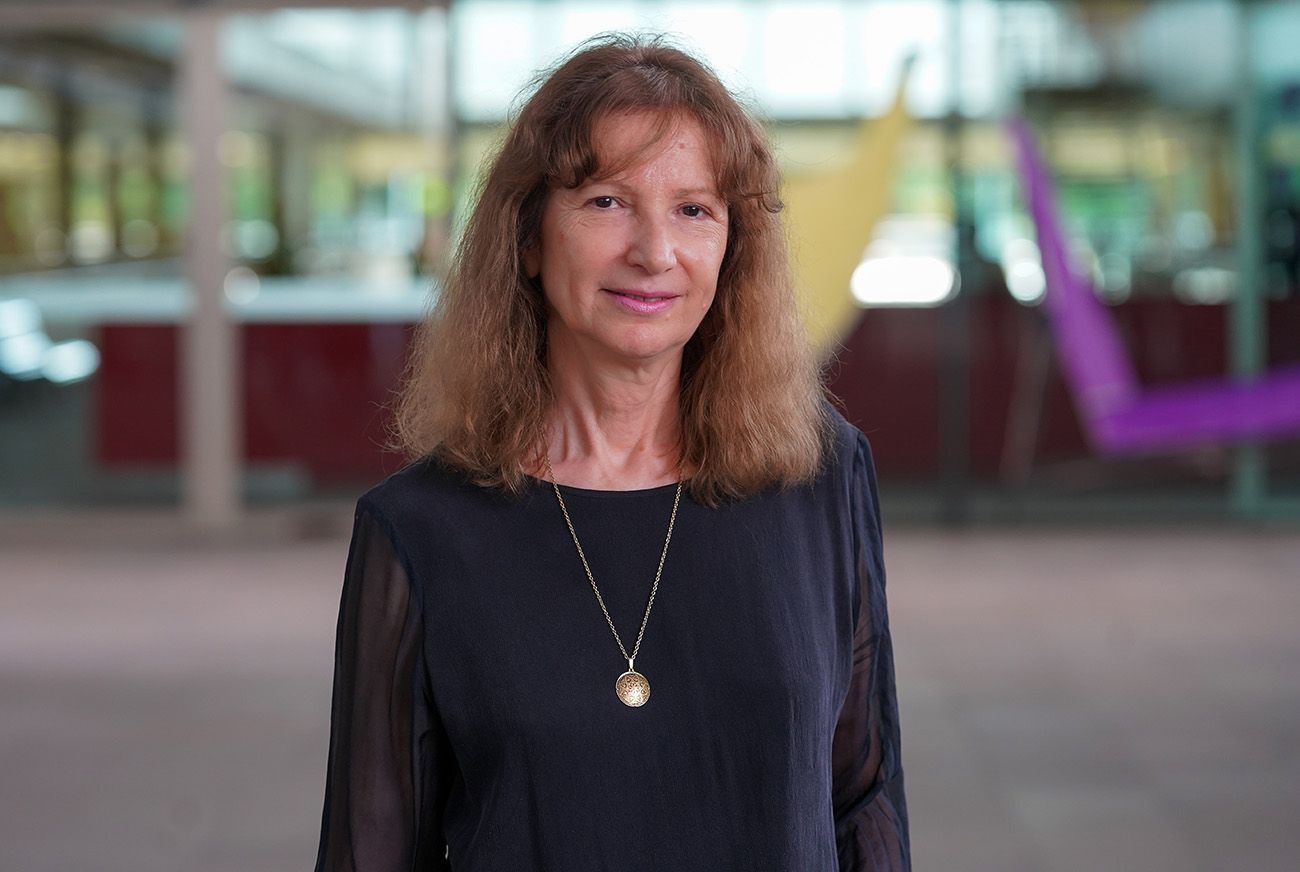
By José Tadeu Arantes | Agência FAPESP – María Laura Silveira, an Argentine geographer and former student of Milton Santos, is currently a principal researcher at the Argentinian National Scientific and Technical Research Council (CONICET) and a graduate professor at the University of Buenos Aires. She was one of his closest collaborators in the last years of his life. She participated in the last project he submitted to FAPESP and continued the research after his death. She updated central concepts of his work, especially the theory of the two circuits of the urban economy, in light of recent transformations, such as financialization, digitalization, and the platform economy. In this interview, Silveira shows how Milton Santos’s thinking remains relevant and capable of interpreting the contemporary world.
Agência FAPESP – What was the focus of Milton Santos’s last study, which he was unable to finish?
Maria Laura Silveira – It was about the circuits of the urban economy, a project that, after his death, I took up on my own, with support from FAPESP. He wanted to focus primarily on the marginal portion of the upper circuit and on the new configuration of the lower circuit, taking into account the changes that had occurred since the 1970s, when the theory of the two circuits of the urban economy was first proposed. That theory was revolutionary, in a context where comparisons between cities in the so-called “Third World” and those in the “developed world” still predominated, as if the former were an earlier stage of the latter, following the same evolutionary path. Milton radically challenged that in the 1970s and wanted to revisit the topic in the 1990s.
Agência FAPESP – What is the marginal portion of the upper circuit?
Silveira – Circuits are defined by varying degrees of capital, technology, and organization, with the upper circuit having high levels and the lower circuit having low levels. The marginal portion of the upper circuit shares elements of both, and may, in some cases, have significant levels of technology but financial vulnerability. Consider, for example, a small pharmaceutical laboratory that makes a specific type of medication or produces a base drug for a large laboratory. Or an IT firm that provides a specific service to a large company. Or an auto parts factory that produces a specific component for a major vehicle manufacturer. These companies need technological knowledge, work tools, and a level of organization that enables that interaction, allowing them to act as suppliers. However, they’re vulnerable because if the large purchasing company, for any reason, stops buying from them, they may default on their payments and fall into the lower circuit of the economy.
Agência FAPESP – Does that marginal portion constitute a third sector?
Silveira – There aren’t three sectors with their own distinct demands: an upper, a lower, and an intermediate sector. The marginal portion is integrated into the upper circuit. But because of its vulnerability, it can fall into the lower circuit. That’s why we’ve always preferred to use the word “portion,” so as not to give the impression that there are three separate circuits.
Agência FAPESP – How did you carry out this research?
Silveira – FAPESP supported a new project, which served as a continuation of the previous one. I’ve published several articles and book chapters. My students have presented dissertations and theses. We’re continuing with this line of research because we believe it remains relevant.
Agência FAPESP – Updating Milton, how has the lower circuit changed in recent decades?
Silveira – The first major transformation was that poverty became structural. Between the 1970s and 1990s, the phenomenon of poverty spread and intensified in our countries. Another variable that’s become absolutely fundamental to defining the current period of globalization is consumption. The poor haven’t stopped consuming. So today, we have this fundamental fact: the simultaneous growth of poverty and consumption. How did that become possible? Thanks to the level of financialization, which also saw explosive growth. People with lower purchasing power end up going into debt so they can continue consuming. That also allows the agents who are part of the lower circuit to continue producing.
Agência FAPESP – Especially in the last decades of his life, Milton placed great importance on the role of technology. How did technical resources contribute to this new configuration?
Silveira – Through what Milton himself called “soft techniques.” These are techniques that don’t require significant resources. Today, with a computer, a cell phone – in short, with self-contained devices – a person can, from a room in their home, produce something, some good or service. That, then, enables grassroots production, a form of popular production.
Agência FAPESP – Did the lower circuit also transform its organizational structures to adapt to this?
Silveira – Yes. The lower circuit had to adapt its organizational and sales structures to meet a similarly transformed demand and to compete with the upper circuit for the ability to sell on credit. All of this has created a lower circuit that’s expanding with astonishing elasticity.
Agência FAPESP – Milton was very visionary, because he foresaw a situation that would become dominant with the advent of digital platforms and what has come to be known as the “uberization” of work.
Silveira – Exactly, exactly. Those platforms didn’t exist back in his day. Nor later, during the time I spent in São Paulo. It’s a much more recent phenomenon, one that’s led to precarious work on an unprecedented scale. At the same time, I believe all of this is strengthening those grassroots economies, in which there’s a growing fragmentation of tasks, products, and time. It’s important to note that the two-circuit theory isn’t classificatory. It seeks to understand socioeconomic reality as a unity, in which each process of modernization, upon becoming hegemonic, paves the way for other divisions of labor, which don’t disappear but coexist. The lower circuit isn’t what’s left over. It tries to adapt. Nor is it an independent entity. It’s the indirect result of modernization. It does what it can with the data of the time.
Agência FAPESP – Why do we usually speak of “technique” rather than “technology”?
Silveira – What Milton called the “technical phenomenon” encompasses technique and action. It’s not just the objects, but also the way the objects are used. At the time, there was no concept of a technical-scientific-informational milieu. But his vision of the future led him to conceive of categories that can continue to be filled with new things.
Agência FAPESP – What was Milton like on a personal level?
Silveira – First of all, he was very, very rigorous. He was rigorous about his work and his word. But at the same time, he was a fun person who made everyday life feel light. Irony was his trademark. And enthusiasm: let’s research this, let’s write that.
Agência FAPESP – And from an intellectual and spiritual perspective?
Silveira – I think he was a very intuitive person. He was quite critical of a purely Cartesian, purely rational mindset. And he strongly emphasized the idea of “other rationalities,” of how people at the bottom have “other reasons.” That’s why he always held out hope that the poor would play an important historical role. I don’t think he was someone who had no beliefs at all. As he grew ill, he sometimes spoke of God.
Republish
The Agency FAPESP licenses news via Creative Commons (CC-BY-NC-ND) so that they can be republished free of charge and in a simple way by other digital or printed vehicles. Agência FAPESP must be credited as the source of the content being republished and the name of the reporter (if any) must be attributed. Using the HMTL button below allows compliance with these rules, detailed in Digital Republishing Policy FAPESP.
