





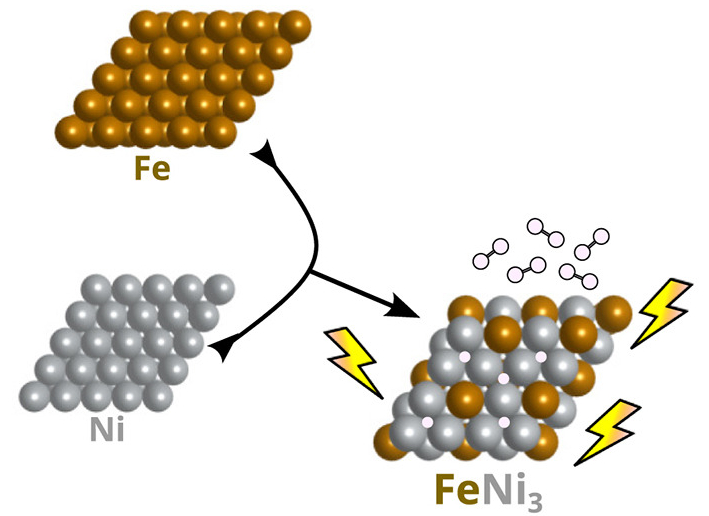
Agência FAPESP* – Researchers affiliated with the Center for Research and Development of Functional Materials (CDMF) participated in a study that proposes a new strategy for designing more efficient and lower-cost catalysts for hydrogen production.
Based at the Federal University of São Carlos (UFSCar), CDMF worked as one of FAPESP's Research, Innovation, and Dissemination Centers (RIDC) from 2013, its inaugural year, until June 2026.
The results were published in the International Journal of Hydrogen Energy and show that a controlled mixture of abundant metals can precisely adjust the attraction between hydrogen and a material’s surface. Controlling this attraction is essential for accelerating the hydrogen evolution reaction, a chemical process in which hydrogen atoms are “forced” to bond and rise in the form of gas bubbles, separating from the water. Mastering this reaction is crucial for making green hydrogen plants viable.
Currently, materials capable of efficiently promoting this reaction are based on noble metals, such as platinum, which are expensive and in limited supply. To address this issue, the researchers investigated alloys made from more abundant metals. They analyzed how different chemical combinations could replicate or improve the efficiency observed in noble metals.
Using computer simulations, the scientists evaluated hydrogen’s ability to “adhere” to the surface of these metal alloys. This phenomenon, adsorption, is the key indicator of whether the material will be a good catalyst: in adsorption, the gas temporarily sticks to the surface of the metal. The results showed that in the iron-nickel alloy, this attraction works like a well-oiled machine. Simply altering the ratio of the two metals allows for precise control over the force with which hydrogen binds to the surface. This makes the chemical reaction faster and more predictable.
Rational materials design
According to the authors of the article, the results provide an important theoretical guide for developing new catalysts based on abundant metals. These catalysts are potentially cheaper and more scalable than those based on noble metals.
The study also reinforces the role of computational modeling in rational materials design, an approach that predicts the behavior of new materials before they are synthesized in a laboratory.
This strategy can accelerate the development of green hydrogen technologies, which are considered a strategic energy vector for reducing carbon emissions in sectors such as transportation, industry, and power generation.
The article “Tuning hydrogen adsorption through synergy in non-noble bimetallic substrates” can be read at sciencedirect.com/science/article/pii/S0360319926003290.
* With information from the CDMF
Republish
The Agency FAPESP licenses news via Creative Commons (CC-BY-NC-ND) so that they can be republished free of charge and in a simple way by other digital or printed vehicles. Agência FAPESP must be credited as the source of the content being republished and the name of the reporter (if any) must be attributed. Using the HMTL button below allows compliance with these rules, detailed in Digital Republishing Policy FAPESP.
