





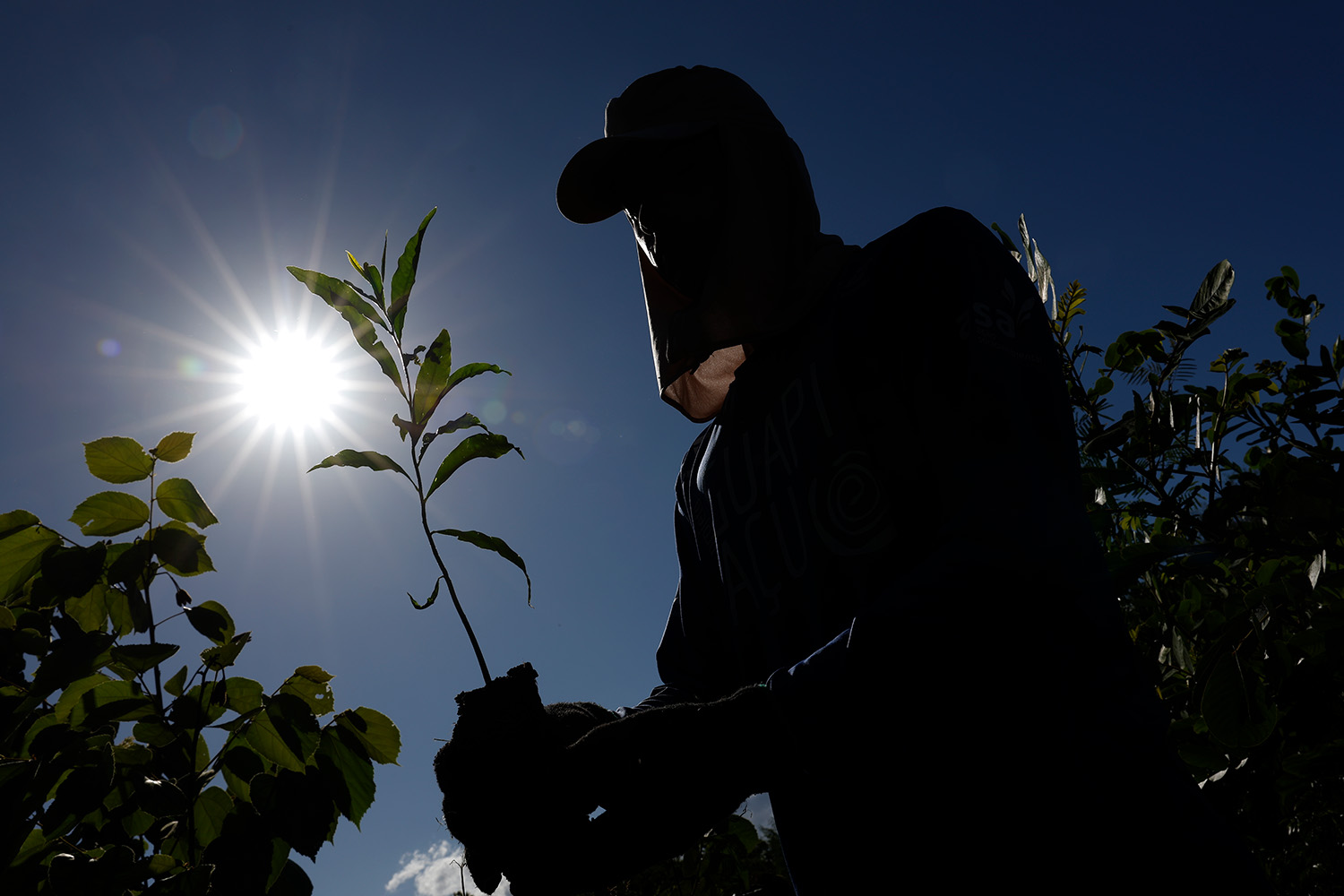
By Elton Alisson, from Leiden (Netherlands) | Agência FAPESP – The restoration of tropical forests has become one of the most promising nature-based solutions for addressing the climate crisis. However, limiting the objectives of reforestation policies and projects solely to carbon sequestration may compromise biodiversity conservation and impact water regulation and agricultural pollination.
Ricardo Augusto Gorne Viani, a professor in the Department of Environmental Sciences at the Federal University of São Carlos (UFSCar) in the state of São Paulo, Brazil, issued this warning during FAPESP Week Netherlands, an event held October 27–29 at Leiden University.
Viani, who also works as a researcher at the Laboratory of Silviculture and Forest Research (LASPEF), says that although forest restoration has gained significant momentum, it cannot be viewed as a “magic solution” and cannot replace the rapid and drastic reduction in greenhouse gas emissions by industry and the energy sector.
“Restoring forests is an important mitigation measure because trees remove carbon dioxide from the atmosphere as they grow. However, when we plant native trees for restoration, we need to consider the full range of expected benefits. If we prioritize carbon [storage] alone, we may create direct conflicts with biodiversity conservation,” said Viani.
Brazil has committed to restoring 12 million hectares of native vegetation by 2030 – an area equivalent to three times the total land area of the Netherlands. According to Viani, achieving this goal requires a scientific foundation to prevent reforestation efforts from resulting in ecologically impoverished forests.

Ricardo Augusto Gorne Viani from UFSCar during his presentation at Leiden University in the Netherlands (photo: Elton Alisson/Agência FAPESP)
Risk of diversity loss
One of the key points Viani addressed concerns the selection of tree species in restoration projects. To demonstrate how the choice of plant can radically alter results, the researcher presented visual data on native species planted on the same day and under the same soil conditions. While a pink cedar (Cedrela fissilis) specimen was stunted after two years, a fumo-bravo (Solanum granulosoleprosum) seedling had surpassed two meters in height and was flowering and bearing fruit during the same period.
“There’s enormous variation in performance and growth rate among native species. Those dynamics directly affect the cost of restoration, the duration of ground shading, and carbon retention capacity,” Viani explained.
However, the pursuit of quick, low-cost results has led to a concerning distortion. Viani presented the results of a comprehensive survey conducted at his UFSCar laboratory. The survey was the subject of Crislaine de Almeida’s doctoral research, in which she analyzed more than 1,000 restoration plantings across the Atlantic Forest based on records from the NGO SOS Mata Atlântica.
The study revealed that these projects use an extremely limited selection of native flora. Of the more than 4,000 tree species found in the Atlantic Forest, the evaluated reforestation projects employed only 423 species – less than 8% of the biome’s tree diversity.
Beyond the low absolute number, the research identified a geographic pattern: the species selected for planting are virtually the same throughout the entire biome, regardless of regional characteristics.
“We found that restoration plantings in the Atlantic Forest are much more similar to one another, in terms of species composition, than they are to the surrounding remnant native forests. That promotes a process known in ecology as biotic homogenization, in which the regional flora is standardized by the repetitive use of a small group of plants,” Viani told Agência FAPESP.
This selection prioritizes fast-growing (pioneer) species and those with seeds that are easy to collect and propagate in nurseries. While these species are beneficial for closing the canopy and combating invasive grasses, this approach underrepresents slow-growing species, endangered plants, and trees whose fruits attract seed-dispersing fauna.
The severity of biotic homogenization depends on the landscape in which the restored area is located. If there are preserved native forest fragments nearby, seeds carried by the wind and animals can colonize the plantation’s understory, enriching the forest over time. However, in highly degraded and isolated agricultural landscapes, unplanted species will never colonize the area naturally.
To reconcile economic viability with ecological integrity, Viani argues that restoration planning should be based on a detailed landscape assessment.
“We aren’t arguing that hundreds of species need to be planted in absolutely every location. In landscapes with good coverage of remaining native forest, planting a few fast-growing species can be an efficient, inexpensive strategy because nature will provide diversity. The problem arises when that logic is extended to fragmented landscapes. In such areas, it’s essential to actively introduce greater diversity of native species, including those with low natural dispersal potential,” he noted.
Example from the Cerrado
This mismatch between biomass accumulation and biodiversity recovery has also been documented in the Cerrado, Brazil’s savanna-like biome. Upon analyzing 111 studies on the restoration of the biome, the UFSCar research group identified 39 studies that compared restored areas with preserved ecosystems. The data showed that although carbon and biomass return to levels close to those of the original vegetation, the diversity of native plants remains significantly lower than in reference areas.
The review also revealed a gap in scientific research. Of the 111 studies analyzed, only 13 simultaneously assessed parameters related to biomass and carbon, as well as plant diversity.
“The vast majority of scientific studies measure either carbon or biodiversity. The data confirm that restoring carbon stocks in the Cerrado does not guarantee the return of native plant species, reinforcing the need for projects to monitor both indicators in an integrated manner,” Viani noted.
For more information on FAPESP Week Netherlands, visit: fapesp.br/week/2026/netherlands.
Republish
The Agency FAPESP licenses news via Creative Commons (CC-BY-NC-ND) so that they can be republished free of charge and in a simple way by other digital or printed vehicles. Agência FAPESP must be credited as the source of the content being republished and the name of the reporter (if any) must be attributed. Using the HMTL button below allows compliance with these rules, detailed in Digital Republishing Policy FAPESP.
