





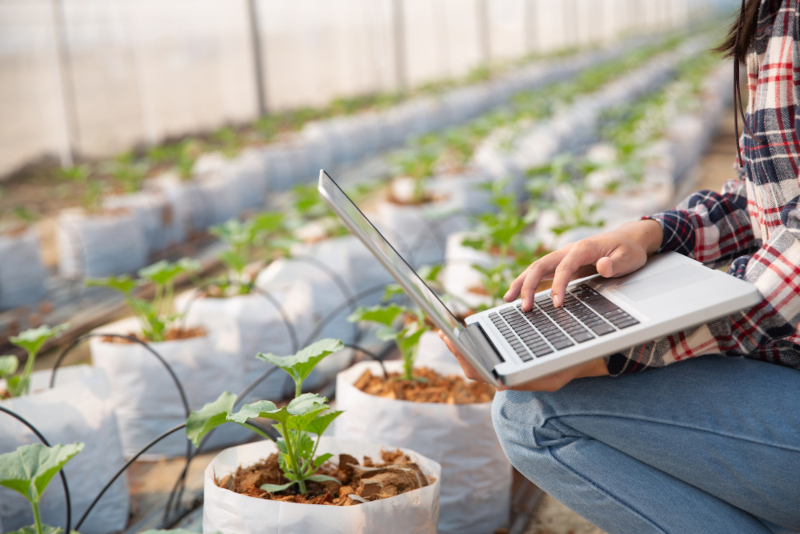
Agência FAPESP* – A study published in the journal Agricultural Systems identified the main factors driving the adoption of so-called Agriculture 4.0 technologies in Brazil and proposes strategies to promote their responsible use in the agri-food system. The research is part of the initiatives of the Science Center for Digital Agriculture Development (Semear Digital). Semear Digital is headquartered at Embrapa Digital Agriculture, a decentralized unit of the Brazilian Agricultural Research Corporation (EMBRAPA), in Campinas in the state of São Paulo. It is one of FAPESP’s SCDs.
The work stems from a recurring observation in the sector: promising technologies do not always actually reach producers or generate the expected impact in the field. “We still see a significant gap between what’s developed in academia and what actually reaches the field and delivers results for farmers,” says Jayme Barbedo, co-author of the study.
To understand this disconnect, the researchers analyzed 18 determinants of technology adoption, referred to in the study as “drivers,” which are organized into social, political, and technological dimensions. Through relationship modeling, the authors mapped how these factors influence one another and which ones exert the greatest effect on the system as a whole based on a literature review and consultations with experts.
Franco da Silveira, a postdoctoral researcher supported by FAPESP and also an author of the study, explained that the study sought to go beyond the mapping of barriers, a topic already explored by the Semear Digital group, to identify the factors driving the adoption of Agriculture 4.0 technologies and understand how they interact within the system. “Not all of them carry the same weight. Some trigger a chain reaction within the ecosystem. Those are the ones that interest us most,” says the author.
The researchers identified rural connectivity, youth in rural areas, government action, mechanisms for disseminating information, and the representativeness of the agri-food ecosystem as drivers with the greatest potential for influence.
Connectivity emerges as a structural condition. Although internet access has improved in recent years, significant gaps remain in productive areas. “Most producers already have internet at home. But in production areas, where Internet of Things [IoT] technologies need to operate, coverage is still very limited,” says Barbedo. Without adequate infrastructure, digital solutions fail to function as intended.
The study also highlights the role of young people as agents of change in rural areas. According to Silveira, young people serve as a bridge between the digital world and the reality of farm operations. “Young people feel their parents’ struggles in daily life while also keeping up with what’s happening in the digital world. They can bring that perspective to the political sphere and onto the farm,” he says.
However, the continued presence of this generation in rural areas depends on concrete conditions. “It isn’t that young people dislike the countryside. They want to feel like they’re part of the world. If they don’t have access to infrastructure and opportunities, they’ll leave for the city,” Barbedo notes. Using technology can reduce the workload and make farming more appealing.
Another key point is the flow of information. Silveira draws attention to the existing asymmetry in the country. “There are regions where farmers haven’t yet had contact with certain technologies. If information doesn’t reach them adequately, resistance increases,” he states. He believes that demonstration strategies on model farms and living laboratories reduce uncertainties by allowing producers to see concrete results before investing.
In terms of public policy, the article emphasizes the need for tailored approaches for different types of producers. “Policy can’t be the same for everyone,” says Silveira. While large producers tend to push the technological frontier, small and medium-sized producers face financial and capacity constraints. The study suggests offering regional incentives, creating experimental areas, strengthening partnerships between the government, universities, and startups, and integrating agricultural data into public platforms.
Responsible scaling
A central concept of the study is responsible scaling. The proposal is that the dissemination of Agriculture 4.0 technologies in rural areas should consider their social, environmental, and economic effects. This will help avoid exacerbating inequalities or undermining sustainable development goals. In other words, we must consider not only which technologies to adopt but also how to disseminate them. “We need to talk about technology adoption, but also pave the way for responsible expansion – responsible scaling in technology adoption,” says Silveira.
One example would be expanding digital platforms for small-scale producers and implementing inclusion policies. In addition to offering sensors and artificial intelligence-based tools, the initiative should provide rural connectivity, ongoing training, access to credit, clear rules on data use and ownership, and environmental impact monitoring. In this way, technology spreads with efficiency gains and a measurable reduction in inequalities and unwanted environmental effects.
Technologies with impacts
According to Barbedo, this kind of research helps guide strategic decisions in the formulation of rural development policies and projects, such as Semear Digital, which develops solutions for small and medium-sized farms. “These studies provide insights to better direct efforts and focus on technologies that truly make an impact,” he says. The SCD has ten agrotechnological districts across the country that generate data and experiences that can fuel new analyses and create a cycle between research and application.
The researchers note that the technological landscape is dynamic, especially given recent advances in artificial intelligence. “Things are evolving very quickly. Even those who work directly with artificial intelligence have difficulty predicting the next steps,” Barbedo reflects. In this context, periodic analyses are essential for updating assessments and strategies.
As a next step, Silveira is preparing a study that will incorporate economic and environmental factors in greater depth and examine how technology adoption can align with the United Nations (UN) Sustainable Development Goals (SDGs). “If we don’t develop strategies for these factors, we may undermine the very goals that the technology itself aims to support,” he states.
The article “Exploring the drivers of responsible scaling of Agriculture 4.0 technologies for transformative impact in the modern agri-food ecosystem: An ISM-based analysis” can be read at sciencedirect.com/science/article/abs/pii/S0308521X25002483.
* With information from Paula Drummond of Semear Digital