




The experimental setup at UFF in Niterói, from where photons are sent toward the CBPF in Rio de Janeiro. The optical system includes the light source and the telescope that projects the beam through the 7 kilometers of atmosphere over Guanabara Bay (photo: André Luiz da Silva Santos Junior)
An experiment conducted between Niterói and Rio de Janeiro paves the way for proving the preservation of quantum entanglement outdoors and for developing future ultra-secure communication networks.
An experiment conducted between Niterói and Rio de Janeiro paves the way for proving the preservation of quantum entanglement outdoors and for developing future ultra-secure communication networks.
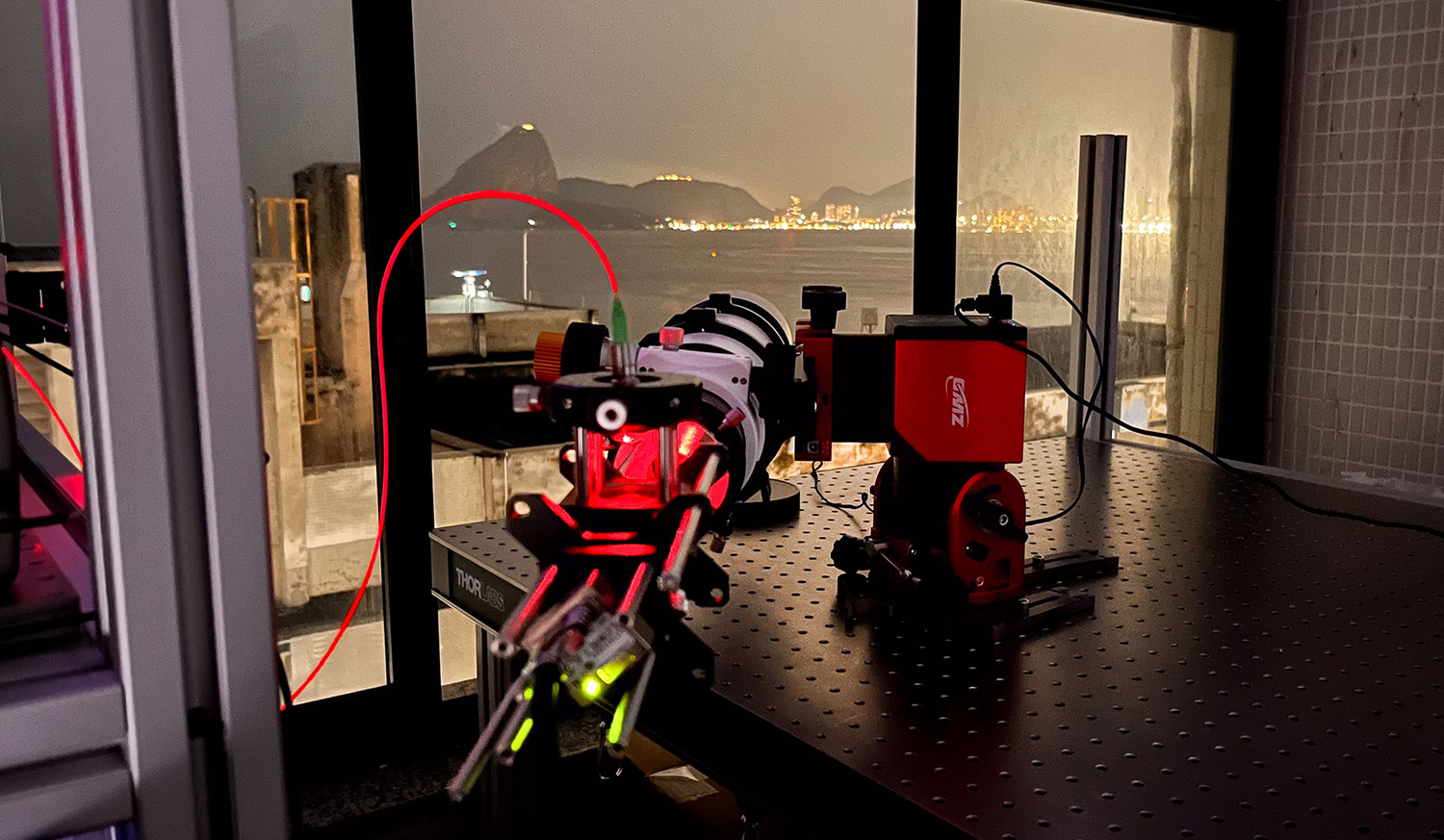
The experimental setup at UFF in Niterói, from where photons are sent toward the CBPF in Rio de Janeiro. The optical system includes the light source and the telescope that projects the beam through the 7 kilometers of atmosphere over Guanabara Bay (photo: André Luiz da Silva Santos Junior)
By José Tadeu Arantes | Agência FAPESP – In Brazil, researchers at Fluminense Federal University (UFF) took an important step toward quantum communication and a future ultra-secure internet. They generated pairs of “twin photons,” or particles of light, and proved that they remained strongly correlated even after one traveled about seven kilometers through the air and crossed Guanabara Bay. While one photon remained in the laboratory on the UFF campus in Niterói, its “twin” traveled to Urca Hill in Rio de Janeiro.
“A comparison of the two detections revealed a number of temporal correlations far greater than what could occur by chance,” explains Antonio Zelaquett Khoury, a professor at UFF’s Institute of Physics (IF) and coordinator of the “Quantum Rio Network” project, funded by FAPESP.
The experiment strongly suggests that the photons were quantum-entangled and preserved their entangled state even after one member of each pair encountered atmospheric turbulence. If this hypothesis is confirmed, it will be an important step toward implementing a free-space quantum communication channel.
When two particles are entangled, their properties are correlated in such a way that the pair must be described as a single quantum system, even if its components are separated by great distances. This can be exploited in quantum communication to encode information. For instance, it could be used to distribute cryptographic keys with a level of security that is impossible to achieve in classical communication. Any attempt to intercept and measure the photons would alter the quantum correlations and could reveal the presence of an intruder.
“Demonstrating that entanglement survives kilometers of propagation through the atmosphere could pave the way for constructing free-space quantum networks, including ones that can connect ground stations to satellites,” says Khoury.
The twin photon source was developed by IF-UFF doctoral student André Luiz da Silva Santos Junior under Khoury’s guidance. The research is funded by FAPESP.
“The decisive result becomes apparent when the records from the two detectors are compared. Since one of the photons is detected practically right next to the source and the other must travel across the bay, there’s a small time interval of about 20 microseconds between the two detections, essentially corresponding to the travel time of the second photon. It’s immediately after that interval that a pronounced peak of coincidences appears [proving that the two devices captured twin photons and not random ambient light],” says Santos Junior.
The experiment recorded 7,000 coincidences over a five-second interval, an extremely significant result considering the transmission was horizontal. Information losses in vertical transmission are much lower because the atmosphere becomes more rarefied the farther one is from the surface (i.e., there are fewer gas molecules, dust, and water vapor acting as “obstacles” to reflect, deflect, or absorb light). In horizontal transmission, however, the photons had to pass through an extensive layer of air with turbulence and other sources of loss.

Peak in coincidences between detections made at UFF in Niterói and at the CBPF in Rio de Janeiro. The sharp increase in coincidences within the expected time interval allows for the identification of photons belonging to the same pair, despite the 7-kilometer separation between the detectors (image: André Luiz da Silva Santos Junior)
Born together
Photons are the elementary units of electromagnetic radiation. In simpler terms, they are the fundamental particles that make up visible light and other types of radiation. They are called “twins” when produced in pairs simultaneously in the same physical process. In the UFF experiment, photons are generated when a laser with a wavelength of 405 nanometers – in the blue-violet range of the spectrum – is directed at a nonlinear optical crystal.
The nonlinearity of the crystal is a fundamental aspect of the experiment that requires a more detailed explanation. In ordinary materials, under so-called “linear optics,” the electric polarization induced in the object – that is, the displacement of electric charges caused by light – varies proportionally to the electric field of the light itself. Under these conditions, light can change direction, speed, or polarization as it passes through the material. However, in principle, no new frequencies are generated (i.e., if blue light enters, it exits as blue light with the same wavelength). In certain materials, however, this response also contains components that depend on the incident electric field in a more mathematically complex way. When these components become relevant, we enter the realm of “nonlinear optics.” One consequence is the ability to convert light of one frequency into light of other frequencies.
This property allows twin photons to be generated. In the experiment, a process called “spontaneous parametric down-conversion” (SPDC) is used. In this process, a laser photon, known as the “pumping photon,” is converted within the crystal into two lower-energy photons, called the “signal” and “complementary” photons. According to the principle of energy conservation, the sum of the energies of the two produced photons must equal the energy of the original photon (as if they were sharing the energy of the photon that generated them). The conditions under which the conversion occurs, particularly the phase-matching conditions, establish relationships between the frequencies, directions of propagation, and polarizations of the two photons. Consequently, the two photons can emerge with strongly correlated properties. Depending on the setup, the resulting quantum state may be entangled such that the properties of the two photons can no longer be described independently, as if they shared a single quantum identity even when separated.
“The crystal used was chosen precisely to increase the production of these pairs. Generation is a cumulative process; the longer light travels through the material, the greater the probability of conversion. And the brighter the source becomes in that it generates more pairs. The design featuring a long crystal was chosen by André [Santos Junior] precisely to maximize pair generation,” Khoury explains.
All of this was carefully planned. The unique aspect of the experiment was conducting it outdoors instead of in the controlled conditions of a laboratory. “To overcome the loss we’d inevitably face, we needed to generate many pairs. So, we tested different configurations until we arrived at the architecture used in the light source,” Santos Junior notes.
Entanglement: Yes or no?
However, there is an important distinction. Just because two photons are twins does not mean they remain entangled. Entanglement is a specific quantum correlation, one that is much deeper, in which certain properties cannot be attributed to either particle independently; rather, they belong to the state formed by the pair.
The source built by Santos Junior was designed to produce photons that are entangled in their polarization. Polarization relates to the spatial orientation of the oscillation of the electric field of light. It can be horizontal or vertical, for example, like a taut rope being swung up and down to create vertical waves or from side to side to create horizontal waves. In entanglement, the two photons form a single quantum state. Thus, the entangled pair can be in a superposition of “horizontal and horizontal” and “vertical and vertical” without assigning an independent polarization to each photon in advance.
“Polarization entanglement has already been demonstrated when the two photons are measured locally at UFF. The challenge now is to demonstrate that this entanglement persists when one of the photons flies over Guanabara Bay,” Khoury summarizes.
The researcher adds that verifying the correlation – that is, the twin-like nature of the two photons – was the biggest hurdle. This hurdle was overcome with the detection of coincident signals. “Without the signals, we wouldn’t have been able to test anything. Once we confirm that we’re indeed observing a pair of entangled photons – one detected at UFF and the other seven kilometers away – we can begin working on improving signal quality and seeking evidence of entanglement.”
This caveat is essential. The experiment has not yet demonstrated that the two photons remain entangled after being separated by seven kilometers. Thus far, it has only shown the local production of highly entangled pairs and the remote detection of coincidences between the twins. The next step is to use distant detectors to perform polarization measurements to verify whether entanglement persists after one photon travels across the bay.
A channel through the atmosphere
Getting a single photon to travel through kilometers of atmosphere and reach the desired location is no trivial matter. Long before conducting experiments with pairs, the group studied the behavior of the optical channel between Niterói and Urca using conventional laser light. Atmospheric turbulence can significantly alter the spatial distribution of the beam, displace it, and make it difficult for the receiving telescope to capture. However, the tests also revealed a favorable characteristic: the polarization of the light was extremely resistant to the journey.
“In the tests conducted by our group, different polarization states were transmitted across the bay and recovered with a fidelity exceeding 99%. This signaled to us that polarization was the best property for encoding information in photons,” Khoury emphasizes. This result is important because the group intends to use polarization to establish entanglement between separated photons and subsequently implement quantum communication protocols.
The fact that entanglement has not yet been fully demonstrated may create the false impression that the study is in its early stages. This is not the case. The group has already come a long way. Even pointing the telescopes required developing an active stabilization system. Small mechanical and thermal variations can cause the equipment to slowly misalign. At a distance of seven kilometers, this misalignment can prevent the beam from reaching the receiver. A light source installed at the opposite end serves as a reference. A camera tracks its position, and when displacement is detected, a program activates motors that automatically correct the alignment of the telescope.
According to Khoury, the characterization of the polarization of light transmitted through the air channel and the active stabilization system were developed at IF-UFF by postdoctoral fellow Amanda Kronhardt Fritsch, a FAPESP fellowship recipient, and doctoral student Marcos Gil de Oliveira, a National Council for Scientific and Technological Development (CNPq) scholarship recipient. The research also benefited from the contributions of Altilano Cristino Barbosa, a FAPESP doctoral scholarship recipient, and Iury Prego Grego Correa, a scientific initiation scholarship recipient.
Synchronizing the two sides of the experiment with great precision was also necessary. Each detector produces an electronic signal when it registers the arrival of a photon, and the moment of this detection must be recorded precisely. The sought-after signal emerges from this temporal comparison. To identify which records from Niterói and Urca corresponded to the same pair, the time stamps had to be compared. Each station had its own clock synchronized via GPS to accomplish this. Additionally, comparing the detection times required transmitting data from one station to another.
“The data transmission rate over the conventional internet was insufficient for properly recording the coincidences in real time. The problem was solved with the installation of a dedicated radio link between the two stations by the company MLS Wireless, whose CEO, Dr. Rogério Passy, was my graduate school classmate at PUC-Rio [Pontifical Catholic University of Rio de Janeiro] in the 1990s and has extensive experience in optical communications,” says Khoury.
There are photons from other sources and coincidences that can occur accidentally. However, when the pair source is turned on, a significant number of coincidences appear within the expected time interval. “The graph showing the peak is the result itself. It was the signal we were looking for. By a happy coincidence, we obtained the first detections on August 20, 2026 – the same day the Brazilian Physical Society was celebrating its 60th anniversary,” Khoury celebrates.
The Agency FAPESP licenses news via Creative Commons (CC-BY-NC-ND) so that they can be republished free of charge and in a simple way by other digital or printed vehicles. Agência FAPESP must be credited as the source of the content being republished and the name of the reporter (if any) must be attributed. Using the HMTL button below allows compliance with these rules, detailed in Digital Republishing Policy FAPESP.
