





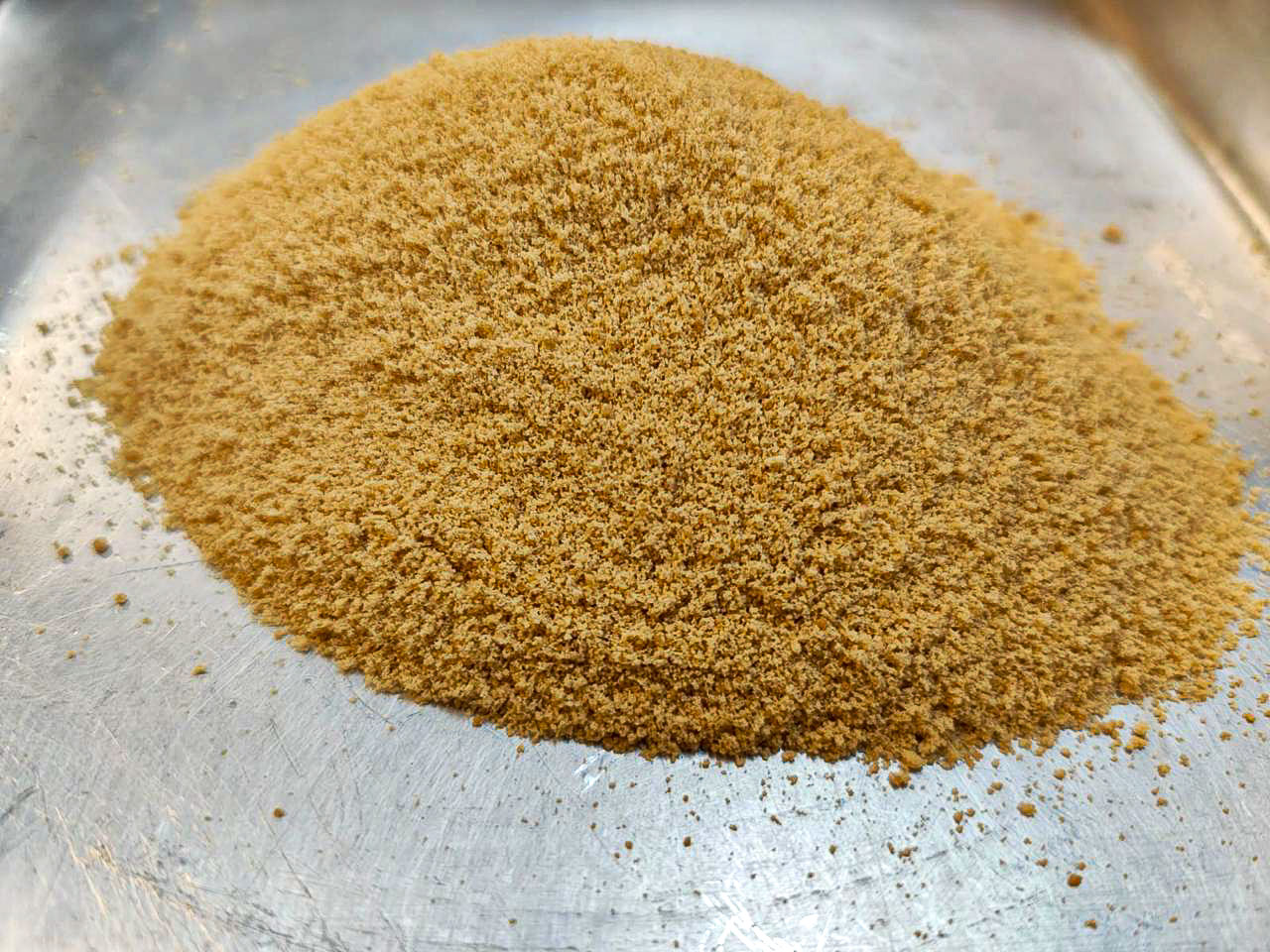
By Elton Alisson | Agência FAPESP – Defective green coffee beans and the thin red skin surrounding peanuts have just become the greatest allies of people unable to give up sugar. Researchers affiliated with the Integrated Biotechnology Platform for Healthy Ingredients (PBIS) used extracts obtained from these agro-industrial byproducts to develop a sucrose derived from sugarcane that is absorbed much more slowly by the body. This reduces the glycemic index (GI) of the ingredient without altering its flavor.
The GI measures the rate at which sugar from a food enters the bloodstream and raises glucose levels. Foods with a high GI cause rapid spikes in glucose, which can overload the pancreas (the organ responsible for producing insulin) and trigger metabolic diseases in the long term.
“There’s now a consensus that a low glycemic index diet is healthier because it helps prevent type 2 diabetes and metabolic syndrome, for example. Therefore, a sugar with that characteristic would benefit everyone. People who already suffer from metabolic disorders would see significant benefits, but its use is certainly not limited to that group,” Juliana Macedo, a professor at the School of Food Engineering at the State University of Campinas (UNICAMP) in the state of São Paulo, Brazil, tells Agência FAPESP. She is the coordinator of the project.
The product, for which a patent application has been filed with the National Institute of Industrial Property (INPI), is a crystal-form sugar substitute for food manufacturers to use in processed foods without altering formulations.
“Our goal was to develop a sugar that could be absorbed more slowly by the body and, at the same time, incorporate agro-industrial byproducts in Brazil, such as defective coffee beans rejected by the industry and peanut skins,” says Macedo.
Innovative method
The scientific basis for this innovation emerged from in vitro laboratory tests, which demonstrated that phenolic extracts derived from peanut skins and defective green coffee beans help the body process carbohydrates, such as sugar, more slowly. Phenolic compounds are organic molecules with strong antioxidant properties that can combat free radicals and modulate metabolic processes. The researchers’ next challenge was to transform these liquid extracts into a solid ingredient that could easily be applied in industrial processes.
They found a solution in the sucrose matrix co-crystallization technique, a recent encapsulation method in the food industry that embeds these antioxidant extracts within sugar crystals. This process involves modifying the structure of the carbohydrate.
Sucrose is known for its highly organized crystalline structure. Subjecting it to the co-crystallization process disrupts and reorganizes the crystal structure in an irregular manner, creating numerous gaps or empty spaces where the antioxidant extracts can be incorporated.
Since phenolic compounds are temperature-sensitive and the traditional co-crystallization process has physical limitations regarding space and temperature, the researchers modified the technique. They dissolved the sucrose using the liquid extract and water prior to the concentration step.
“Modifying that process allowed us to increase the material incorporation capacity by 7.5 times, resulting in a highly crystalline product with preserved phenolic properties,” explains Regiane de Brito Vieira, a Ph.D. candidate at UNICAMP under Macedo’s supervision and a project participant.
Reduction in the glycemic index
To verify that the technology reduced the GI of the sugar, the researchers conducted a clinical trial with human subjects.
The trial involved 25 volunteers over six days. During each session, the participants consumed pure glucose, pure co-crystallized sucrose, co-crystallized sucrose with coffee only, co-crystallized sucrose with peanuts only, or a mixture containing both extracts, called the “blend.” The participants’ blood glucose levels were monitored for two hours after consumption.
Preliminary results indicated that the mixture containing peanut and coffee co-crystals significantly reduced the GI of sucrose, lowering it from moderate to low.
However, the scientists have not yet assessed whether the product has a reduced energy content. “In principle, we assume that the caloric value is the same as that of conventional sucrose. But it’s also possible that this new sugar isn’t fully absorbed and that there’s some reduction. That’s something that would need to be tested,” says Macedo.
Through a partnership with the University of Bologna in Italy, the group plans to soon test the impact of the product on the human microbiota (the collection of beneficial microorganisms that inhabit the gut). “If that sugar is absorbed more slowly and remains in the gut longer, what effect does the compound have on the microbiota? We assume it’s positive due to the action of the antioxidant compounds,” says Macedo.
Heading to the market
The Integrated Biotechnology Platform for Healthy Ingredients was created in 2021 with support from FAPESP through the Science Centers for Development (SCDs) program. It brings together the Institute of Food Technology (ITAL), UNICAMP, the University of São Paulo (USP), nine companies in the food sector, and the Shunji Nishimura Technology Foundation. The goal is to develop healthy, sustainable, and innovative ingredients from domestic raw materials (read more at agencia.fapesp.br/59092).
Following an open innovation model adopted by the PBIS, the low-glycemic-index sugar will be offered to the market as a technology package ready for licensing.
The companies participating in the platform have invested directly in research and development and have exclusive preference in licensing PBIS patents and processes. In the four and a half years since its inception, this model has resulted in the creation of over 30 food ingredients and 20 new industrial processes.
If partner companies do not express commercial interest within the predefined timeframe, the solutions exit the consortium and become available to the general market. There, they may be licensed by other food companies, startups, or academic spin-offs (companies formed from university research).
The new ingredient is part of a PBIS technology package that aims to obtain and formulate phenolic extracts with high antioxidant potential. The researchers have applied the technology to processed foods such as milk chocolate and green tea with pineapple nectar.
“We’ve reached TRLs [Technology Readiness Levels] 5 and 6 in terms of product, process, and application,” Gisele Anne Camargo, the project’s executive manager and principal investigator, told Agência FAPESP. TRL is an international scale of technological maturity for solutions ranging from 1 to 9, where the initial levels validate the scientific concept and the advanced levels indicate systems ready for commercial operation. “The technologies are ready for industries to take the next steps,” she says.
Although compliance with national standards is an essential step for bringing innovations to market, Camargo clarifies that the role of the platform is to provide technical support to industries. Industries must lead the legal procedures for registering products developed using technologies created within the PBIS framework.
According to the researcher, the PBIS will provide all the scientific support and body of evidence on bioactivity accumulated over the years to substantiate health claims before regulatory agencies (i.e., advertising and informational messages highlighting the functional and beneficial properties of food). Companies are responsible for the practical steps involved in obtaining registrations.
“We still don’t have a label in Brazil that can be used on the packaging of low-glycemic-index foods, but we should have one, similar to those that already exist in Europe and the United States,” Macedo argues.