




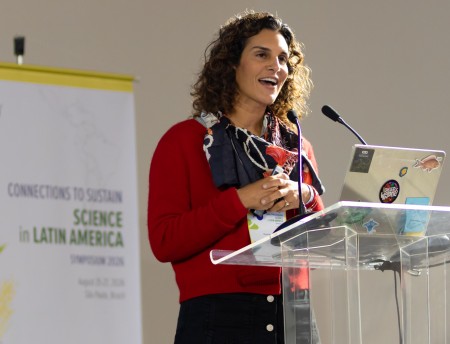
Diva Amon participated in the LAC Connections Symposium 2026, an event hosted by FAPESP and the Brazilian Academy of Sciences from August 25 to 27 (photo: Thiago Silva)
In an interview with Agência FAPESP, Diva Amon, a scientist from Trinidad and Tobago who led the first Caribbean deep-sea expedition, explains the urgency of keeping specimens and data in their countries of origin and strengthening South-South partnerships.
In an interview with Agência FAPESP, Diva Amon, a scientist from Trinidad and Tobago who led the first Caribbean deep-sea expedition, explains the urgency of keeping specimens and data in their countries of origin and strengthening South-South partnerships.
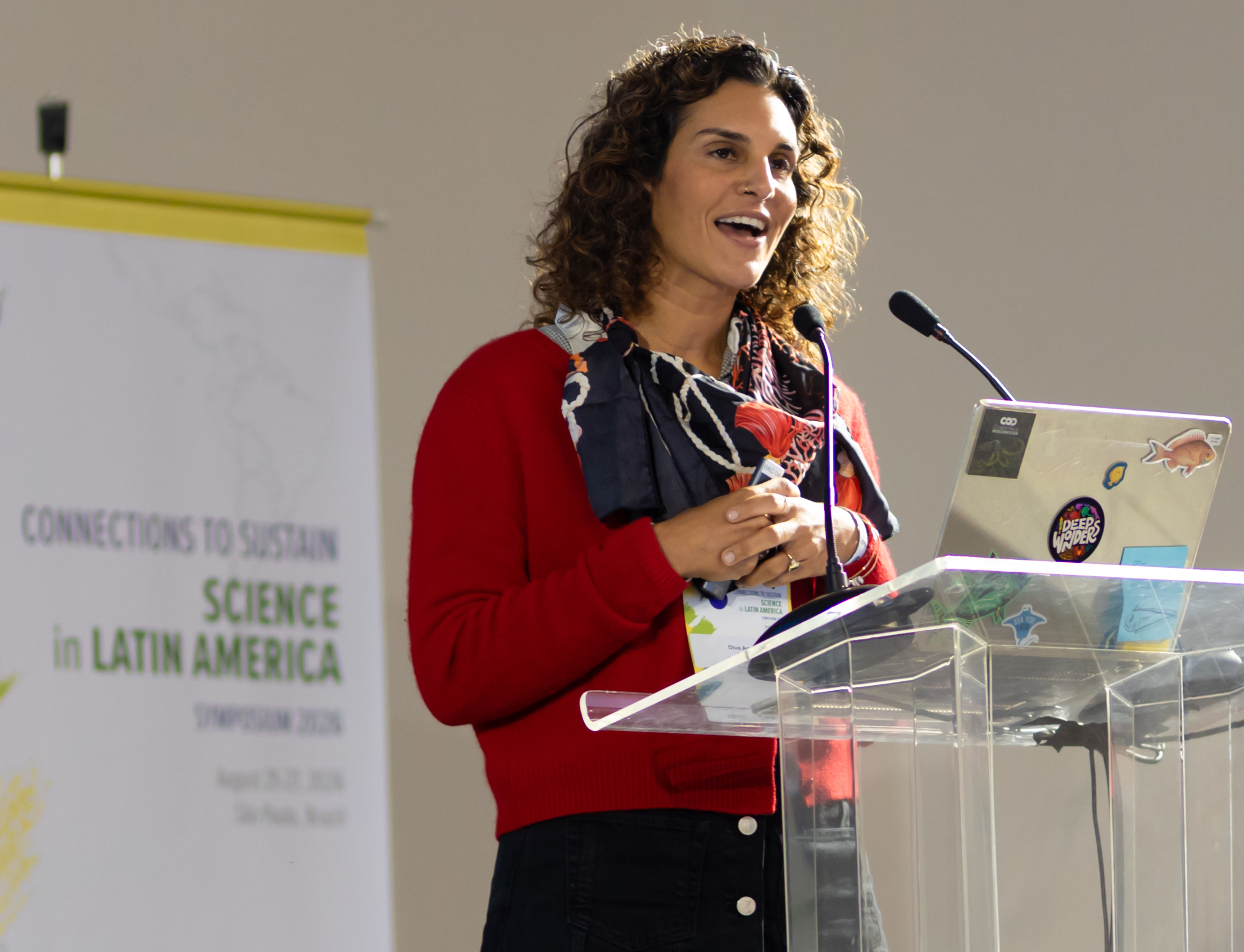
Diva Amon participated in the LAC Connections Symposium 2026, an event hosted by FAPESP and the Brazilian Academy of Sciences from August 25 to 27 (photo: Thiago Silva)
By André Julião | Agência FAPESP – Diva Amon was born in Trinidad and Tobago, an island nation in the southern Caribbean. While studying biology in the United Kingdom, she noticed a paradox in her field. Although every point in her homeland is just a few kilometers from the deep sea – the portion of the ocean that is deeper than 200 meters – this geographical proximity did not guarantee the local population access to the scientific discoveries made in those waters.
As in other parts of the world, nearly all biological material collected from the deep sea off the coast of Trinidad and Tobago is housed in institutions in the Global North, a term used to describe developed countries primarily located in the Northern Hemisphere. This means that even scientists from Trinidad and Tobago must travel to these institutions in the United States and Europe to study their own marine fauna and flora. This pattern of knowledge production has been termed “colonial science.”
During the LAC Connections Symposium 2026, held by FAPESP and the Brazilian Academy of Sciences (ABC) from August 25 to 27 in Itatiba in the state of São Paulo, Brazil, Amon stated that colonial science, or “parachute science,” still accounts for a large portion of studies on the ecosystems of her region – a phenomenon that also occurs throughout most of the Global South, including Latin America, Africa, and Southeast Asia.
In “parachute science,” researchers from the Global North collect scientific material in the Global South, take it back to their institutions, and publish their work without the participation of scientists from the country where the material originated. This practice occurs in other fields as well and remains prevalent even decades or centuries after the countries supplying the animals, plants, and artifacts ceased being European colonies (read more at agencia.fapesp.br/56702, agencia.fapesp.br/58938, and agencia.fapesp.br/57687).
Amon, a researcher at the University of California, Santa Barbara, and the director of SpeSeas, a nonprofit organization based in her home country, served as the chief scientist on the first Caribbean-led deep-sea expedition off the coast of Trinidad and Tobago. The expedition took place between June and July of 2026.
A study she presented at the Itatiba event revealed that of all the biological material collected from the deep waters of Trinidad and Tobago and Barbados, only 3% remained in Trinidad and Tobago, none remained in Barbados, 10% remained in an unknown location, and 87% remained in institutions in the Global North.
In the following interview, she discusses how she became aware of the ongoing effects of colonial science, how to establish equitable partnerships with institutions in the Global North, and how countries in the Global South can collaborate to better understand their oceans.
Agência FAPESP – How did you become interested in issues such as colonial science and “parachute science”?
Diva Amon – As a researcher, I study the deep ocean, trying to understand what lives there, but also how we’re impacting the marine environment. In that journey to answer those questions, it became very clear, very quickly, how unequal ocean science – and science in general – can be, and just how much colonial science still exists. I remember when I was still an undergraduate, around 2008 or 2009, and I took a class on an ecosystem called the Barbados Accretionary Prism [a gigantic underwater geological structure located east of the Caribbean Sea], where the French had conducted a great deal of research. I remember thinking, “That must be in the waters off Barbados, which is close to us.” I began to realize that I knew nothing about the ocean near me, even though I was studying ocean science. That’s when the questions started. Of course, I was still a student, and that’s a time when you don’t have the power to change things.
Agência FAPESP – And what were your first scientific expeditions like?
Amon – Many of the expeditions I went on in the first half of my career were colonial science. They were led by institutions from the Global North and conducted in the Global South. At first, I didn’t see the problem. What I noticed was that there was no one who looked like me or sounded like me, no one from my country or from other developing countries present. That’s what really stood out at first. When I go to scientific conferences, the same thing happens. There are far more people from the United States and Europe. It was in the second half of my career that I began to think about how to address that. How can we gather data on this issue to demonstrate that it exists, and how can we start to change this situation? I believe that, especially during the COVID pandemic, there was a huge increase in inclusion and diversity in many countries of the Global North, particularly in the United States. And I think that’s when many of those conversations really became serious. They’re still happening, but it remains a struggle. When you talk to scientists from the Global South, they fully agree and share similar experiences. But there are many scientists in the Global North who simply don’t think about it; they just do their research. However, there are many people fighting for this to be recognized and changed – not only in deep-ocean research, but in conservation and science globally.
Agência FAPESP – Studying the deep ocean is particularly expensive, since it relies on scientific expeditions, ships, and so on. So, most of the time, you likely depend on partnerships with institutions in the North. How do you secure those resources while maintaining your independence?
Amon – That’s the million-dollar question. Some things are happening, since this problem isn’t limited to a single country but affects economically less developed countries around the world. And not just in deep-sea science, but in various fields. I can only speak from my own experience, but what I’ve realized is that it comes down to choosing the right people to work with. People who recognize these challenges and want to be part of the solution. But it’s a long journey. It took me a decade to reach a point where I had enough influence, reputation, or whatever it took to start calling for change – and for people and institutions to start listening. As individual scientists, we can initiate change, but that also involves institutions. Building meaningful partnerships with people who are on the same page as you, but also with others in positions of power to push for institutional change. For example, I work extensively with the National Geographic Society. Over the past three or four years, they’ve introduced rules stating that if you’re applying for their funding, you must be working in your home country or have collaborators in the country where you want to work. You can’t just “drop in” and engage in colonial science. And that only happened because the explorers and scientists supported by the National Geographic Society called for that change. I believe that’s what we’re seeing globally, and it’s essentially what we need to do: push for institutional changes.
Agência FAPESP – How were the materials collected during the expedition you led shared?
Amon – We did it the way I learned on a 2023 expedition with researchers from Costa Rica. All the biological material collected – the specimens – will remain in Trinidad and Tobago, every single one of them. That was part of the agreement we made when we were seeking foreign collaborators. If there are duplicates or fragments, they can take them. The idea is to avoid repeating what has happened for most of history, with samples being stored in countries of the Global North and we, in the Global South, having no access to them.
Agência FAPESP – Do you believe it’s possible to conduct ocean science – or research in other scientific fields – using only a network of institutions from the Global South?
Amon – Yes! At first, there was this notion that expertise should be built in a North-South direction [institutions in the Global North training researchers from the Global South]. And we’re realizing that that isn’t a one-way street. The process is shared and goes both ways. In fact, I can say that the most interesting partnerships I have today are between the Global South and the Global South. I’m working extensively with colleagues from South Africa, the Seychelles, Sri Lanka, and Caribbean countries. It was a partnership with scientists from Costa Rica that allowed me to participate in an expedition and learn how to lead one myself later on. Another important point is sharing. For example, when we think of less developed countries, Brazil is a leader in deep-sea science. There are incredible people at USP [University of São Paulo] and other institutions who are truly showing the rest of the world – especially scientists from developing countries like mine – how to do that in their own countries. In Brazil, I know there are many partnerships with the oil and gas industry to make good use of its resources. That’s the kind of learning we can have among countries in the Global South – how to overcome challenges, many of which are the same, such as a lack of resources. So working together can help us build robust solutions.
The Agency FAPESP licenses news via Creative Commons (CC-BY-NC-ND) so that they can be republished free of charge and in a simple way by other digital or printed vehicles. Agência FAPESP must be credited as the source of the content being republished and the name of the reporter (if any) must be attributed. Using the HMTL button below allows compliance with these rules, detailed in Digital Republishing Policy FAPESP.
