





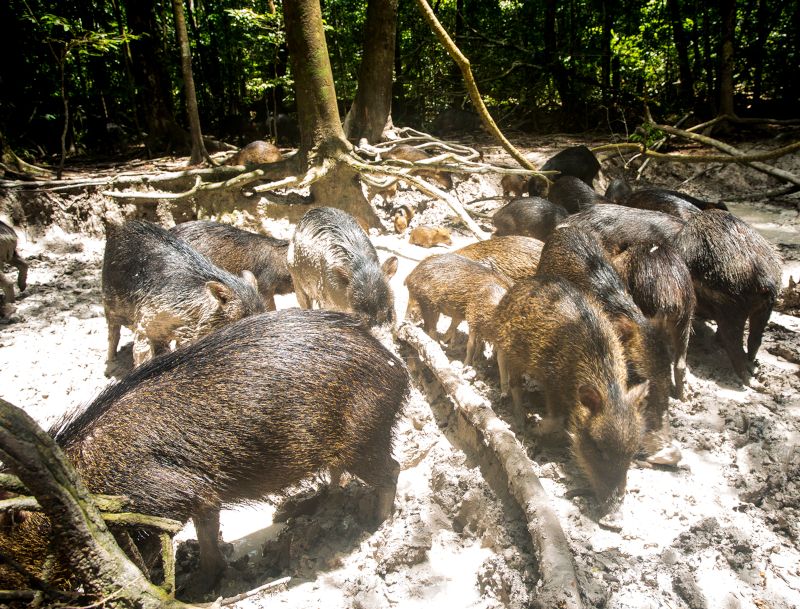
By André Julião | Agência FAPESP – A study published in the journal Ecological Monographs indicates that large mammals, such as tapirs, peccaries, agoutis, and deer, alter the chemical composition of litter and soil in tropical forests of the Brazilian Atlantic Forest. As a result, they increase nutrient availability and, possibly, soil fertility.
The study was conducted by members of the Center for Research on Biodiversity Dynamics and Climate Change (CBioClima), a Research, Innovation, and Dissemination Center (RIDC) supported by FAPESP and based at the Institute of Biosciences of São Paulo State University (IB-UNESP) in Rio Claro. The findings underscore the critical role of these animals, which are heavily targeted by poachers and experiencing population decline, in the long-term survival of the biome, even within areas where forest cover remains intact.
“Most of the mammalian biomass in contiguous areas of the Atlantic Forest consists of peccaries, native wild pigs that live in herds that can exceed 100 individuals,” says Letícia Gonçalves Ribeiro, the lead author of the study. Ribeiro conducted the research as part of her Ph.D. at IB-UNESP with support from FAPESP.
“They arrive in an area and spend a lot of time trampling and rooting around in the ground, searching for fallen fruits and seeds, as well as defecating and urinating. As a result, they end up influencing nutrient cycling, altering soil chemistry and the diversity of the litter – the layer of leaves, twigs, and fruits on the soil surface,” the scientist explains. Other large herbivorous mammals that inhabit the biome include tapirs, deer, and agoutis, another species of wild pig.
To better understand the importance of these animals to the Atlantic Forest ecosystem, the researchers compared soil and litter samples from areas where the mammals roam freely with samples from fenced-off areas where they were temporarily eliminated. The results revealed substantial differences in acidity (pH) – less acidic with animals present and more acidic without – as well as in the availability of nutrients, such as calcium and aluminum.
“Aluminum, which is harmful to plants at high levels, was reduced where there was a greater presence of animals. This nutrient has a special relationship with pH and calcium. A balance between the two is necessary for greater soil fertility,” says Ribeiro. In practice, this means that the presence of large mammals increases forest soil fertility.
In areas with mammals, a reduction in lignin was observed in the leaf litter. Lignin is a complex molecule that coats plant cells and hinders their decomposition. When stirred up and trampled by animals, leaf litter becomes more evenly distributed and breaks down into smaller pieces. This increases its contact with the soil, facilitating the breakdown of lignin and the decomposition process.
Greater diversity was also observed in the leaf litter that had been rummaged through and trampled by large animals. Samples collected from areas with large mammals had a more balanced proportion of leaves, twigs, fruits, and seeds – another factor contributing to the decomposition of these materials on the forest floor.
“Our research has demonstrated, with increasing certainty, how large herbivores play a vital role in forests. It’s precisely those animals – which are most targeted by hunters – that act as ecosystem engineers, influencing everything from the composition of plants in the landscape to the chemistry of the soil,” says Mauro Galetti, a professor at IB-UNESP who coordinated the study and is one of the principal investigators at CBioClima.
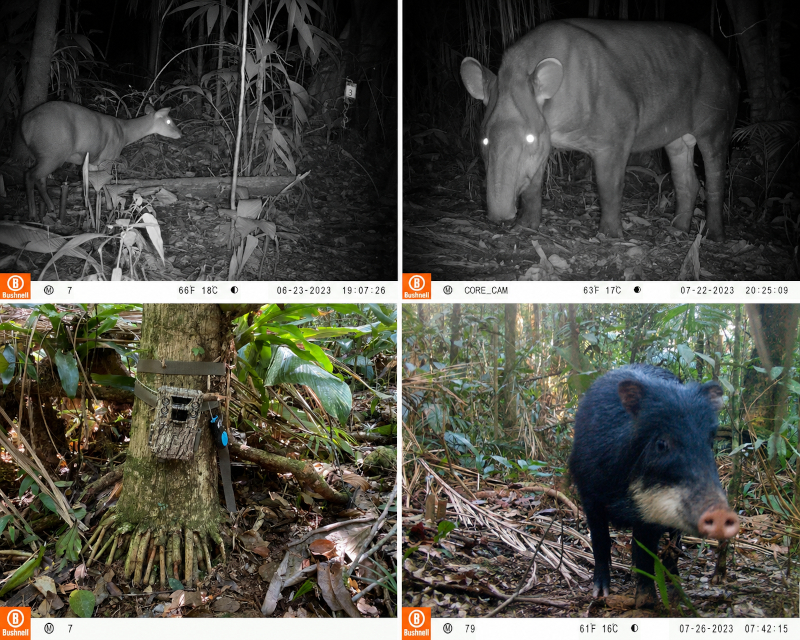
Top, a red brocket deer (Mazama rufa) and a tapir (Tapirus terrestris); right, a peccary (Tayassu pecari). These photos were captured by camera traps installed in the study areas (photos: camera traps and Letícia Gonçalves Ribeiro/IB-UNESP)
Long-term study
The research was based on data obtained through the project “DEFAU-BIOTA: Effects of Defaunation on Soil Carbon and Functional Plant Diversity in the Atlantic Forest”, supported by FAPESP under the Research Program on Biodiversity Characterization, Conservation, and Sustainable Use (BIOTA-FAPESP).
Since 2009, the experiment has been conducted in the Serra do Mar mountain range in the state of São Paulo. It compares 15-square-meter areas (plots) open to free animal movement with areas where access is restricted by fences installed by researchers to prevent the entry of large mammals.
The current study analyzed ten open and ten closed plots in Carlos Botelho State Park in the municipality of São Miguel Arcanjo. The park is part of a large mosaic of protected Atlantic Forest areas in the Vale do Ribeira region in southeastern part of the state. The researchers estimated mammal biomass using images from “camera traps,” which are triggered when an animal passes in front of them.
Previous studies have demonstrated that the absence of large herbivorous mammals reduces soil nitrogen, decreases plant diversity, and alters relationships between plants and their natural enemies, thereby changing the ecological dynamics of the forest (read more at agencia.fapesp.br/34975, agencia.fapesp.br/31840, and agencia.fapesp.br/51580).
Another study by the group in March of this year indicated that the absence of large mammals leads to the homogenization of the forest, or the dominance of a few plant species that thrive in the absence of these herbivores.
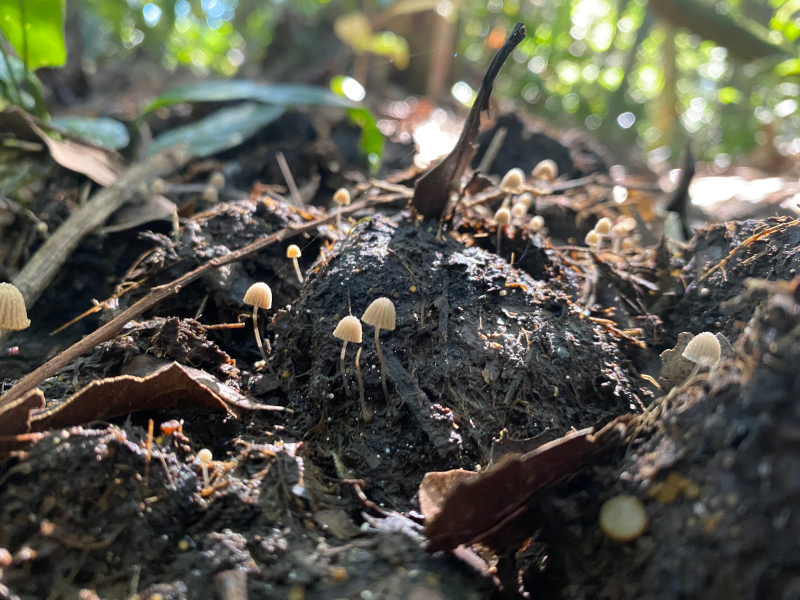
Tapir droppings in Carlos Botelho State Park. The presence of large mammals increases the availability of nutrients for forest maintenance (photo: Letícia Gonçalves Ribeiro/IB-UNESP)
Life in the soil
In a more recent phase of the ongoing research, Ribeiro is analyzing the effect of large mammals on nematodes, which are microscopic, worm-like soil organisms that serve as indicators of ecosystem quality.
“Nematodes are one of the most abundant groups in soil fauna, occupying different trophic levels. Some specialize in eating bacteria, some feed only on fungi, and some are predators that feed on other nematodes and soil fauna organisms,” Ribeiro explains. She is currently pursuing a doctoral internship at Aarhus University in Denmark with a scholarship from FAPESP.
Preliminary analyses of soil samples collected from the study areas indicate that the presence of large mammals contributes to a higher abundance of predatory nematodes. “All the other trophic levels must be present for this type of nematode to exist. Therefore, their abundance indicates a healthier ecosystem,” she says.
However, no publication date has yet been set for the results of this new phase of the study.
The study was also supported by FAPESP through a doctoral scholarship awarded to Mateus de Melo Dias, a co-author of the paper.
The article “Mammals’ zoogeochemical effects change litter and soil biogeochemistry in a tropical rainforest” can be read at esajournals.onlinelibrary.wiley.com/doi/10.1002/ecm.70070.
Republish
The Agency FAPESP licenses news via Creative Commons (CC-BY-NC-ND) so that they can be republished free of charge and in a simple way by other digital or printed vehicles. Agência FAPESP must be credited as the source of the content being republished and the name of the reporter (if any) must be attributed. Using the HMTL button below allows compliance with these rules, detailed in Digital Republishing Policy FAPESP.
