




Cristiano Chiessi collects a marine sediment core sample (photo: Dana Pittauerova)
Research shows that the AMOC, a system fundamental to the Earth’s climate, has undergone sudden changes in the past, driven by climate shifts similar to those we are experiencing now.
Research shows that the AMOC, a system fundamental to the Earth’s climate, has undergone sudden changes in the past, driven by climate shifts similar to those we are experiencing now.
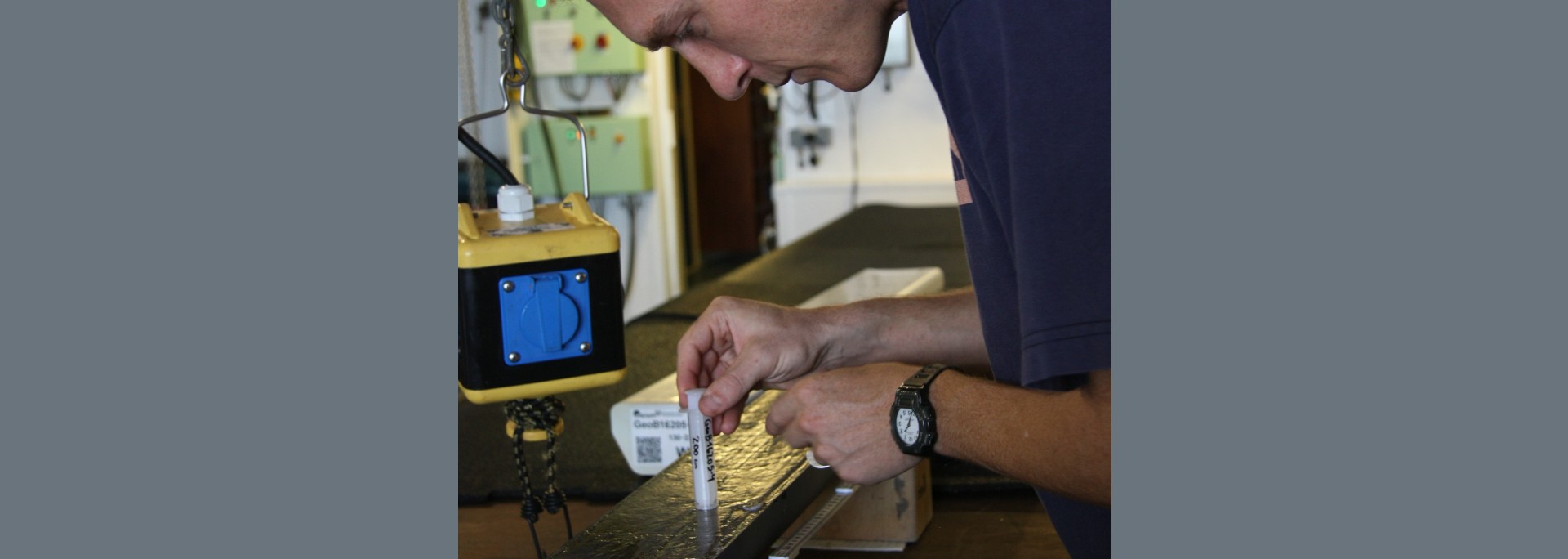
Cristiano Chiessi collects a marine sediment core sample (photo: Dana Pittauerova)
By Igor Zolnerkevic | Agência FAPESP – According to a new study led by researchers from Brazil and Germany, the main system that transports heat from one end of the Atlantic Ocean to the other may undergo sudden changes in intensity driven by climate changes similar to those we are experiencing now, even when it is already weakened. The Atlantic Meridional Overturning Circulation (AMOC) is a vast system of ocean currents that functions as a conveyor belt for heat across the Atlantic. It carries warm water from equatorial and tropical regions to high latitudes in the North Atlantic. This helps regulate the climate in both hemispheres by moderating temperatures in Europe and parts of North America. It also influences rainfall patterns in intertropical regions of Africa and South America.
Global warming has gradually weakened the AMOC, and researchers have warned for decades about the risk of the circulation reaching a critical threshold that would trigger an abrupt slowdown and radically alter the climate in various regions of the planet. Previous research indicated that the circulation could remain in this weakened, relatively stable state for thousands of years. However, a new study shows that the AMOC may be much more dynamic than previously thought, indicating that society needs to prepare not only for abrupt climate change but also for a series of such changes.
The study, led by Cristiano Mazur Chiessi of the School of Arts, Sciences, and Humanities at the University of São Paulo (EACH-USP) in Brazil and Stefan Mulitza of the University of Bremen in Germany, found evidence of two episodes of significant AMOC intensification between 17,800 and 14,800 years ago.
During this period, known as “Heinrich Stadial 1,” the circulation was, for the most part, much weaker than it is today. However, the analysis of marine sediments by the German-Brazilian team concluded that the AMOC experienced two abrupt surges in intensity during this time: one lasting from 16,500 to 15,800 years ago and a shorter one lasting about 100 years around 15,400 years ago. During the latter episode, the AMOC’s intensity even exceeded its current level.
These results were published in May in the journal Nature Communications.
“This is the first time it’s been shown that the AMOC can experience bursts of strengthening during periods when it’s weakened,” says Chiessi, a specialist in paleoceanography and paleoclimatology (sciences that study the past of the ocean and climate). “As one of the article’s reviewers wrote, this completely changes the way we understand the Atlantic Meridional Overturning Circulation.”
The main driver of the AMOC is the sinking of cold, salty water off the coast of Greenland. This deep water then flows southward and returns to the surface primarily in the Antarctic Circumpolar Current, where strong winds promote upwelling. Surface currents then carry some of this water back north, completing the circuit.
However, global warming caused by greenhouse gas emissions is currently weakening this circulation. The melting of Greenland’s glaciers, the warming of the Arctic Ocean, and increased rainfall in the region are reducing the salinity and density of surface waters, making it harder for them to sink.
Researchers predict that this process could lead to a sudden, significant weakening of the AMOC but still do not know when or how intensely this might occur. Until recently, even the best climate models evaluated by the United Nations’ Intergovernmental Panel on Climate Change (IPCC) could not predict the AMOC’s evolution with sufficient accuracy. In April of this year, however, a team of researchers from the University of Bordeaux in France published improved predictions in the journal Science Advances, based on new observational data. According to the researchers, the AMOC could weaken by between 43% and 59% by 2100, even if all countries meet their commitments to reduce greenhouse gas emissions.
A weakening of the AMOC on this scale has not occurred since the end of the last Ice Age. During the Last Glacial Maximum, the coldest period of the last Ice Age, much of Eurasia and North America was covered by gigantic glaciers over 3,000 meters high. These glaciers extended as far south as Chicago in the United States. The enormous volume of water locked in ice caused sea levels to drop 120 meters below current levels. Even during that period, the AMOC was as strong as it is today.
However, a long period of deglaciation began when climate changes triggered by natural variations in the Earth’s orbit raised global temperatures. After about 1,000 years of glacial melting, the AMOC experienced an abrupt decline in intensity from which it did not recover until 3,000 years later, at the end of the Heinrich Stadial 1 (HS1) event.
Chiessi points out that the AMOC’s previous 1,000-year weakening period does not guarantee the same timeframe for a future decline. “Climate conditions were entirely different,” he explains. “During that period, the concentration of carbon dioxide in the atmosphere was lower than in the pre-industrial era. We can learn from past events, but they aren’t perfect analogues.”
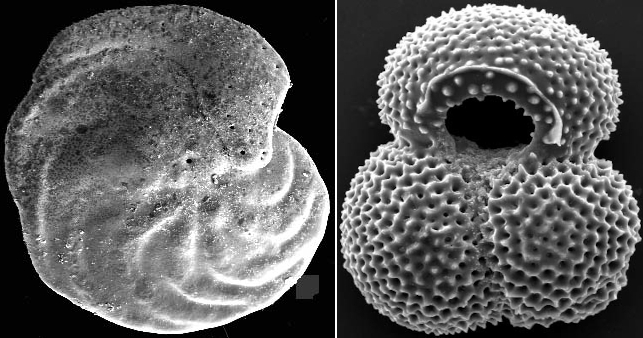
Foraminifera shells viewed under a microscope. Age differences between benthic (left) and planktonic (right) specimens reveal changes in the AMOC (images: Cristiano Chiessi)
Reconstructing the past
The study analyzed a marine sediment core collected in the equatorial Atlantic Ocean at a depth of 1,367 meters and approximately 189 kilometers off the coast of Maranhão state, Northeast Brazil, during a 2012 cruise by the German research vessel RV Maria S. Merian. During the HS1 event, as well as during other periods of weakened AMOC, precipitation increased significantly in northeastern Brazil, while it decreased dramatically in the northern Amazon and other regions farther north. “The sedimentation rate where we collected the sample was high because it rained heavily, causing significant erosion and deposition,” Chiessi explains. “That allowed us to conduct many analyses. It’s like having a movie with many frames per second in extremely high resolution.”
To estimate the strength of past ocean currents, Chiessi and Mulitza’s team used a sophisticated, costly, but highly accurate method called radiocarbon ventilation dating. This technique calculates how long deep ocean water has been isolated from the atmosphere, enabling researchers to measure the speed of the currents.
In each sediment layer, the researchers identified and dated shells from two types of microorganisms, both of which are called foraminifera, using carbon-14 (radiocarbon). Since this isotope is produced in the atmosphere and absorbed by microalgae only at the ocean’s surface, the apparent “age” of these shells reflects the depth at which they formed.
The shells of planktonic foraminifera (which live on the surface) are younger than those of benthic foraminifera (which live on the ocean floor). This age difference occurs because carbon-14 only reaches the depths when carried by surface waters that sink in the Greenland region.
Currently, it takes 350 years for this water to circulate in the equatorial Atlantic, which is known as the “ventilation age” of the AMOC. Therefore, as Chiessi concludes, “The age difference between a shell formed at the surface and one formed at the bottom is a direct indicator of how intense the AMOC is.”
Researchers Partha Sarathi Jena and Ines Beese conducted the analyses during their postdoctoral fellowships at EACH-USP and the University of Bremen, respectively. Their findings concluded that just before the HS1 event, the apparent age difference between planktonic and benthic foraminifera was 325 years. During most of the event, this difference increased to 960 years due to the weakening of the AMOC. However, during the first episode of intensification, it decreased to 450 years, and during the second, it decreased further, to 200 years.
The team compared their results with those of other paleoclimatic studies, particularly estimates of precipitation during HS1 obtained by analyzing stalagmites collected at Jaraguá Cave in Bonito in the state of Mato Grosso do Sul and at Gruta da Paixão in Andaraí in the state of Bahia. The two peaks in AMOC intensification coincide with two periods when heavy rainfall gave way to a drier climate on the continent, reducing the volume of freshwater reaching the ocean.
These peaks also coincide with increases in atmospheric carbon dioxide concentrations, as recorded by studies of air bubbles trapped in Antarctic ice during HS1. Chiessi and his colleagues suggest that the two AMOC intensifications may have transported deep, carbon dioxide-rich waters – which had been relatively stagnant in the Atlantic when the AMOC was weak – into the Antarctic Circumpolar Current. Once there, the carbon dioxide was released into the atmosphere.
Chiessi hopes his work will improve AMOC forecasts and help develop systems that identify climate signals anticipating abrupt changes. This would enable society to take early adaptation measures. “We’ll need a great deal of resilience, but we can still prevent the worst from happening if we take action to drastically reduce greenhouse gas emissions,” he notes.
The study was conducted under the auspices of the Climate Crisis and Disasters Resilience Research Center (CLIMARES), a FAPESP Research, Innovation, and Dissemination Center (RIDC). It also received support through three other projects funded by the Foundation (18/15123-4, 23/00355-5, and 25/05117-0).
The article “Centennial-scale intensifications of the Atlantic Meridional Overturning Circulation during Heinrich Stadial 1” can be found at nature.com/articles/s41467-026-73364-x.
The Agency FAPESP licenses news via Creative Commons (CC-BY-NC-ND) so that they can be republished free of charge and in a simple way by other digital or printed vehicles. Agência FAPESP must be credited as the source of the content being republished and the name of the reporter (if any) must be attributed. Using the HMTL button below allows compliance with these rules, detailed in Digital Republishing Policy FAPESP.
