




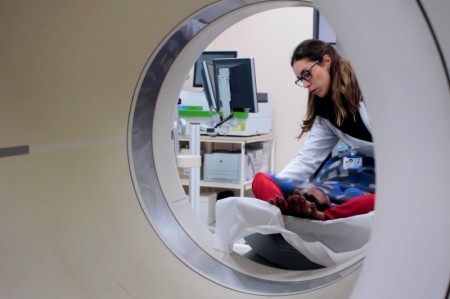
One of CancerThera's key strengths is translation: direct dialogue between chemists, who create the molecules; biologists, who conduct preclinical tests on cells and animals; and clinical oncologists and hematologists (photo: Daniel Antônio/Agência FAPESP)
The agreement between the FAPESP Research, Innovation, and Dissemination Center and the Uruguayan Center for Molecular Imaging aims to boost the development and application of theranostic radiopharmaceuticals.
The agreement between the FAPESP Research, Innovation, and Dissemination Center and the Uruguayan Center for Molecular Imaging aims to boost the development and application of theranostic radiopharmaceuticals.
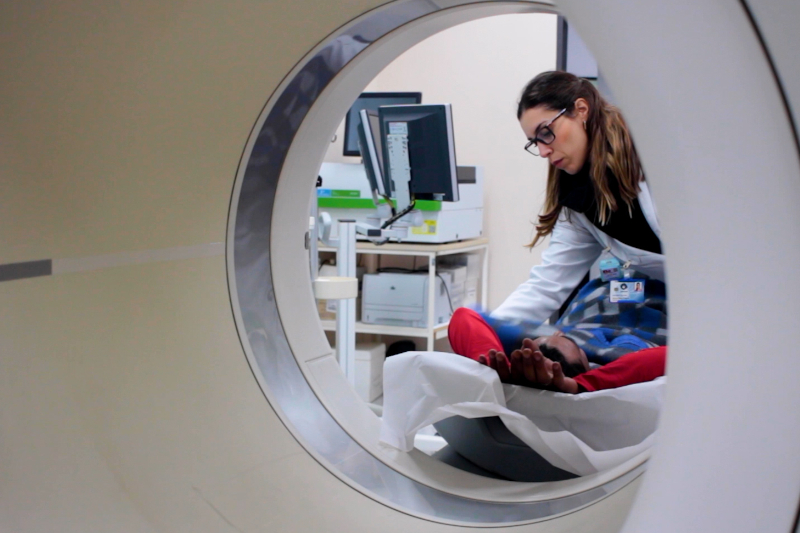
One of CancerThera's key strengths is translation: direct dialogue between chemists, who create the molecules; biologists, who conduct preclinical tests on cells and animals; and clinical oncologists and hematologists (photo: Daniel Antônio/Agência FAPESP)
By Elton Alisson | Agência FAPESP – The Center for Theranostic Innovation in Cancer (CancerThera) has signed a memorandum of understanding for collaboration with the Uruguayan Center for Molecular Imaging (CUDIM), a public nonprofit institution that specializes in diagnostic imaging, highly complex treatments, and health research. CancerThera is one of FAPESP’s Research, Innovation, and Dissemination Centers (RIDCs), based at the State University of Campinas (UNICAMP).
The initiative aims to promote scientific and technological cooperation between researchers from both organizations by fostering the exchange of knowledge and technical staff and encouraging potential clinical research in the field of personalized medicine with an emphasis on imaging and a theranostic approach to cancer.
“This collaboration combines CUDIM’s 15 years of experience developing radiopharmaceuticals and metallopharmaceuticals [drugs containing a metal at their core] with CancerThera’s capabilities in testing, clinical research, and patient recruitment,” Carmino Antonio de Souza, a professor at the Faculty of Medical Sciences (FCM) at UNICAMP and director of CancerThera, tells Agência FAPESP. “We want to exchange experiences to pave the way for closer cooperation,” emphasizes the medical oncologist and hematologist, who is also vice president of FAPESP.
Frontier field
The central focus of the collaboration is the theranostic approach, a new frontier in precision and personalized medicine that involves the extensive use of nuclear medicine for diagnosing and treating cancer. This technique uses radiopharmaceuticals, or radioactive drugs, to identify and treat tumor cells in a personalized manner.
To determine if a tumor has specific receptors for a given molecule, a radiotracer is infused intravenously into the patient. A radiotracer is a targeting molecule combined with a diagnostic isotope, such as fluorine-18. The tracer circulates through the body, binding to specific receptors on tumor cells.
If images obtained by positron emission tomography (PET) or single-photon emission computed tomography (SPECT) confirm that the tumor takes up the molecule, the radiotracer is coupled with a radioactive isotope that emits alpha or beta particles, such as lutetium-177. When injected, the radiopharmaceutical travels through the bloodstream and delivers the radioactive element directly to the cancer cell, sparing adjacent healthy tissue.
The protocol generally calls for four to six infusions at an average interval of six weeks to monitor the clinical response. “It’s like intracellular radiation therapy. Toxicity is very low because we inject very small amounts [nanograms] of the radioactive element. The biggest challenge is identifying which patients have tumors that show uptake of the available radiopharmaceuticals,” Souza explains.
Results and new targets
Researchers at CancerThera have evaluated the use of Lutetium-177 PSMA in over 100 patients with advanced cases of various types of solid and hematological neoplasms.
PSMA (prostate-specific membrane antigen) is a protein found on prostate cell surfaces. Its production increases significantly in cancer cells, making it an ideal target for imaging and targeted therapy.
The project is continuously seeking new therapeutic targets and radiopharmaceuticals that can benefit more patients and expand therapeutic possibilities for new tumors.
“We need to know what our targets are and which tracers are most sensitive to them. It’s a process of refinement to find the best therapeutic approach,” says Souza. The group is now preparing a scientific article describing the diagnostic use of PSMA. Additionally, they plan to introduce new tracers later this year, such as FAPI (fibroblast activation protein inhibitor) and pentixafor, to explore treating other solid tumors and lymphomas.
“The idea is to finish the initial phase of our work with PSMA and incorporate other radiopharmaceuticals into our research routine. There are still other options that we intend to test progressively,” says Souza.
In his assessment, one of CancerThera’s key strengths is translation: direct dialogue between chemists, who create the molecules; biologists, who conduct preclinical tests on cells and animals; and clinical oncologists and hematologists. This synergy is essential to ensuring that laboratory discoveries effectively reach patients in the future and are not confined to publications.
“This allows basic researchers to communicate with preclinical researchers, for example, and begin moving the most mature findings into the clinical setting. This takes place over a long period with constant challenges,” Souza explains.
Regional autonomy and cost reduction
Technological sovereignty is one of the critical aspects of the partnership. Currently, Brazil faces logistical and domestic production challenges regarding radiopharmaceuticals and relies on costly imports from Middle Eastern countries and Uzbekistan. Proximity to Montevideo opens up the possibility of exchanging supplies and, eventually, direct imports from CUDIM, which would facilitate access to treatments.
“Our current cost via imports for research is about ten times lower than the market price. Domestic or regional production is the path to greater availability and lower prices,” Souza emphasizes.
The agreement is already yielding practical results. In early March, Uruguayan researchers attended the CancerThera Congress in Campinas, presenting studies and discussing topics ranging from isotope quality control to strategies for scientific dissemination.
The partnership was formalized in late February when a delegation of researchers from the Brazilian institution visited the headquarters of the Uruguayan research center.
The visit coincided with CUDIM’s 15th anniversary. Uruguayan President Yamandú Orsi, the Minister of Public Health Cristina Lustemberg, and the Minister of Industry, Energy, and Mining Fernanda Cardona attended the event. During the gathering, the recent designation of the Uruguayan research institution as the first International Atomic Energy Agency (IAEA) Collaborating Center in Latin America in its field of expertise was celebrated.
The Agency FAPESP licenses news via Creative Commons (CC-BY-NC-ND) so that they can be republished free of charge and in a simple way by other digital or printed vehicles. Agência FAPESP must be credited as the source of the content being republished and the name of the reporter (if any) must be attributed. Using the HMTL button below allows compliance with these rules, detailed in Digital Republishing Policy FAPESP.
