





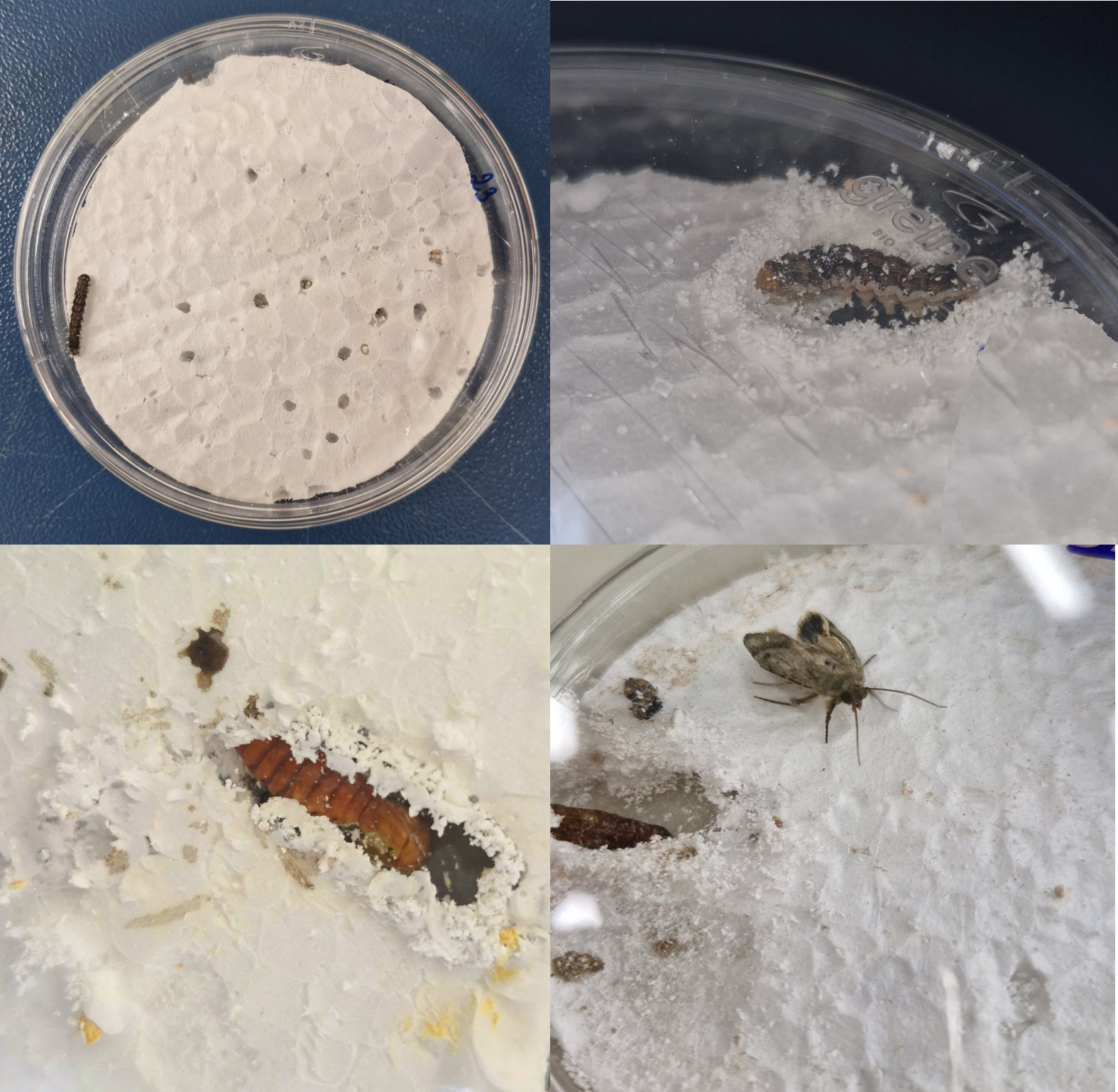
By Frances Jones | Agência FAPESP – A moth caterpillar identified by the agribusiness sector as one of the most destructive pests of soybean, cotton, and corn crops may harbor fungi and bacteria in its gut that can degrade expanded polystyrene, also known as Styrofoam. In an article published in the journal BMC Microbiology, researchers from the Federal University of São Carlos (UFSCar) and São Paulo State University (UNESP) in Brazil presented the results of a study investigating the gut microbiota of Helicoverpa armigera and its role in degrading this petroleum-derived plastic.
Since well-established research already exists on bacteria in insect guts, the study led by the Molecular Biology Laboratory at UFSCar focused on fungal diversity in the context of polystyrene biodegradation. The laboratory is known for developing a transgenic sugarcane plant that is resistant to the Sphenophorus levis beetle and for discovering a sugarcane protein whose recombinant form can protect tooth enamel. The researchers have now succeeded in isolating and identifying four fungi present in the intestines of Helicoverpa armigera caterpillars and have demonstrated, using scanning electron microscopy, the potential of each fungus to degrade the polymer.
“The studies published by our group are likely the first in Brazil on fungi from the gut microbiota of insects involved in polystyrene degradation,” says Flavio Henrique Silva, a biologist, professor in the Department of Genetics and Evolution at UFSCar, and corresponding author of the article. Silva is also the advisor for Gabrieli Seiscentos Cardenas’s undergraduate research project, supported by FAPESP, which led to the publication on Helicoverpa. This research was conducted as part of the Regular Research Grant project, “Sphenophorus levis and Helicoverpa armigera as sources of polystyrene-degrading microorganisms”.
To conduct the experiments, the insects were divided into three groups that received different diets. One group was fed only expanded polystyrene blocks (abbreviated as EPS). A second group received a mixed diet containing up to 50% EPS, and a third group was fed a conventional diet. Analysis of the microbiota via metabarcoding revealed that diet plays a decisive role in the fungal composition of the caterpillars. Although yeast of the genus Diutina was ubiquitous, its abundance decreased significantly in groups fed polystyrene (EPS). This change permitted greater diversification of the microbial community, with the emergence of genera such as Aspergillus, Talaromyces, Metarhizium, and Trematosphaeria. This suggests that the microbiota adapted to consuming the polymer.
The researchers subsequently isolated four fungi from the larval gut microbiota: Aspergillus sp., Talaromyces sp., and two species of Penicillium. They then placed the spores of these fungi on an ultra-thin polystyrene film and incubated them for 60 days. Scanning electron microscopy analysis revealed that the fungi grew and interacted with the polymer surface, altering it in the process. “If the fungus was able to grow on that film, it’s because it used the film as a carbon source – that is, a food source. Two of them are more efficient, while the other two make more subtle changes to the films,” Silva comments.
Another article by the same research group, published in March in the journal Frontiers in Microbiology, describes studies on the microbiota of the larvae of the beetle Sphenophorus levis, also known as the sugarcane weevil. This insect attacks sugarcane monocultures. The researchers highlight the effectiveness of the bacterium Paenibacillus lautus in breaking down polystyrene and reducing its molar mass. This study resulted from doctoral research conducted by bioprocess and biotechnology engineer Eduardo Pereira de Souza, who also receives support from FAPESP and is a co-author of the article on Helicoverpa.
The researchers are now analyzing the insects’ feces to determine if they merely transform the polymer into micro- or nanoplastics or if digestion results in the complete breakdown of the carbon rings.
‘Trojan mealworm’
Another insect studied by the group at UFSCar’s Molecular Biology Laboratory is the Zophobas morio beetle. Its larva, known for its voracious appetite, is popularly called the “giant mealworm.” “It has an interesting characteristic because it’s much more resilient than the larvae of Sphenophorus levis, for example, which are found in sugarcane and die easily in the laboratory,” says Silva. “Z. morio can survive for weeks feeding only on Styrofoam or other polymers.”
The researcher says extensive work lies ahead to identify the microorganisms, genes, and proteins involved in the polymer degradation process. “We need to determine which microorganisms are most efficient and whether they cooperate with one another. In our work on Paenibacillus, we sequenced the bacterium’s genome and identified genes that encode proteins known to be involved in plastic degradation. By studying this mechanism, we hope to identify more efficient enzymes,” says Silva.
The researchers plan to develop a collection of bacteria and fungi that efficiently degrade polystyrene and colonize the gut of an insect, such as the giant mealworm. “Then we’d have a powerful and highly efficient larva for degradation – a kind of Trojan horse.”
Recently, Leticia Garcia Beghini, another one of Silva’s undergraduate research students, was honored with the SBBq Award at the 55th Meeting of the Brazilian Society of Biochemistry and Molecular Biology for her work involving Zophobas morio larvae and polystyrene degradation, with support from FAPESP.
Although many studies have examined plastic degradation by soil microorganisms, fewer have focused on insect gut microorganisms, particularly those involved in expanded polystyrene degradation, Silva explains. “Styrofoam has always been less studied. Recycling it has always posed a challenge from a logistical standpoint since a block of this material contains only 2% plastic, with the rest being air.” The professor also believes that fungi can contribute to this process. “They’re excellent producers and secretors of enzymes, many of which are capable of breaking down cellulose and complex polymers.”
The article “Helicoverpa armigera (Lepidoptera, Noctuidae) as a reservoir of potential polystyrene-degrading fungi” can be read at link.springer.com/article/10.1186/s12866-026-05021-8.
Republish
The Agency FAPESP licenses news via Creative Commons (CC-BY-NC-ND) so that they can be republished free of charge and in a simple way by other digital or printed vehicles. Agência FAPESP must be credited as the source of the content being republished and the name of the reporter (if any) must be attributed. Using the HMTL button below allows compliance with these rules, detailed in Digital Republishing Policy FAPESP.
