




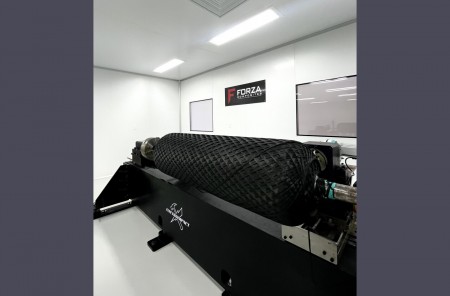
The material, called “towpreg,” consists of a bundle of carbon or glass filaments impregnated with a polymer resin that hardens only when heated during the curing process. This results in a composite with low density and high mechanical strength (image: Forza Composites)
With support from FAPESP, a São Paulo-based company is developing its own technology to manufacture a coating in Brazil that will make gas storage tanks, such as those for hydrogen, up to 70% lighter, thereby reducing transportation weight.
With support from FAPESP, a São Paulo-based company is developing its own technology to manufacture a coating in Brazil that will make gas storage tanks, such as those for hydrogen, up to 70% lighter, thereby reducing transportation weight.
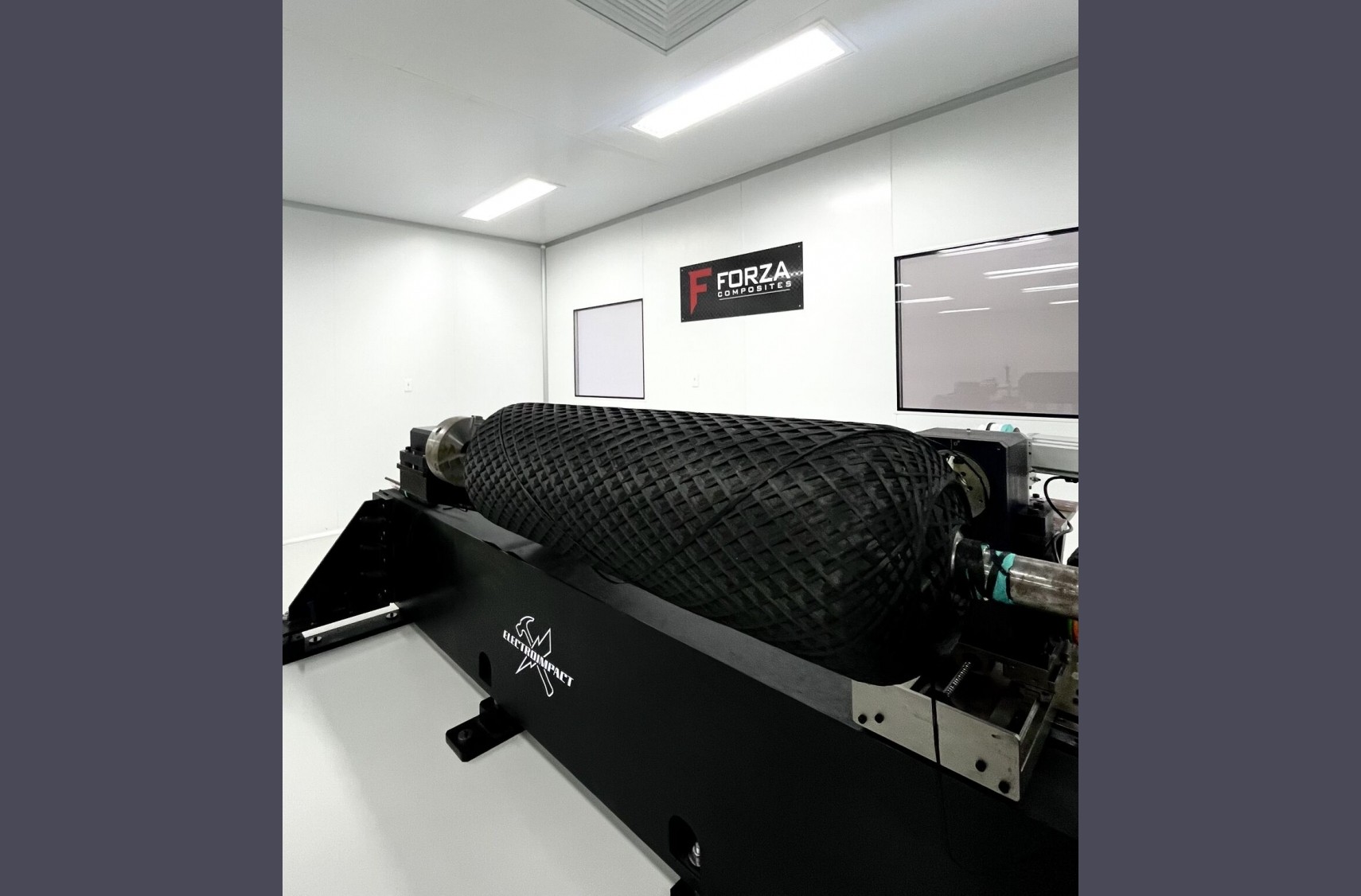
The material, called “towpreg,” consists of a bundle of carbon or glass filaments impregnated with a polymer resin that hardens only when heated during the curing process. This results in a composite with low density and high mechanical strength (image: Forza Composites)
By Roseli Andrion | Agência FAPESP – Imagine a material that can create structures as strong as steel but much lighter. This material, called towpreg, already exists and is in high demand by Brazilian industries in the aerospace, automotive, agricultural, and infrastructure sectors. However, there’s one problem: all of this material must be imported since no Brazilian company has mastered the technology needed to manufacture it domestically.
Forza Composites, a startup incubated at the São José dos Campos Technology Park in the state of São Paulo, aims to change this reality with help from FAPESP. The company is developing the first Brazilian-made towpreg prototypes for use in manufacturing gas storage cylinders, such as those for hydrogen and biomethane, that are up to 70% lighter than traditional steel versions. Experts estimate that this would reduce the total weight of cylinder transport by 20%, increase the load capacity per truck by 50%, and lower logistics costs per cubic meter of gas by up to 45%.
The company’s researchers have made progress in prototyping and strength testing and are moving toward semi-industrial-scale production. FAPESP’s Innovative Research in Small Businesses Program (PIPE) is supporting the project.
Towpreg is a coating that resembles industrial electrical tape but is in the form of a continuous filament wound like a ball of yarn. According to chemist Michelle Leali Costa, the project coordinator, it has a “stickiness” similar to that of adhesive tape. She refers to this property as “tack.” This characteristic makes it easy to wrap the filament around the structure to be reinforced. However, to preserve the material until application, it must be kept at -18 °C throughout storage and transport.
Because the supply chain is entirely external, the process is risky. Upon arrival in Brazil, the product must clear customs. If it is held up without adequate refrigeration, the entire batch may become completely unusable. Furthermore, a towpreg with a one-year shelf life that reaches the buyer after three months of transit and customs procedures has only nine months of usable life remaining. “Depending on the production date, it arrives with only three months left before it expires,” Costa laments.
Combination of properties
Towpreg consists of a bundle of carbon or glass filaments impregnated with a polymer resin, usually a high-strength epoxy resin. The resin protects the fibers from the environment and acts as a structural adhesive that hardens only when heated during the curing process. Before that, the filament retains the stickiness described by Costa, which is useful for shaping but requires careful handling.
After the curing process, the resulting material can be used to manufacture lightweight, strong structures, especially tubular ones, such as gas storage cylinders. The startup’s project uses thermosetting epoxy resin, which hardens permanently when heated and transforms into a lightweight, extremely strong reinforcement.
When combined with the resin, carbon fiber forms a composite – a material whose properties exceed those of its individual components. “The fiber contributes tensile strength, while the resin provides damping and stress distribution,” Costa explains. In terms of mechanical strength, the material is equivalent to steel, but it has a much lower density. This ensures the same structural performance at a fraction of the weight.
Carbon and glass fiber composites are everywhere. Everything described as being made of carbon fiber, from racing bicycles to fishing rods to tennis rackets to golf clubs, actually uses its composite form. “The fiber alone can’t hold its shape,” says Costa. “It needs the polymer matrix to exist as a product,” the researcher adds.
In aviation, for example, towpreg is used in the fuselages of modern aircraft via automated fiber placement (AFP). Filament winding, a technique used by the company in producing tanks, is essential for pressure vessels and aerospace components.
In commercial aviation, using these composites in about half of the Boeing 787 Dreamliner’s structure has reduced the aircraft’s weight by 20%, improving energy efficiency and corrosion resistance. In Formula 1 cars, where 90% of the bodywork uses these materials, the composite provides enhanced safety by absorbing impacts and dissipating energy.
Greater lightness and strength
The founders of Forza Composites first envisioned the product being used in the energy sector. While developing vanes for vacuum pumps, which were also imported, the team identified a transformation in the energy sector driven by the high demand for pressure vessels for biomethane and green hydrogen.
These tanks require maximum safety because hydrogen is a small, volatile molecule. Any cylinder failure poses a risk of explosion and fire, which could be catastrophic. Historically, these containers were manufactured from metal, a heavy and corrosive material that imposes high costs on road transport, the predominant mode of transportation in Brazil.
One solution may be the Type IV cylinder, like those that Forza has started producing in Brazil. These cylinders combine a high-performance polymer interior with an exterior coated in layers of towpreg. The result is a cylinder that is 60% to 70% lighter, corrosion-resistant, and ideal for saline environments such as pre-salt platforms used for deepwater oil exploration.
Costa estimates that local production will reduce the cost of these cylinders in Brazil by up to 40%. “Without domestic production, the imported product becomes too expensive to compete with steel cylinders, despite all its technical advantages,” he notes.
Target product
The project, developed by researchers at the startup with support from PIPE-FAPESP, focuses on three pillars: formulating a stable epoxy resin (eliminating the need to refrigerate the material for at least 90 days), optimizing fiber impregnation on a laboratory scale, and developing a prototype for pilot-scale production.
The final challenge will be certification. For biomethane tanks, the Brazilian Institute of Metrology, Quality, and Technology (INMETRO) follows European standards. However, for hydrogen, there is still no national certification, so it is necessary to rely on foreign standards. “A pressure pump can’t have any leaks. The risk of explosion and asphyxiation in confined spaces demands absolute rigor,” Costa concludes.
Although the project is still in the pre-industrial production phase, it is already attracting interest from strategic sectors. The Brazilian Navy is evaluating the use of towpregs for submarine applications, and companies developing hydrogen-powered drones have approached the startup seeking lightweight, compact containers.
Within Mercosur, Argentine companies have shown interest. However, the startup maintains its primary focus on the domestic market, where efficient local logistics provide a competitive advantage. With potential applications ranging from orthopedic prostheses to pipes for civil construction and automotive components, this Brazilian technology promises to drive growth across sectors operating under critical conditions of pressure and corrosion.
The Agency FAPESP licenses news via Creative Commons (CC-BY-NC-ND) so that they can be republished free of charge and in a simple way by other digital or printed vehicles. Agência FAPESP must be credited as the source of the content being republished and the name of the reporter (if any) must be attributed. Using the HMTL button below allows compliance with these rules, detailed in Digital Republishing Policy FAPESP.
