




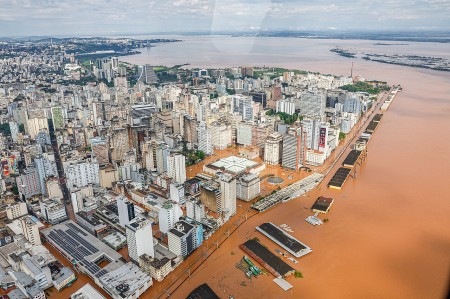
The research was based on a sample of 60,000 disaster records between 1991 and 2024; altogether, these events accounted for 4,774 deaths, 3,031 missing people, and economic losses of over USD 123.89 billion (helicopter flyover of the areas affected by the rains in Canoas, Rio Grande do Sul state, in May 2024; credit: Ricardo Stuckert/PR/Wikimedia Commons)
An analysis of 60,000 records of flooding, waterlogging, flash floods, landslides, storms, and droughts reveals regional impacts in Brazil and may inform public policy.
An analysis of 60,000 records of flooding, waterlogging, flash floods, landslides, storms, and droughts reveals regional impacts in Brazil and may inform public policy.
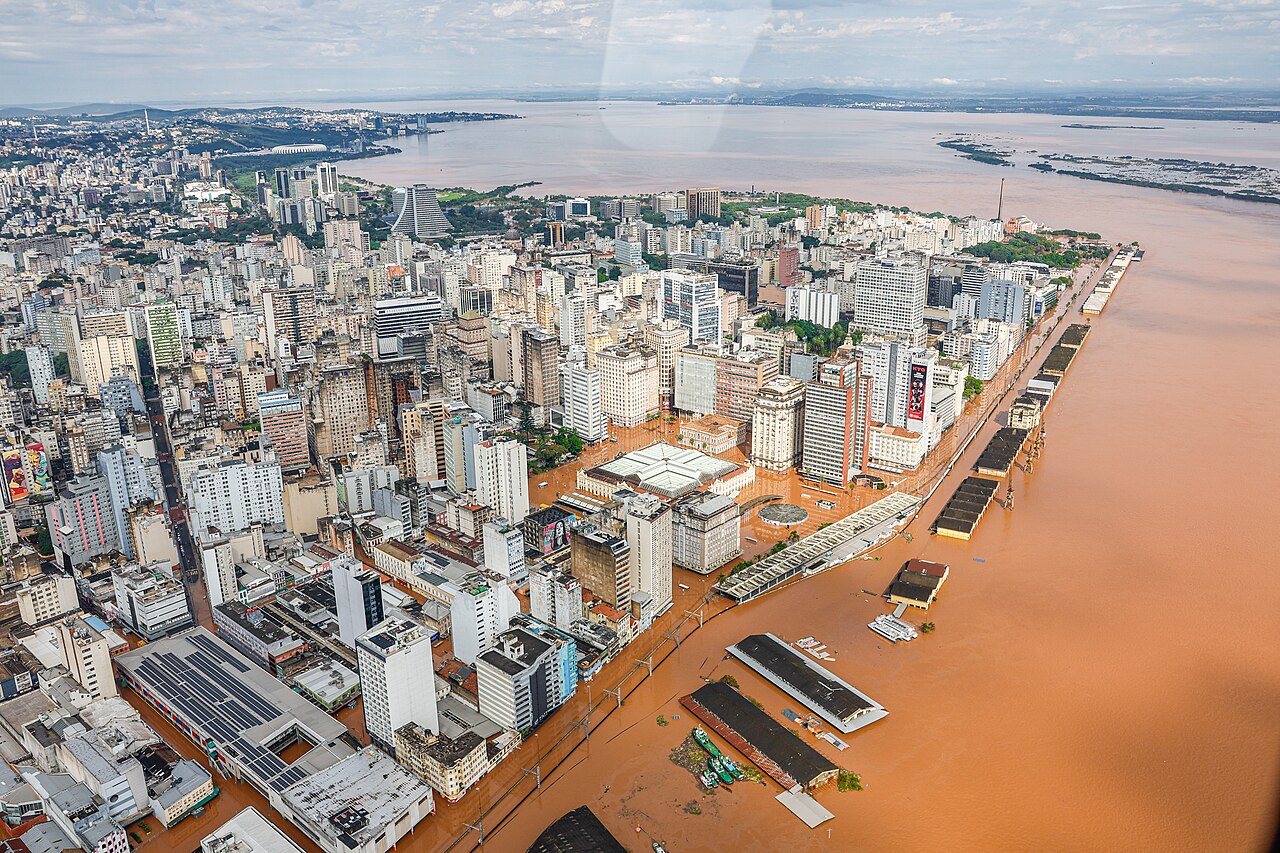
The research was based on a sample of 60,000 disaster records between 1991 and 2024; altogether, these events accounted for 4,774 deaths, 3,031 missing people, and economic losses of over USD 123.89 billion (helicopter flyover of the areas affected by the rains in Canoas, Rio Grande do Sul state, in May 2024; credit: Ricardo Stuckert/PR/Wikimedia Commons)
By Luciana Constantino | Agência FAPESP – Extreme weather events are becoming increasingly frequent and severe. The El Niño predicted for 2026–2027 is one such event. These events have caused environmental, economic, and social impacts in Brazil, requiring specific public policies. To transform scientific data into a foundation for developing prevention, adaptation, and mitigation measures, a group of Brazilian researchers analyzed approximately 60,000 records of hydrogeological disasters in Brazil between 1991 and 2024.
They found that 91.5% of the 5,570 municipalities reported at least one disaster related to flooding, waterlogging, flash floods, landslides, storms, or drought during this period. Specifically, 1,814 cities experienced at least one incident caused by three of these factors, while another 270 cities experienced all of them. The Northeast had the most affected cities (1,765), followed by the Southeast (1,405), the South (1,152), the North (433), and the Midwest (342).
The researchers mapped various impacts, including deaths and economic losses. The Southeast had the highest number of flood-, waterlogging-, flash flood-, and landslide-related deaths, the South had the highest number of storm-related deaths, and the Northeast had the highest number of drought-related deaths. Flooding occurs when a river overflows its banks. Waterlogging occurs when the drainage system cannot handle the volume of water. Flash flooding is a type of flooding that occurs when a large amount of rain falls in a short period of time.
When analyzing damage by region, including direct property damage and indirect consequences affecting the economy and local resilience, floods, waterlogging, and flash floods had the greatest impact in the South. Landslides and droughts affected the Northeast the most, and storms affected the Southeast the most.
Examples include São Sebastião, a city on the northern coast of São Paulo state that was partially cut off during Carnival 2023 due to record-breaking rainfall, which caused at least 60 deaths and infrastructure damage, and the worst climate-related tragedy in Rio Grande do Sul. In May 2024, storms affected 2.3 million residents across 471 municipalities in the state, causing more than 180 deaths.
The study, conducted by scientists from the National Center for Monitoring and Early Warning of Natural Disaster (CEMADEN), the University of São Paulo (USP), and the National Institute for Space Research (INPE), was published in the April issue of Environmental Research Letters, a journal that seeks to draw the attention of policymakers and the scientific community to socio-environmental issues.
“We wanted to dispel the myth that a disaster is something supernatural, that its causes stem from disproportionate forces. There are exceptions that climate models can’t predict, but for most events, national agencies such as CEMADEN issue alerts, and public authorities are informed of what may happen. The problem is negligence, a lack of infrastructure, and even a failure to act. We decided to call them socio-natural or socio-environmental disasters because there’s an anthropogenic aggravating factor – not only related to climate change but also to failures in public management,” says Elton Vicente Escobar Silva, the first author of the study and a CEMADEN researcher conducting this research as part of his postdoctoral work.
Silva points out that Brazil has made progress in recent years in developing databases and providing information to help understand disasters. However, the country still faces challenges in data collection and institutional structures for monitoring.
Challenges
According to the findings, the 59,658 natural disasters analyzed resulted in at least 4,774 deaths and 3,031 missing persons and affected more than 129.79 million people. Economic losses are estimated to have exceeded USD 123.89 billion.
However, the researchers caution that these figures tend to be higher than those in the databases. This is because the results were derived from data from the Integrated Disaster Information System (S2iD) and the Digital Atlas of Disasters in Brazil. Both platforms are publicly accessible and managed by the National Department for Civil Protection and Defense (SEDEC).
These records are self-reported by municipalities and serve, among other purposes, to seek federal government funding when local and state administrations lack the capacity to handle and respond to adverse events affecting the municipality. In other words, many cases may have resulted in unreported losses or fatalities because local administrations were able to manage the situation themselves or due to a lack of reporting infrastructure.
A survey by the National Confederation of Municipalities (CNM) estimates that approximately 1,660 cities in Brazil lack an organized civil defense agency. Furthermore, a study published last year showed that civil defense agencies need to invest in professionalization and their own resources to address climate risks (read more at agencia.fapesp.br/54705).
In an interview with Agência FAPESP, Silva points out that the data collection approach used by these platforms does not consider events simultaneously, nor does it take a “multi-risk” perspective. For example, if a landslide was caused by flooding, only the flooding would be reported. Another issue is the inaccuracy in recording the causes of deaths during disasters.
The S2iD platform has data available only starting in 2013, with its database expanding over the years. The percentage of cities reporting disasters increased from 29% in 2013 to 88% in 2024. This creates gaps in the relationship between the increase in natural disaster records and climatic factors.
Regarding monetary estimates of economic losses, the systems contained information through 2024 when the study was completed (with data from the previous year adjusted for inflation).
Through its communications office, SEDEC informed Agência FAPESP that it is developing a new version of S2iD, scheduled for release this year, as well as a new Digital Disaster Atlas. These will enable the recording of events using a multi-risk approach and continuous information updates following federal recognition.
“To overcome historical limitations, such as a lack of detail on human casualties and underreporting at the municipal level, the new platform will enable the disaggregation of data by gender and age group. Meanwhile, SEDEC will strengthen the system’s reach through technical training and distance learning for local managers. This restructuring aims to reduce disparities between state and municipal civil defense agencies, consolidating S2iD as a tool for planning and formulating public policies,” stated the department. One of its members, Lucas Mikosz, was listed as an author of the article.
Prevention
According to Victor Marchezini, a sociologist, CEMADEN researcher, and author of the article, it is necessary to invest in mechanisms aimed at reducing losses rather than merely recovering from them.
“This study provides a longitudinal analysis of the impacts of disasters in Brazil, which is important for demonstrating that they stem from a chronic crisis, not a one-off event. We need to stop treating economic losses as a given. How long will we continue to invest solely in disaster response and reconstruction without considering mechanisms to reduce losses?” asks Marchezini, who coordinates the Organizational Capacities for Preparedness for Extreme Events (COPE) project, funded by FAPESP.
The foundation supported the research through scholarships awarded to Silva (21/11435-4 and 24/02748-7, as well as the Center for Research, Innovation, and Dissemination in Neuromathematics (NeuroMat) and two other projects (20/09215-3 and 23/13453-5).
“Our goal is to ensure that science contributes to the development of public policies. It’s an effort to ensure the results reach society,” Silva concludes. For his doctoral research, Silva combined models that predict urban expansion, land use changes, and hydrodynamics. This combination created a methodology that can provide geographic information identifying locations in cities at a higher risk of flooding, including those caused by extreme rainfall (read more at agencia.fapesp.br/41618).
The article “Water-related disasters in Brazil: an assessment from 1991 to 2024” can be read at iopscience.iop.org/article/10.1088/1748-9326/ae5991.
The Agency FAPESP licenses news via Creative Commons (CC-BY-NC-ND) so that they can be republished free of charge and in a simple way by other digital or printed vehicles. Agência FAPESP must be credited as the source of the content being republished and the name of the reporter (if any) must be attributed. Using the HMTL button below allows compliance with these rules, detailed in Digital Republishing Policy FAPESP.
