




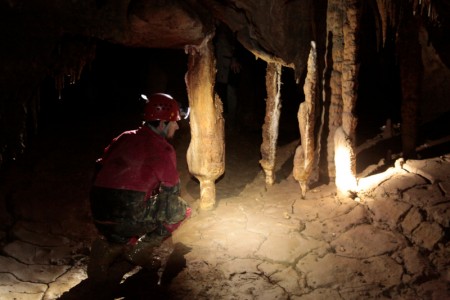
The scientists analyzed stalagmites from the Malfazido Cave in the Doutor Ulysses municipality of the Curitiba metropolitan area (photo: Julio Cauhy)
Researchers analyzed samples of sediment preserved in stalagmites to reconstruct the region’s climatic history. The 20th century saw one of the highest frequencies of extreme events in the last 7,500 years.
Researchers analyzed samples of sediment preserved in stalagmites to reconstruct the region’s climatic history. The 20th century saw one of the highest frequencies of extreme events in the last 7,500 years.
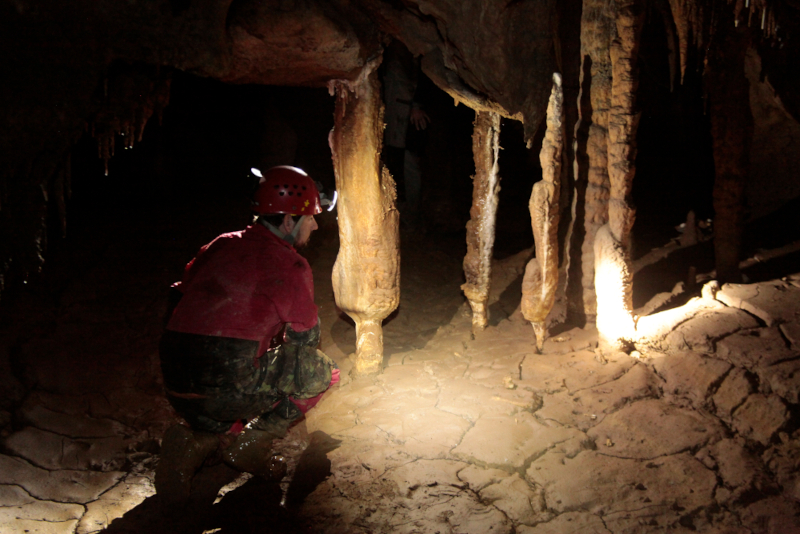
The scientists analyzed stalagmites from the Malfazido Cave in the Doutor Ulysses municipality of the Curitiba metropolitan area (photo: Julio Cauhy)
By Luciana Constantino | Agência FAPESP – A cave in the interior of the state of Paraná in Brazil contains a “climate archive” that enabled Brazilian researchers to reconstruct the history of extreme rainfall in the South region of Brazil over the past 7,500 years. Their findings revealed that the frequency of these events in the 20th century was among the highest in the historical record. They also identified two factors that influence this process: climate variability in Antarctica and El Niño events, both of which are present today.
The scientists discovered that summer periods with lower temperatures in West Antarctica tend to coincide with more extreme events in the South of Brazil. They hypothesize that changes in the temperature gradient between high and mid-latitudes (i.e., between the colder polar regions and the warmer temperate and subtropical zones) alter atmospheric circulation, favoring the formation of cold fronts and the transport of moisture from the Amazon to the region.
Over the past thousand years, a significant relationship has also been observed between the frequency of extreme rainfall and moderate or strong El Niño events. El Niño is characterized by the abnormal and persistent warming of the waters of the equatorial Pacific Ocean, which alters wind circulation and the distribution of heat and moisture across the planet.
These findings are especially relevant this year, as the World Meteorological Organization (WMO), which is affiliated with the United Nations, predicts a moderate-to-strong El Niño in the coming months. The impacts will be felt in Brazil. The National Center for Monitoring and Early Warning of Natural Disasters (CEMADEN) released a technical note warning of possible heavy rains and hydrogeological disasters in south-central Brazil. Meanwhile, drought is a concern in the rest of the country.
Natural archive
Driven by the need to comprehend events like the floods that ravaged over 470 municipalities in Rio Grande do Sul state in May 2024 (an El Niño year), the scientists examined speleothems (stalagmites) from Malfazido Cave in Doutor Ulysses, a municipality in the Curitiba metropolitan area of Paraná state. Since 2019, they have constantly monitored flooding at the site.
During these floods, fine sediments are deposited on the stalagmites, which are rock formations of mineral origin that grow from the floor. These sediments are preserved in microscopic layers within the growing carbonate. One of Malfazido’s unique features is the rapid growth of its speleothems, which contributes to this type of study.
The stalagmites were dated using isotopic methods, which analyze the ratio of certain chemical elements that function as a “natural clock” to calculate the age of the samples. This resulted in the identification of 921 flood layers. This method was validated by comparing some of these layers with records from 2023, when the Turvo River flooded. The cave’s waters flow into the Turvo River, so the correspondence between the geological findings and current conditions was revealed.
Thus, these layers served as a kind of “natural archive,” enabling the researchers to estimate the frequency of extreme events over millennia. These findings were published in April in the journal Communications Earth & Environment.
“Until now, all of our knowledge was limited to instrumental records, which generally cover the last hundred years at most in Brazil. There were some lake sediment records, for example, which have chronological issues. Others use tree rings, which are very discontinuous. Speleothems can grow continuously and rapidly, as in the case of the Malfazido Cave, producing a high-resolution record. In other words, it’s possible to determine the interannual or even annual frequency of these events. As a result, we were able to produce the first record of extreme events for the distant past,” summarized geologist Julio Cauhy, the lead author of the article, in an interview with Agência FAPESP. He conducted part of the research at the Max Planck Institute for Chemistry and at Johannes Gutenberg University Mainz, both in Germany.
When he began his studies more than seven years ago, Cauhy was pursuing a master’s degree at the University of São Paulo (USP). He collaborated with professors Nicolás Misailidis Strikis and Francisco William da Cruz Júnior of the Institute of Geosciences (IGc-USP). The latter served as the principal investigator for the Thematic Project, “PIRE: Climate Research and Education in the Americas Using Examples of Tree Rings and Speleothems,” which was funded by FAPESP.
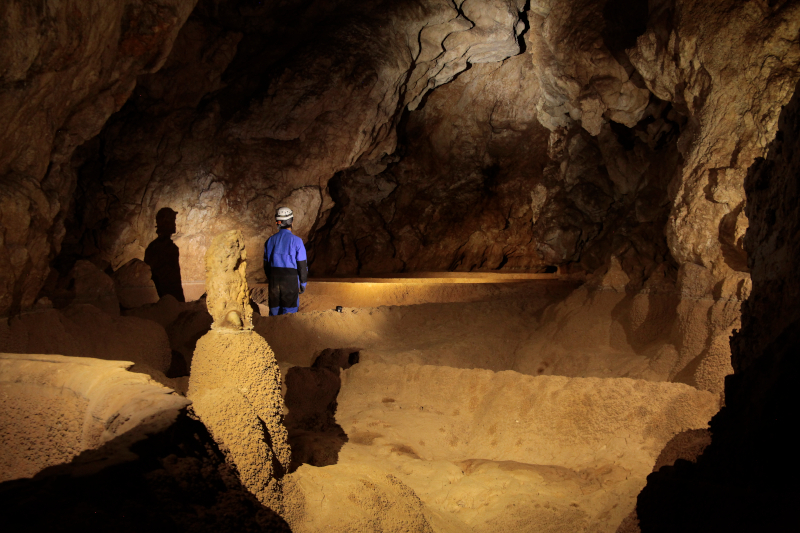
The sequence of limestone dams inside the cave is known as “travertine dams” (photo: Julio Cauhy)
From ‘mud’ to history
The research was only possible because of the unique conditions of the cave. Malfazido is divided into two galleries, upper and lower, and is characterized by a main passage (a sort of “tube”) fed by an underground river that forms a canyon.
The upper gallery consists of a narrow passageway with defined flood zones and numerous candle-shaped stalagmites. The second gallery features a series of large calcite dams that interrupt the flow of the underground river, creating a system of “siphons” that trap water and sediments during floods. This natural damming in both galleries is crucial for the deposition of fine sediments on the speleothems during prolonged flood periods.
Flooding begins in the deepest part of the cave and gradually moves toward the entrance, successively filling a series of limestone dams known as “travertine dams.”
In the Malfazido Cave, these formations, which can reach up to two meters in height, transform the passage into a series of natural pools. These pools fill with water and mud during flood events. Depending on the amount of rainfall, the water can reach the entrance of the cave. At this point, many stalagmites become submerged with a thin layer of mud on top that records the flood event.
“This makes it ideal. We’ve explored hundreds of caves across Brazil and have never seen a passage with this configuration, which allows for a unique approach. It isn’t the kind of thing you get to do every day. The work of Julio [Cauhy] has become a benchmark,” says Strikis.
Increased frequency
The researchers found that, between 3,000 and 2,000 years ago, there was a period during which extreme rainfall events were rare. In contrast, the highest frequency of such events occurred between 7,500 and 4,000 years ago, as well as during the last millennium – particularly in the 20th century.
“This study places extreme events in historical perspective. Once we begin to observe that they’re becoming more frequent and take into account the rise in atmospheric temperature, we can paint a clearer picture,” Strikis adds.
The study suggests that global warming caused by human activities may be contributing to the recent intensification of these events. Therefore, it emphasizes the need for strategies to mitigate and adapt to climate change, especially in the most exposed and vulnerable communities and regions.
The article “A Holocene history of extreme rainfall events in Southern Brazil” can be read at nature.com/articles/s43247-026-03506-y.
The Agency FAPESP licenses news via Creative Commons (CC-BY-NC-ND) so that they can be republished free of charge and in a simple way by other digital or printed vehicles. Agência FAPESP must be credited as the source of the content being republished and the name of the reporter (if any) must be attributed. Using the HMTL button below allows compliance with these rules, detailed in Digital Republishing Policy FAPESP.
