




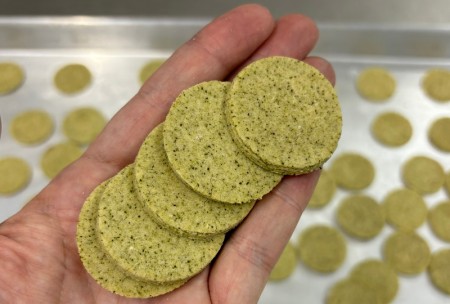
Even with an addition of just 1%, the seaweed significantly increased the phenolic compound content and antioxidant activity of the cookies (photo: Bruna Lago Tagliapietra)
Ingredient derived from Sargassum filipendula shows high potential as functional component even in small quantities.
Ingredient derived from Sargassum filipendula shows high potential as functional component even in small quantities.
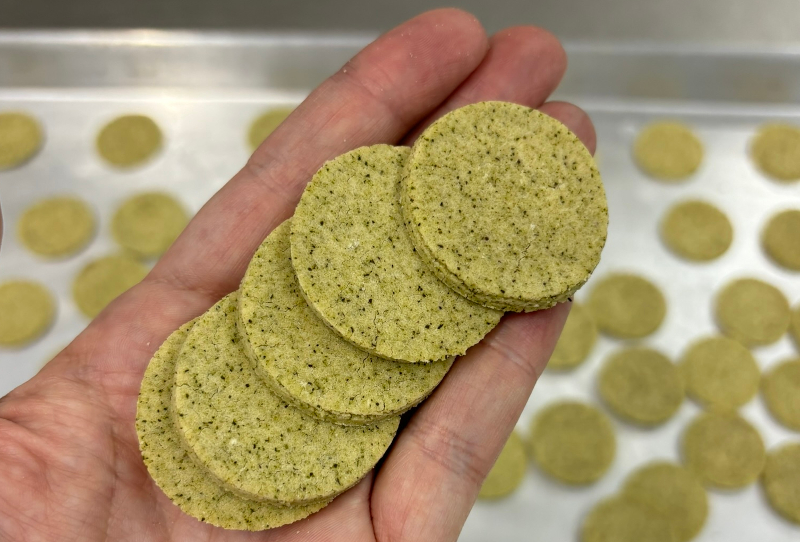
Even with an addition of just 1%, the seaweed significantly increased the phenolic compound content and antioxidant activity of the cookies (photo: Bruna Lago Tagliapietra)
By Thais Szegö | Agência FAPESP – Flour made from the brown seaweed Sargassum filipendula can increase the nutritional value and digestibility of gluten-free cookies. This conclusion is based on a study published in March in the journal Food Research International.
Bruna Lago Tagliapietra conducted the study at the State University of Campinas (UNICAMP) in the state of São Paulo, Brazil, as part of her postdoctoral research funded by FAPESP. Maria Teresa Pedrosa Silva Clerici, a professor at the Faculty of Food Engineering (FEA-UNICAMP), supervised the work, which involved collaboration with Cristina Martinez-Villaluenga of the Institute of Food Science and Technology and Nutrition (ICTAN-CSIC) in Madrid (Spain).
Seaweed was chosen as a promising alternative food source due to its high nutritional value, sustainability, and lack of competition with agricultural land or dependence on freshwater resources. Brazil has great potential for seaweed cultivation due to its extensive coastline of over 8,600 kilometers and favorable maritime conditions. Approximately 18% of the population lives in coastal regions, reinforcing the social and economic potential of the production chain. Sargassum filipendula is of particular interest because it is widely found along the rocky coast of São Paulo.
Small quantity, big difference
The first step of the research involved collecting samples from Praia das Cigarras, located at the northern end of the São Sebastião Channel on the São Paulo coast. The samples were transported to the UNICAMP laboratory, where they were cleaned. Then, they were dried in an oven and/or freeze-dried until the moisture content was less than 6%.
The dried seaweed was then ground into flour, an ingredient used in gluten-free cookie production. Two versions were prepared: one with 100% rice flour and another with 99% rice flour and 1% seaweed flour, while keeping the other ingredients constant.
The composition and technological properties of the seaweed and produced cookies were evaluated. Finally, during the research period in Spain, simulated in vitro gastrointestinal digestion was performed. In this phase, the digestibility and bioavailability of the compounds were analyzed, as well as the phenolic compound profile, antioxidant activity, and changes in nutrients throughout the digestive process.
“Our study showed that including Sargassum filipendula significantly increased the phenolic compound content and antioxidant activity of the cookies, even with an addition of only 1%. This demonstrates that small amounts are enough to improve the functional value of food, indicating its potential use as an ingredient in the food industry, particularly in products aimed at enhancing nutritional value and functionality,” states Tagliapietra, a professor in the Department of Food and Nutrition at the Federal University of Santa Maria (UFSM) in Rio Grande do Sul state.
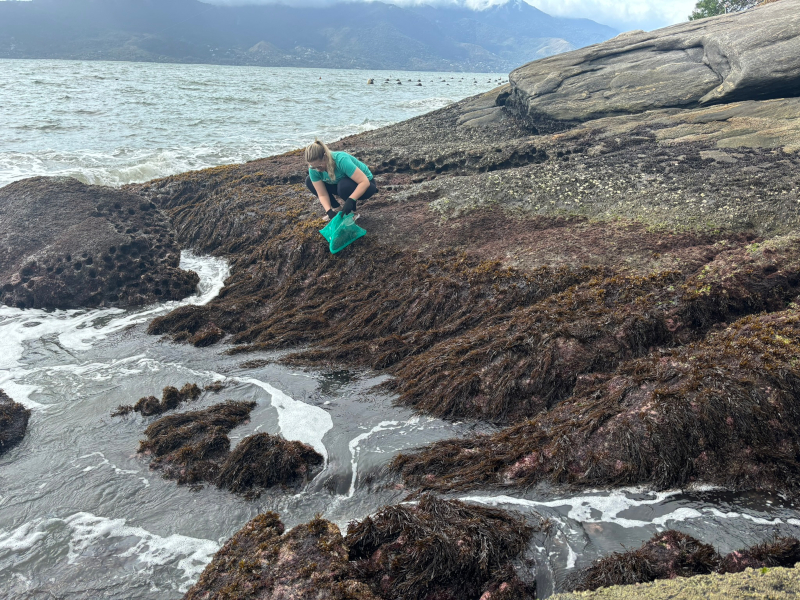
The first step in the research was collecting samples at Praia das Cigarras, located at the northern end of the São Sebastião Channel on the São Paulo coast (photo: Bruna Lago Tagliapietra)
She also points out that the compounds proved to be heat-stable, which is extremely relevant for applications in processed products. There was also an increase in protein content and essential amino acid content, as well as an increase in dietary fiber content.
Addressing these issues is particularly important in developing gluten-free foods, which are vital for people with celiac disease or gluten sensitivity, yet often lack nutritional density.
Seaweed flour helps maintain the structural and technological integrity of products, improving moisture retention and yielding a softer texture.
The results indicate great potential for industrial application, particularly as a functional ingredient in products such as cookies, snacks, and gluten-free foods. However, further development is needed before large-scale application. This includes standardizing the raw material, conducting sensory evaluations with consumers, ensuring compliance with regulations, such as those required by the Brazilian Health Regulatory Agency (ANVISA), and conducting more in-depth studies on safety and mineral composition. “We’re in a transitional phase between research and practical application, but the results are very promising,” says Tagliapietra.
The article “Sargassum filipendula flour improves composition, digestibility, and antioxidant activity of gluten-free biscuits” can be read at sciencedirect.com/science/article/pii/S0963996926005831.
The Agency FAPESP licenses news via Creative Commons (CC-BY-NC-ND) so that they can be republished free of charge and in a simple way by other digital or printed vehicles. Agência FAPESP must be credited as the source of the content being republished and the name of the reporter (if any) must be attributed. Using the HMTL button below allows compliance with these rules, detailed in Digital Republishing Policy FAPESP.
