




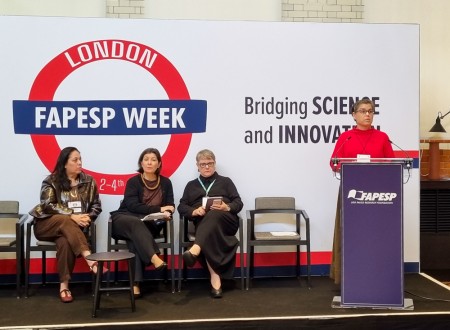
Erika Hingst-Zaher, director of the Butantan Institute’s Biological Museum, emphasized that the project gained strategic importance when it was recognized that dengue is no longer exclusive to tropical regions (photo: Elton Alisson/Agência FAPESP)
Announced at FAPESP Week London, the initiative will address the diseases’ global expansion from social, climatic and geopolitical perspectives.
Announced at FAPESP Week London, the initiative will address the diseases’ global expansion from social, climatic and geopolitical perspectives.
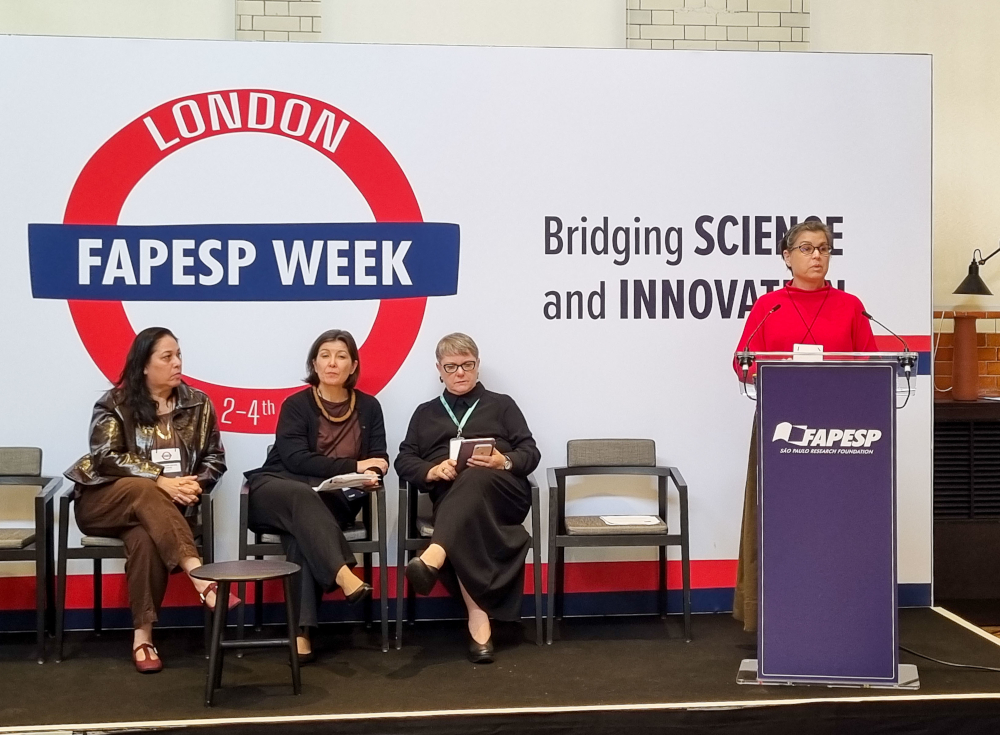
Erika Hingst-Zaher, director of the Butantan Institute’s Biological Museum, emphasized that the project gained strategic importance when it was recognized that dengue is no longer exclusive to tropical regions (photo: Elton Alisson/Agência FAPESP)
By Elton Alisson, from London | Agência FAPESP – The Butantan Institute's scientific work is about to cross the Atlantic and gain global visibility in one of the world's most prestigious museums. During FAPESP Week London, held June 2–4, representatives from the São Paulo state institution in Brazil and the Science Museum in London announced the start of discussions to develop a joint exhibition on dengue.
“The idea is to create a joint exhibition or, at the very least, feature content on dengue produced by the Butantan here at the museum. We’re already considering some galleries and are committed to incorporating it into our programming as soon as possible,” Giovana Zocoli, the Science Museum's global engagement manager and the person responsible for the institution’s collaborations with Latin America, revealed to Agência FAPESP. The exhibition is forecast for 2027 or 2028.
The project gained strategic importance when it was recognized that dengue is no longer exclusive to tropical regions. This idea was emphasized by Erika Hingst Zaher, director of the Butantan Institute’s Biological Museum, in her presentation at FAPESP Week London.
“Climate change is spreading the disease northward, and the design of a shared exhibition allows audiences in London and São Paulo to engage with this debate simultaneously.” Zaher stated that the goal of the exhibition, which is scheduled for 2027 or 2028, is to serve as a “tool for action,” addressing the disease from social, climatic, and geopolitical perspectives.
“Heritage institutions aren’t just spaces for preservation; they can also be tools for action,” she noted.
New exhibition models
Zaher emphasized that the announcement of the partnership comes at a time of profound transformation at the Butantan Institute. Two of the institution’s six museums are undergoing renovations. The Biological Museum will restructure its technical infrastructure and exhibition spaces this year. The new design will feature immersive environments based on a project sketch by architect Lina Bo Bardi from the 1960s.
The new exhibition design will allow visitors to explore the spaces in various ways without guided mediation. The animals on display will be presented within their cultural and ecological context rather than as isolated specimens.
“We’re moving away from the zoo perspective and moving more toward that of a museum,” Zaher stated.
At the same time, the Museum of Public Health is expanding its original building, the former São Paulo Central Disinfection Station. The new space will house an exhibition on the history of public health in the state of São Paulo, complementing the museum’s existing collection.
In April of this year, the Butantan opened an exhibition on the Caatinga, a semi-arid biome in the Northeast of Brazil. Along with the exhibition on dengue, it is emblematic of the changes taking place in the institution’s public engagement program.
“What we’re doing at the Butantan Cultural Development Center is an attempt to demonstrate, in practice, how a heritage institution can evolve to address emerging challenges at the intersection of science, health, and society in a climate change scenario, combining the rigor of a research center with the openness of a public space,” she said.
Not just fun
The Science Museum’s director of global engagement, Helen Jones, argued in her presentation that the pursuit of entertainment should not be the sole mission of science museums and that they should not shy away from serious topics, such as dengue fever, in an attempt to attract larger audiences.
“Entertainment is something that science centers and museums do very well. We’re social spaces where people want to spend their free time, and we want them to come. But that’s not all we do,” she said.
“My heart sinks a little when I repeatedly hear that science must be made fun to be interesting to non-scientists. People are willing to tackle difficult topics through literature, film, and the performing and visual arts. Assuming that the public can’t handle difficult science topics is unfair to them. People come to museums for an enriching experience, and having fun is only part of that,” Jones said.
Some of the British Science Museum’s recent exhibitions on more arid topics included one on cancer in partnership with Cancer Research UK and another on the pandemic titled “Injecting Hope: The Race for the Vaccine.”
“None of us will look back fondly on the pandemic. But museums are repositories of memory, and the pandemic was a significant moment in our history. That’s why our curators started a project early on to collect material evidence of the health crisis, from laboratory equipment to children’s drawings,” she said.
Recently, the London Science Museum hosted an exhibition that showcased the beauty and biodiversity of Brazil’s Pantanal while highlighting the devastating effects of increasingly frequent and widespread fires caused by climate change. During the planning of the exhibition, one of the issues debated was whether to include disturbing images, such as those of animals incinerated by fire, given that the museum has a large family audience.
“One of the discussions was whether we should impose an age restriction for the exhibition. But we decided to trust our audience and simply placed a warning message at the beginning. The exhibition was very well received and exceeded its target audience,” said Jones.
Stimulating creativity
If the purpose of science museums is to provide a space for reflection, then the purpose of art museums may be to stimulate creativity, according to Oliver Cox, head of research partnerships at the Victoria and Albert Museum (V&A).
According to Cox, there has been a notable reduction in creative educational opportunities for students in universities and schools in the United Kingdom today.
“Visually interacting with art materials or collections is increasingly becoming a luxury within our state-funded school system. That’s why we’re interested in ways to fill that gap because, as an art museum, we believe that the power of creativity belongs to everyone,” he said.
One of the institution’s initiatives in this regard was the recent creation of the Young V&A, an interactive museum for children up to age 12, located in Bethnal Green in East London.
“This is the first museum in the UK dedicated to children’s creativity. And what we aim to address with it is the problem of the arts being increasingly removed from the school curriculum in favor of STEM subjects [science, technology, engineering, and mathematics],” said Cox.
As for the grown-ups, the novelty is V&A East Storehouse, located at the Here East in the Stratford’s Queen Elizabeth Olympic Park in East London. The museum, open in March 2025, has the David Bowie Center as one of its “crown jewels” – home to an archive with 90,000 items from the British artist who passed in 2016, including lyrics manuscripts, such as the one from Ziggy Startdust, and costumes worn by the singer for the album The Rise and Fall of Ziggy Stardust and the Spiders from Mars.
“It’s a radical reinvention of what a museum collection store might be. We take the visitors right to the heart of our collections instead of looking in from the outside,” said Cox.
More information about FAPESP Week London is available at fapesp.br/week/2026/london.
The Agency FAPESP licenses news via Creative Commons (CC-BY-NC-ND) so that they can be republished free of charge and in a simple way by other digital or printed vehicles. Agência FAPESP must be credited as the source of the content being republished and the name of the reporter (if any) must be attributed. Using the HMTL button below allows compliance with these rules, detailed in Digital Republishing Policy FAPESP.
