





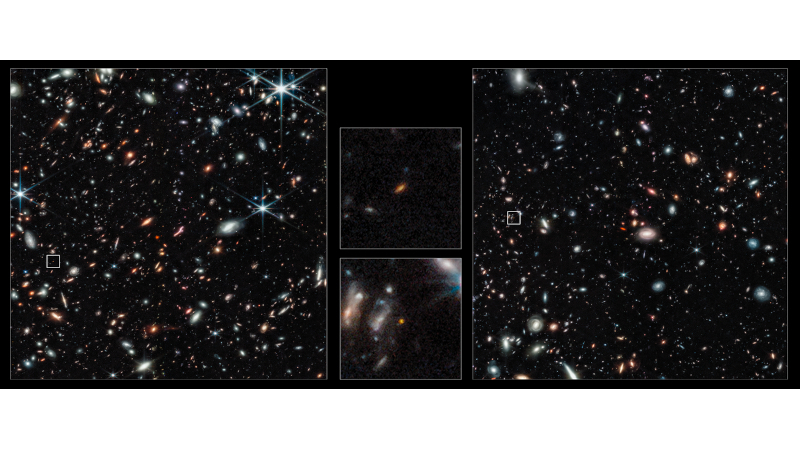
By José Tadeu Arantes | Agência FAPESP – Astronomical observations show that the most massive galaxies in the early Universe formed approximately 3 to 4 billion years after the Big Bang and stopped producing stars very early in cosmic history, around 1 billion years after their formation. This strange behavior has puzzled experts in the field. For comparison, our galaxy, the Milky Way, is as old as the Universe itself and continues to produce stars, albeit at a low rate, even 13.5 billion years after its formation.
A study conducted at the Institute of Astronomy, Geophysics, and Atmospheric Sciences at the University of São Paulo (IAG-USP) in Brazil, in collaboration with international partners and published in the journal Astronomy & Astrophysics, proposes a consistent solution to this problem.
“We focused on two seemingly distinct populations: dusty star-forming galaxies [DSFGs] and massive quiescent galaxies [MQs],” says Laerte Sodré Júnior, a retired full professor, former director of IAG-USP, and doctoral advisor to the lead author of the study, Pablo Araya-Araya.
DSFGs are extremely active, forming stars at rates of up to 500 solar masses per year. For comparison, the Milky Way forms approximately one solar mass per year. Enveloped in dense dust clouds, DSFGs are practically invisible in the optical range (the portion of the electromagnetic spectrum with wavelengths from 380 to 780 nanometers). However, they shine brightly in submillimeter (0.2 to 1 millimeter) and mid-infrared (4.9 to 28.8 microns) wavelengths. For this reason, thousands of DSFGs have been detected by the Atacama Large Millimeter/Submillimeter Array (ALMA) radio telescopes, which operate in the millimeter-submillimeter range. Some of their spatial structures and stellar compositions have been characterized by the James Webb Space Telescope, which operates in the infrared.
MQs pose a significant challenge to galaxy formation models, Sodré explains. “They formed and stopped producing stars rapidly within the first few billion years of the history of the Universe,” he says.
To investigate the connection between the two populations, the researchers used a semi-analytical model of galaxy formation and tracked their evolutionary trajectories at redshifts of 2 to 4 – that is, when the universe was about 3 to 4 billion years old. Redshifts are shifts in electromagnetic radiation toward longer wavelengths resulting from the expansion of the Universe.
The results show that 86% to 96% of MQs previously went through a phase as DSFGs. In other words, virtually all of these inert galaxies had an extremely active past. However, not all DSFGs follow this path.
The study proposes that each progenitor galaxy of an MQ underwent an early and violent merger with a galaxy of similar mass. This catastrophic event triggered two simultaneous processes: an extreme burst of star formation and rapid growth of a supermassive black hole in the central region. “The merger of the two galaxies concentrated large amounts of gas in the core, simultaneously triggering an extreme burst of star formation and intense feeding of the supermassive black hole,” Sodré summarizes.
“In that process, the cold gas is rapidly consumed while the energy released by the active nucleus heats the surrounding halo gas and prevents it from cooling and being reincorporated into the galaxy, blocking the supply of raw material for new stars and halting star formation in less than one billion years,” the scientist explains.
In contrast, most star- and dust-forming galaxies grow more gradually through long-term processes. Significant mergers only occur at later stages, resulting in slower gas consumption and eventual late extinction of star formation, which is observed at lower redshifts.
Recent operations of the James Webb Space Telescope have helped map DSFGs. At the same time, they revealed a greater-than-expected number of massive, quiescent galaxies in the early Universe.
The proposed model has not yet fully resolved the problem, as there are still discrepancies between predictions and observations. “We’re observing far more galaxies with submillimeter emissions than we predicted,” Sodré admits.
Nevertheless, the study provides a coherent framework for explaining the evolution of DSFGs into MQs based on galaxy mergers, bursts of star formation, and the formation of supermassive black holes. Progress in this area will depend on more refined theoretical models, more realistic numerical simulations, and new observations. Instruments such as the Giant Magellan Telescope (GMT), which is under construction at the Las Campanas Observatory in Chile’s Atacama Desert under one of the driest and most stable skies on the planet, are expected to play a crucial role in this process.
“With its 24.5-meter primary mirror, the GMT will be able to produce images three to four times more detailed than the James Webb,” Sodré emphasizes. The GMT is expected to be operational by the middle of the next decade.
The work was supported by a grant from FAPESP for the special project “Exploring the Universe, from Galaxy Formation to Earth-Like Planets with the GMT” and a doctoral scholarship for Marcelo Vicentin, who also participated in the study.
The article “The connection between dusty star-forming galaxies and the first massive quenched galaxies” can be read at aanda.org/articles/aa/full_html/2026/03/aa57426-25/aa57426-25.html.
Republish
The Agency FAPESP licenses news via Creative Commons (CC-BY-NC-ND) so that they can be republished free of charge and in a simple way by other digital or printed vehicles. Agência FAPESP must be credited as the source of the content being republished and the name of the reporter (if any) must be attributed. Using the HMTL button below allows compliance with these rules, detailed in Digital Republishing Policy FAPESP.
