





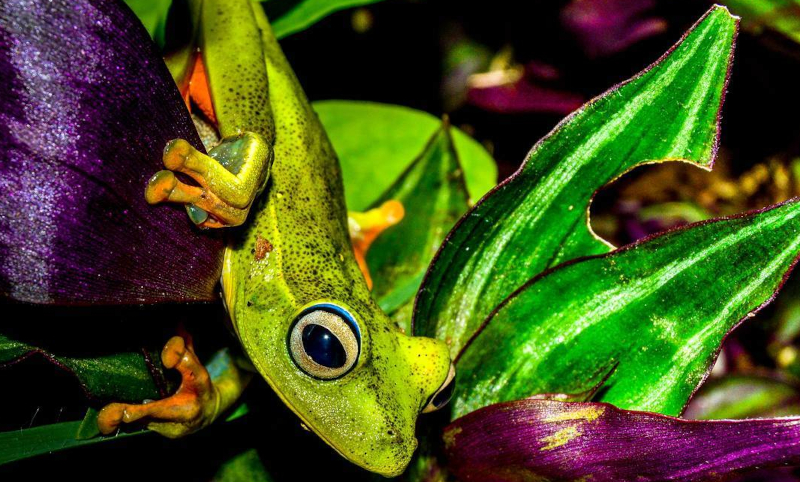
By André Julião | Agência FAPESP – A Brazilian study published in the journal Ecography indicates that the biodiversity of anuran amphibians (toads and frogs) on islands is determined by factors encompassed in two previously opposing theories.
“Biodiversity models that consider island size, distance from the mainland, and productivity [of organic matter per area] have been confirmed with relative success for plants, birds, and mammals, but they hadn’t yet been tested with anuran amphibians, which can’t tolerate salinity and therefore face an insurmountable barrier in the sea,” says Raoni Rebouças, first author of the study, which he conducted as part of his postdoctoral research at the Institute of Biology of the State University of Campinas (IB-UNICAMP) with a fellowship from FAPESP.
To verify whether the models applied to anuran amphibians, the researchers compiled data from over 5,000 marine islands worldwide. Size, distance from the mainland, and climate were among the factors taken into account. The database also included information on the ecological characteristics of 1,924 anuran amphibian species found on marine islands.
The researchers analyzed the number of species on each island, as well as other measures of diversity. These include functional or ecological niche diversity, which considers whether a species is terrestrial, aquatic, arboreal, or fossorial (meaning it lives underground), and phylogenetic diversity, which measures how many evolutionary lineages exist in the area.
“If there are 200 species on an island, but they all belong to the same family and are all aquatic, then there’s high species richness, but low phylogenetic and functional diversity,” explains Matheus Moroti, co-author of the article and a postdoctoral researcher at IB-UNICAMP funded by FAPESP.
In addition to the global analysis, which included all islands and species, the researchers analyzed the biodiversity of anuran amphibians according to climate, distinguishing between tropical and temperate regions.
“Our results show that distance from the mainland, size, and productivity are important for explaining the diversity of anuran amphibians on islands, but their relevance differs depending on the climate [tropical or temperate] and the diversity being considered – whether it’s species richness, functional diversity, or phylogenetic diversity,” says Moroti.
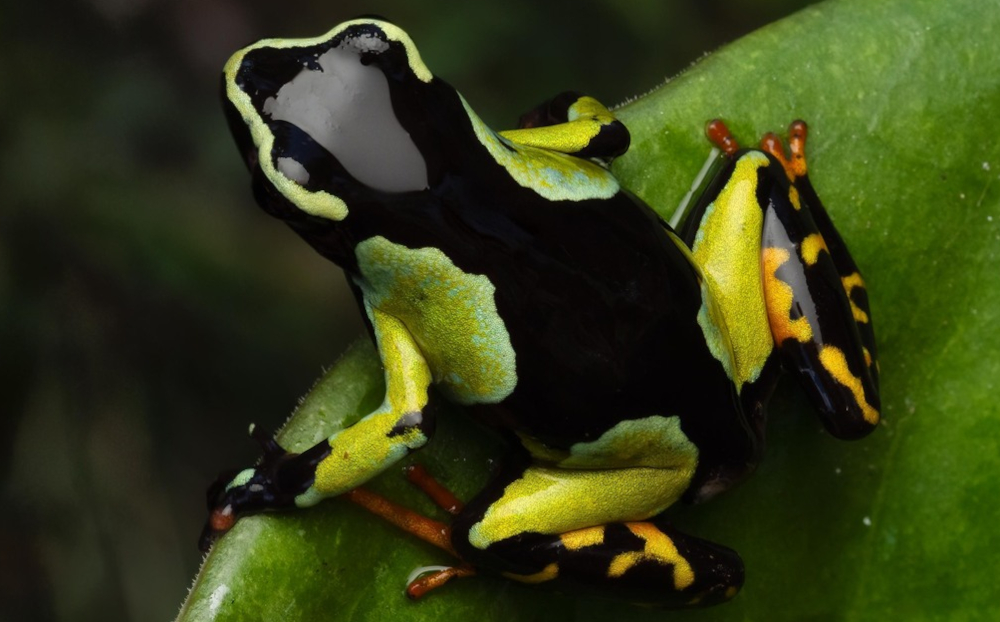
Mantella baroni is one of more than 300 species of anuran amphibians in Madagascar, a large island off the southeast coast of Africa (photo: Leslie Poulson/Creative Commons license via Raoni Rebouças)
Complementary theories
According to the theory of island biogeographic equilibrium, developed based on two papers by Robert MacArthur and Edward O. Wilson, one from 1963 and the other from 1967, the larger the island and the shorter the distance to the mainland, the greater the species richness. This is because species can easily migrate between islands, and larger islands have more space to support many individuals.
On small islands far from the mainland, migration rates would be lower and extinction rates higher, resulting in lower diversity. Subsequently, the theory was tested and confirmed for various groups.
“But for those that can’t tolerate salt, any marine island is distant. That’s why we had to test this theory with anuran amphibians,” recalls Rebouças.
Another important theory regarding island biodiversity considers a factor overlooked by MacArthur and Wilson: the amount of energy available for species to live and evolve on an island, regardless of its size.
Proposed by David Wright in 1983, the species-energy theory suggests that the availability of energy in the form of organic matter productivity per area alone determines diversity on islands.
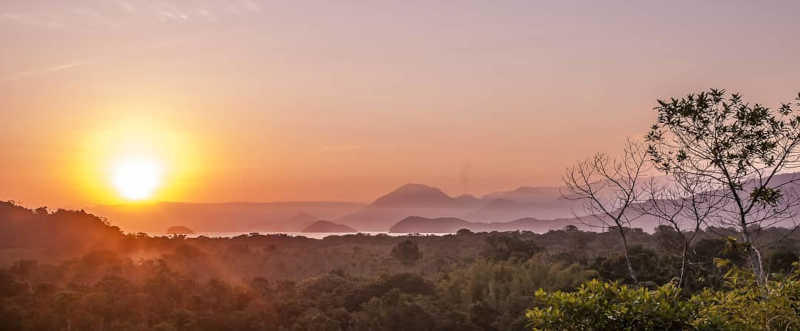
: Islands seen from Ubatuba, on the coast of the state of São Paulo. Island environments influence amphibian biodiversity differently than they do other animals and plants (photo: Raoni Rebouças/IB-UNICAMP)
Thus, islands of the same size can have different species richness depending on their productivity. The greater the energy produced, the greater the capacity to support a large number of individuals.
“A good example is the world’s largest island, Greenland. Covered in ice for much of the year, it has no frog species. Meanwhile, the second-largest, Borneo, has over 400,” Rebouças explains.
After cross-referencing the available data, the researchers concluded that neither theory alone explains the diversity of anuran amphibians on islands. Rather, both theories are complementary, each providing a better explanation depending on the type of biodiversity measured (species, functional, or phylogenetic) and the climate regime (tropical or temperate).
For example, when considering species and lineage richness, global and tropical data point to a strong correlation with island size. However, in temperate regions, this relationship is weak, as seen in Greenland.
Functional diversity, or the diversity of ecological niches such as terrestrial, aquatic, arboreal, and fossorial, is closely linked to climate when considering the entire world and temperate regions. However, the relationship is weak in tropical regions, which do not depend as much on climate for different niches.
Future studies should examine historical factors influencing diversity on islands. Additionally, a finer-grained analysis could be conducted that includes river islands and considers the extent of water bodies present on the islands.
This study received support from FAPESP through three projects (16/25358-3, 19/18335-5, and 20/12658-4). Two of these projects were part of the Research Program on Biodiversity Characterization, Conservation, and Sustainable Use (BIOTA-FAPESP).
The article “Environmental and geomorphological drivers of frog diversity on islands worldwide” can be read at nsojournals.onlinelibrary.wiley.com/doi/10.1002/ecog.07818.
Republish
The Agency FAPESP licenses news via Creative Commons (CC-BY-NC-ND) so that they can be republished free of charge and in a simple way by other digital or printed vehicles. Agência FAPESP must be credited as the source of the content being republished and the name of the reporter (if any) must be attributed. Using the HMTL button below allows compliance with these rules, detailed in Digital Republishing Policy FAPESP.
