




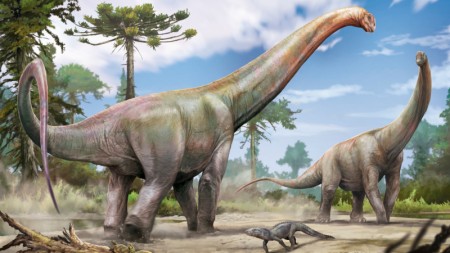
Artistic reconstruction of the new dinosaur from Maranhão state. It was 20 meters long and had a European relative (paleoart: Jorge Blanco)
Dasosaurus tocantinensis was about 20 meters long and lived approximately 120 million years ago. Its closest relative lived in present-day Spain.
Dasosaurus tocantinensis was about 20 meters long and lived approximately 120 million years ago. Its closest relative lived in present-day Spain.
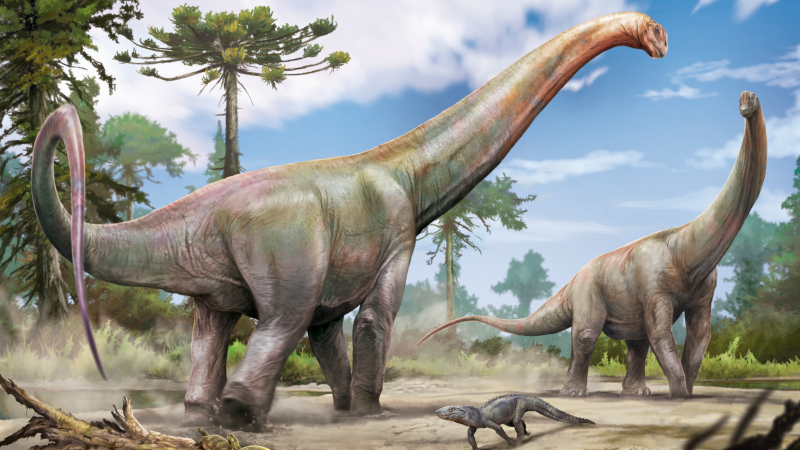
Artistic reconstruction of the new dinosaur from Maranhão state. It was 20 meters long and had a European relative (paleoart: Jorge Blanco)
By André Julião | Agência FAPESP – A study published in the Journal of Systematic Palaeontology describes a new species of dinosaur discovered during construction of a road-rail terminal in the city of Davinópolis in the state of Maranhão, in the Northeast of Brazil. The animal, named Dasosaurus tocantinensis, was approximately 20 meters long and lived about 120 million years ago.
From an evolutionary perspective, its closest known relative lived in what is now Spain. The discovery indicates not only the presence of a new group of dinosaurs in the Brazilian region, but also the ancient connection between the European archipelago of that time and present-day South America.
The researchers state that the ancestors of the Maranhão species likely dispersed to the South American continent via North Africa between 140 and 120 million years ago, when the territories were connected as part of the supercontinent Gondwana.
“It’s the largest known dinosaur for Maranhão, which has other species, but not sauropods like this one; rather, it has smaller ones, such as the diplodocid Amazonsaurus maranhensis, which was about 10 meters long,” says Elver Luiz Mayer, a professor at the Federal University of the São Francisco Valley (UNIVASF) in the state of Bahia.
A specialist in mammals from the much more recent Quaternary period, Mayer was contacted in 2021 while stationed in São Félix do Xingu in the state of Pará, where he served as a professor at the Federal University of Southern and Southeastern Pará (UNIFESSPA)
A team of archaeologists monitoring the Davinópolis construction site, as required for environmental licensing, found the fossils. Initially, they thought the fossils were from megafauna mammals that might have coexisted with ancient humans.
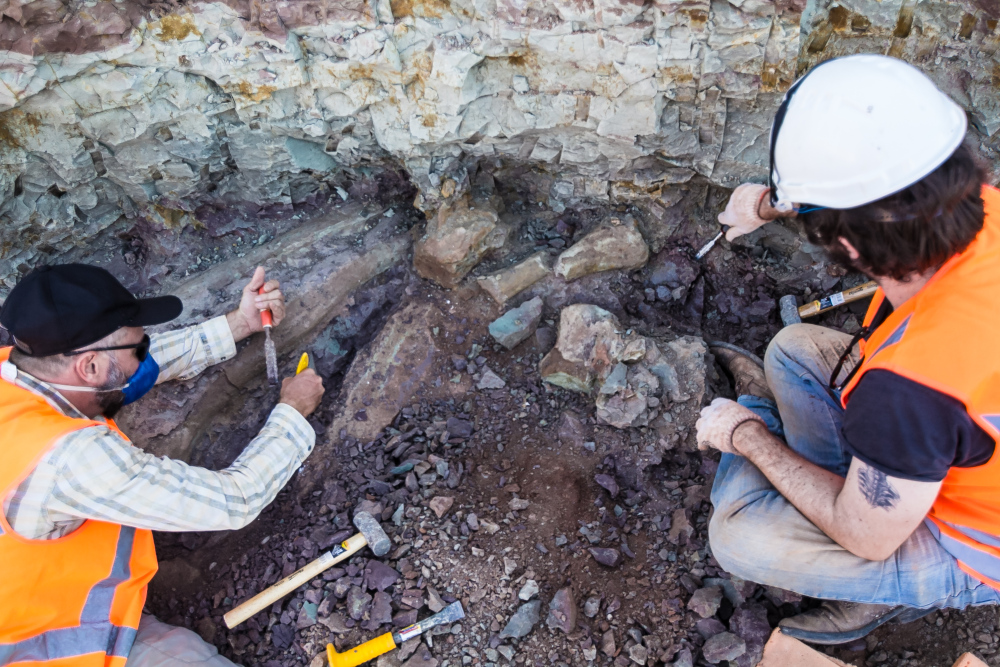
Elver Mayer and a team member excavate around the fossils (image: Amai Fotografia)
“Given its depth of about eight meters, I realized that it was much older. The age of the geological formation was already known from previous research and indicated that it was material from the transition from the Lower to the Upper Cretaceous, about 120 million years ago,” says Mayer. He then contacted various specialists and formed a multidisciplinary group to study the specimen.
After an extensive fossil preparation phase, analyses were conducted in Pará. Then, the specimen returned to Maranhão and is currently housed in the state capital of São Luís at the State Center for Natural History and Archaeology Research, which also participated in the study.
“Because it includes tail vertebrae, a 1.5-meter femur, ribs, foot bones, and arm and leg bones, this is considered a relatively complete specimen. We believe there are more fossils from this same specimen yet to be excavated at the site,” says Max Langer, a professor at the Ribeirão Preto School of Philosophy, Sciences, and Letters at the University of São Paulo (FFCLRP-USP), who participated in the study.
Langer coordinates the project “Exploring the Diversity of South American Cretaceous Dinosaurs and Their Associated Faunas”, which is supported by FAPESP.
Forest dinosaur
The name of the new species refers to the state of Maranhão. “Daso” means “forest,” referring to the woodlands of the region, which the first Portuguese colonizers said formed a large tangle, or “maranhão.” “Tocantinensis,” in turn, refers to the Tocantins River, as the site is located near its eastern bank.
Analyses of the bone microstructure led by researchers Tito Aureliano and Aline Ghilardi of the Federal University of Rio Grande do Norte (UFRN) revealed a growth pattern combining characteristics of older sauropods and titanosaurs, a group closely related to the newly discovered species.
The finding suggests that certain growth and bone remodeling patterns evolved earlier than previously thought. This helps explain how some dinosaurs reached such extreme sizes (read more at agencia.fapesp.br/41684).
The circumstances surrounding the discovery of Dasosaurus reveal a great deal about the paradox of paleontological research. While large-scale construction projects could destroy fossil records, these developments access the ground in ways that paleontologists could not achieve using only pickaxes and chisels.
“Brazil is a tropical country with dense vegetation. Geologists and paleontologists rely heavily on human activity to excavate, expose the rocks, and reveal the fossils. If we map Brazil’s fossil sites, we’ll see highways and quarries. These projects are important for understanding our heritage. But it’s obvious that specialized monitoring and artifact recovery are necessary, which doesn’t always happen,” says Langer.
“That’s why it’s urgent to foster closer cooperation between the parties to reconcile construction projects with federal legislation on fossils and promote new discoveries while ensuring the proper preservation of our heritage,” Mayer comments.
Currently, the research team is negotiating with the construction company to continue excavating in search of more fossils, which could provide new information about the species and the group as a whole.
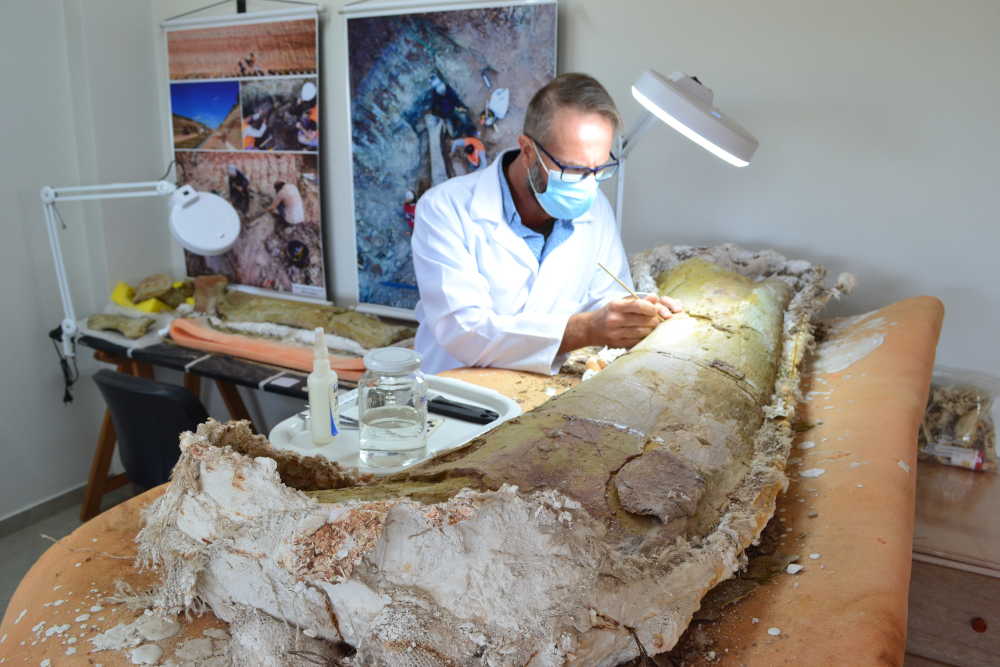
Mayer prepares a femur fossil, approximately 1.5 meters long (photo: Elver Mayer/Univasf)
The work received support from FAPESP in the form of a doctoral scholarship, postdoctoral fellowship, and a grant under the Young Investigator modality.
The article “A new titanosauriform with European affinities in the Early Cretaceous of Brazil: insights on Somphospondyli phylogeny, histology, and biogeography” can be read at tandfonline.com/doi/full/10.1080/14772019.2025.2601579.
The Agency FAPESP licenses news via Creative Commons (CC-BY-NC-ND) so that they can be republished free of charge and in a simple way by other digital or printed vehicles. Agência FAPESP must be credited as the source of the content being republished and the name of the reporter (if any) must be attributed. Using the HMTL button below allows compliance with these rules, detailed in Digital Republishing Policy FAPESP.
