




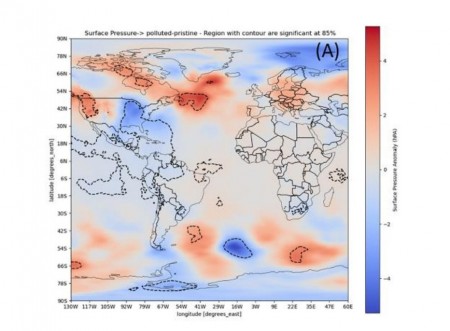
Scientists have discovered that cold waves in the U.S. and high-pressure anomalies in the South Atlantic – meteorological phenomena spanning thousands of kilometers – modify heavy rainfall along the tropical belt of the Atlantic Ocean (image: Geophysical Research Letters)
Study indicates that events such as cold air masses in the Northern Hemisphere alter the transport of aerosols across the Atlantic that nourish forest soils. It was previously believed that this influence came from changes in wind direction.
Study indicates that events such as cold air masses in the Northern Hemisphere alter the transport of aerosols across the Atlantic that nourish forest soils. It was previously believed that this influence came from changes in wind direction.
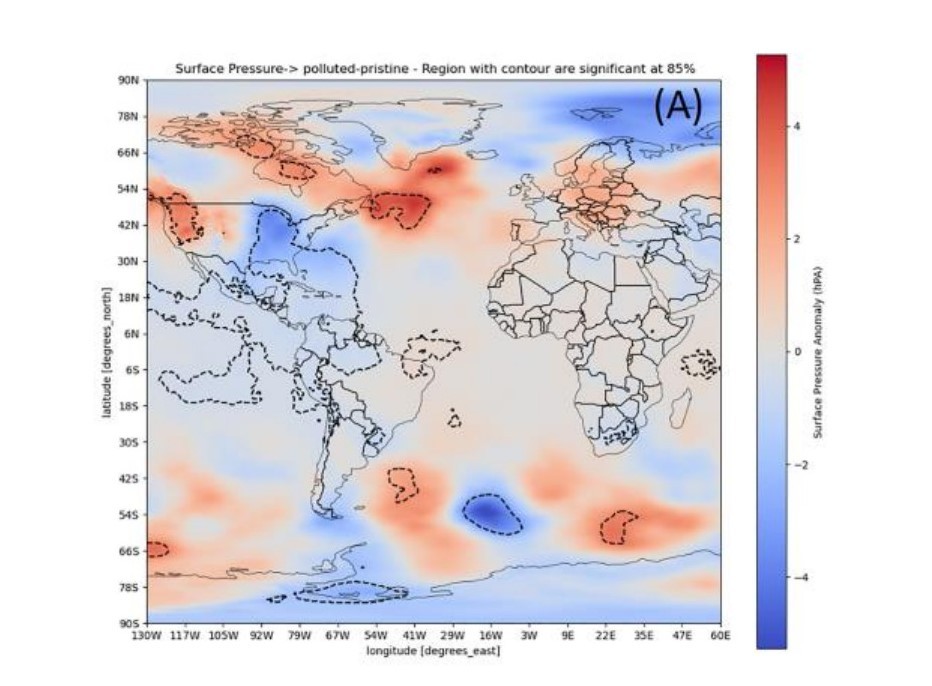
Scientists have discovered that cold waves in the U.S. and high-pressure anomalies in the South Atlantic – meteorological phenomena spanning thousands of kilometers – modify heavy rainfall along the tropical belt of the Atlantic Ocean (image: Geophysical Research Letters)
By Luciana Constantino | Agência FAPESP – How are cold air masses advancing in the United States connected to fertilizers carried by “flying rivers” from Africa that nourish the soils of the Brazilian Amazon? An article published in Geophysical Research Letters reveals an atmospheric connection between these distant regions.
Scientists discovered that synoptic systems – large-scale meteorological phenomena spanning thousands of kilometers – such as cold waves in the U.S. and high-pressure anomalies in the South Atlantic, modify heavy rainfall along the tropical belt of the Atlantic Ocean.
During the wet seasons, these changes determine whether the Amazon receives air laden with particles from Africa or air free of these aerosols. “Clean” days (with fewer particles) were preceded by peak precipitation in the ocean. Until now, the reason for these fluctuations was unclear, and it was assumed that the influence stemmed from changes in wind direction.
The continuous “transport” of dust and smoke aerosols containing minerals between Africa and South America affects the atmosphere and nutrient cycles in the Amazon. Despite its dense vegetation and biodiversity, most soil in the region is nutrient-poor due to intense leaching, the process of “washing” and removing nutrients from surface layers through rainwater or irrigation.
Phosphorus is the most limiting element, followed by calcium, potassium, and magnesium. However, the scarcity of these minerals is partly offset by the transatlantic transport of aerosols from biomass burning in Africa and mineral dust from the Sahara Desert.
“The results demonstrate that there’s an interconnection, a symbiosis of life on the planet. Climate change affects this pattern, causing a disruption whose outcome and consequences for future ecosystems are still unknown,” explains Professor Luiz Augusto Toledo Machado, from the Physics Institute at the University of São Paulo (IF-USP) and a collaborator with the Department of Chemistry at the Max Planck Institute in Germany.
Machado, the corresponding author of the research letter (a more concise, focused, peer-reviewed scientific article format designed to communicate original findings more quickly), highlights the importance of this “exchange” of nutrients, especially those originating from the Sahara Desert.
“Contrary to what one might imagine, this region is very important for the health of the planet. Its dust contains crucial minerals not only for fertilizing the Amazon, but also for sustaining aquatic life. Among them are iron and phosphorus, which are fundamental for forest productivity and life in the oceans,” he explained to Agência FAPESP.
He cites a 2022 study published in the journal Nature led by Brazilian researchers demonstrating that low levels of phosphorus in the soil can limit the growth of the Amazon rainforest even if the atmosphere is rich in carbon dioxide. Higher concentrations of CO₂ cause plants to grow faster, sequestering carbon and mitigating the impacts of climate change.
Two years later, maps developed with the help of artificial intelligence confirmed the low phosphorus levels in the region (read more at agencia.fapesp.br/51531).
Daily measurements
To investigate the factors influencing the variability of atmospheric “cleanliness” in the Amazon, the researchers used daily black carbon measurements recorded by the Amazon Tall Tower Observatory (ATTO), combined with global meteorological data.
Located in the Uatumã Sustainable Development Reserve in the Brazilian state of Amazonas, the tower stands 325 meters tall. Managed jointly by scientists from Brazil and Germany, it aims to continuously record meteorological, chemical, and biological data, such as greenhouse gas concentrations.
Black carbon is used as an indicator of long-range particle transport during the rainy season. It is soot formed by burning fuels and biomass. These microscopic particles absorb sunlight, warm the atmosphere, and can travel over long distances. According to Machado, approximately 60% of the black carbon that reaches the Amazon during the rainy season originates in Africa.
In their study, the researchers assessed the average daily concentrations of black carbon in January and February, which correspond to the start of the rainy season in the region, between 2015 and 2022. They found that concentrations varied significantly, with some days showing high levels due to African influence and others showing exceptionally clear conditions.
To characterize rainfall variability, the group identified days corresponding to maximums and minimums of average daily precipitation, which they classified as “peaks” and “troughs,” respectively. Then, maps were generated corresponding to humid (“clean”) and dry (“polluted”) conditions.
The results revealed that rainy days in the tropical region generally coincide with clean air conditions over the Amazon and are associated with cold air incursions into the United States. These events are characterized by high-pressure systems dominating the eastern United States, while an increase in atmospheric pressure was observed over the central and southern Atlantic in the Southern Hemisphere.
This synoptic configuration promotes stronger low-level wind convergence over the equatorial Atlantic, intensifying moisture transport to the Amazon and leading to increased precipitation and atmospheric cleansing.
Conversely, particles and gases are transported from Africa to South America primarily above the marine boundary layer – the lower part of the atmosphere in direct contact with the ocean – and subsequently to the Amazon basin. This process is aided by the Amazon’s low-level jet stream.
Machado explains that changes in the low-level jets over the Atlantic and the Amazon can alter particle transport and impact the resilience of the ecosystem. For this reason, the study now includes analyzing these jets to understand how they may behave in the coming decades.
The research is supported by FAPESP through a Thematic Project of the Research Program on Global Climate Change (RPGCC).
The article “Hemispheric synoptic patterns control rainfall and long-range aerosol transport in the Amazon” can be read at agupubs.onlinelibrary.wiley.com/doi/10.1029/2025GL117732.
The Agency FAPESP licenses news via Creative Commons (CC-BY-NC-ND) so that they can be republished free of charge and in a simple way by other digital or printed vehicles. Agência FAPESP must be credited as the source of the content being republished and the name of the reporter (if any) must be attributed. Using the HMTL button below allows compliance with these rules, detailed in Digital Republishing Policy FAPESP.
