





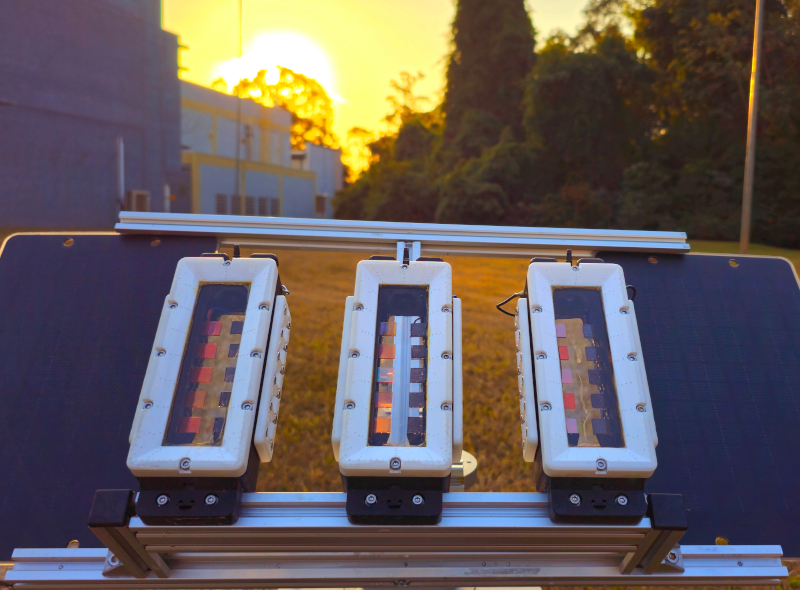
Agência FAPESP* – Researchers at the Brazilian Nanotechnology National Laboratory (LNNano) of the Brazilian Center for Research in Energy and Materials (CNPEM) have developed a system capable of producing hydrogen without emitting carbon using only sunlight, water, and materials widely available in Brazil. The prototype, called a photoelectrolyzer, has been successfully tested in the laboratory and outdoors by the authors of a paper published in the scientific journal ACS Energy Letters.
The photoelectrolyzers are not yet on the market, but they represent a possibility for the production of green hydrogen. Unlike conventional electrolyzers, they are self-sufficient from an energy standpoint. This means they do not need to be connected to a power source to function because they have a photoanode.
The photoanode is one of the two electrodes in a photoelectrolyzer. It absorbs sunlight and uses its energy to promote a series of electrochemical reactions that release hydrogen from water molecules. However, the large-scale production of efficient and stable photoanodes using abundant, low-cost materials has challenged the scientific community for decades.
“In this work, we present an essential advance in this direction by overcoming one of the main bottlenecks in the field: obtaining an efficient, stable, and scalable hematite photoanode,” says Flavio Leandro de Souza, a professor at the Federal University of ABC (UFABC), researcher at LNNano-CNPEM, and member of the Center for Innovation in New Energies (CINE), who led the research. The CINE is an Applied Research Center (ARC) established by FAPESP and Shell in 2018. It is based at the State University of Campinas (UNICAMP), the University of São Paulo (USP), and the Federal University of São Carlos (UFSCar), and involves eight other Brazilian institutions.
Hematite, an iron oxide abundant in nature, is considered very promising for photoelectrolysis because it does not degrade when it comes into contact with water. In their research, the scientists increased the efficiency of the material without compromising its stability by adding small amounts of aluminum and zirconium oxides, materials that are available in Brazil.
Concerned about the scalability of the process, the researchers developed a method for producing photoanodes that can be scaled up to industrial levels. Using this method, the team produced 100 photoanodes, all of which had the same properties. The authors then assembled a modular system using these electrodes: ten photoanodes form a photoelectrolyzer, and ten of these devices operating together can form a one-square-meter module.
In laboratory tests using a sunlight simulator, the system operated stably for 120 hours. Additionally, a prototype consisting of two photoelectrolyzers was tested outdoors and demonstrated the same efficiency observed in the laboratory, as well as robustness.
The research, development, and testing were carried out at the CNPEM by a group of six researchers. They collaborated with Professor Renato Gonçalves from the São Carlos Institute of Physics at the University of São Paulo (IFSC-USP) to build the large-area sunlight simulator used in the laboratory tests.
Currently, the authors are working on developing the other electrode of the photoelectrolyzer: the cathode. The goal is for this device to also use only sunlight as its energy source. “The next step, already underway, is a module operating 100% with solar radiation, with each photoreactor composed of a photoanode and photocathode,” Souza says.
According to the scientist, the system would be ideal for industries that require green hydrogen for specific processes, as it would allow the gas to be injected directly into them. The technology is modular, so the size and capacity of the photoelectrolyzer can easily be adapted to the needs of the industry.
The authors plan to further increase the scale of equipment production, but this requires significant investments in infrastructure and safety to carry out the necessary tests. “It’s a crucial step, and collaboration with interested companies is essential,” the researcher emphasizes.
The research was also funded by FAPESP through the Center for Research in Molecular Engineering for Advanced Materials (CEMol).
The article “Photoelectrode Fabrication and Modular PEC Reactor Integration for Stable Solar Hydrogen Production” can be read at pubs.acs.org/doi/10.1021/acsenergylett.5c02340.
* With information from Verónica Savignano from the CINE
Republish
The Agency FAPESP licenses news via Creative Commons (CC-BY-NC-ND) so that they can be republished free of charge and in a simple way by other digital or printed vehicles. Agência FAPESP must be credited as the source of the content being republished and the name of the reporter (if any) must be attributed. Using the HMTL button below allows compliance with these rules, detailed in Digital Republishing Policy FAPESP.
