





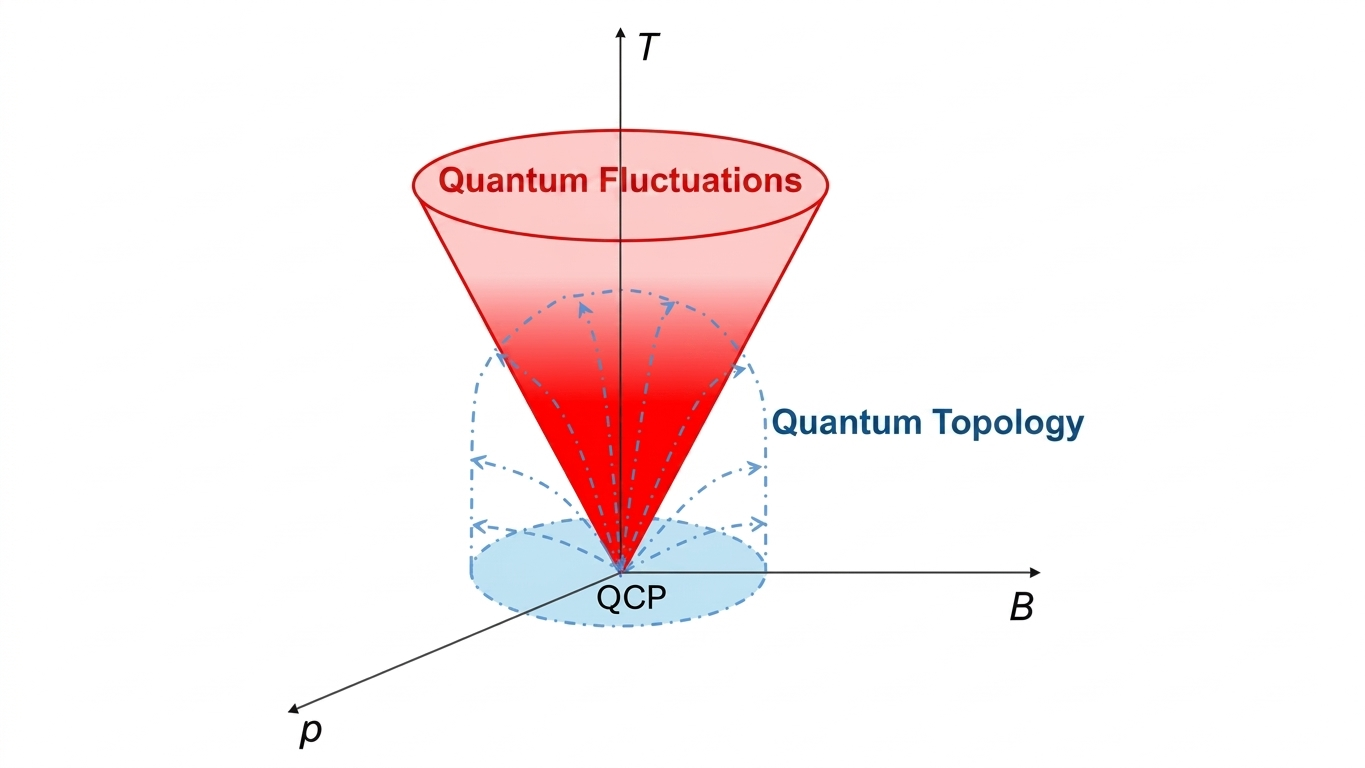
By José Tadeu Arantes | Agência FAPESP – So-called “exotic phases of matter” are currently a major focus of scientific research. There are two reasons for this. From the perspective of basic science, they represent a largely unexplored frontier of quantum physics. From the perspective of applied science, they are the foundation of emerging technologies, including robust quantum computing.
A recent study by an international team of researchers revealed that the heavy fermion compound CeRu₄Sn₆ exhibits an entirely new electronic state: a topological semimetal stabilized not in spite of, but thanks to, quantum criticality. (Brief descriptions of the main physical concepts mentioned in this article are available in the glossary at the end of the text.) An article on the subject was published in Nature Physics.
“The work expands the repertoire of exotic phases of matter and suggests that quantum critical points may act as ‘nurseries’ for strongly correlated topological states,” says Julio Larrea Jiménez, a physicist, professor at the University of São Paulo’s Physics Institute (IF-USP) in Brazil, co-founder and head of the institute’s Laboratory for Quantum Matter under Extreme Conditions (LQMEC), and one of the authors of the paper.
Topological materials are those whose electronic properties are protected by symmetries; small impurities, deformations, or fluctuations cannot easily destroy the global quantum state. Interest in this type of material is understandable, as topology can protect the quantum state against local perturbations. This could be useful for storing and handling quantum information with less decoherence, which is a major challenge for developing quantum computing.
According to Larrea, the breakthrough of the study was the experimental demonstration that sophisticated symmetries associated with nontrivial topologies, such as chirality, can produce quantum states different from those studied nearly a century ago using the Schrödinger equation. It is worth noting that, in addition to previously known states, there are others conditioned by the action of unusual symmetries on the system.
“The way electrons organize themselves in a material – the so-called ‘trivial topology’ generated by conventional symmetries – is typically described using Bloch states. In metallic materials, the interactions between electrons are usually explained using the concept of quasiparticles. But in the heavy-fermion compound CeRu₄Sn₆, in a state of genuine quantum criticality, these quasiparticles simply cease to exist. Surprisingly, however, we find the emergence of a topological semimetal in this extreme regime,” says Larrea.
To understand this phenomenon, the authors studied a theoretical model of a semimetal at the critical point where the Kondo effect is destroyed. This model shows that topological crossings can emerge in the electronic bands even without well-defined quasiparticles, created by the system’s own quantum fluctuations.
“Under normal conditions, the CeRu₄Sn₆ system exhibits entanglement between conduction electrons and electrons in the cerium 4f shell – the so-called Kondo effect. But when subjected to extreme conditions of pressure, magnetic field, and temperatures near absolute zero, this entanglement breaks down, and the material reaches a quantum critical point at which quantum fluctuations dominate the entire dynamics. It’s at this limit that the new topological phase emerges,” comments Larrea.
In this scenario, the researchers observed the spontaneous Hall effect in the CeRu₄Sn₆, which is the appearance of a transverse voltage without an external magnetic field. This type of response is typical of Weyl semimetals. In the theoretical model proposed in the article, the team considered a Weyl-Kondo semimetal at the Kondo breakdown limit when quantum fluctuations become so intense that they dissolve the heavy fermion fluid. However, rather than dismantling the electronic structure entirely, these fluctuations generated new types of topological crossings.
Larrea emphasizes that the core focus of the study was to combine interactions and symmetries. “Our experiment provided the first empirical demonstration of a process that had previously been predominantly theoretical,” he summarizes.
In the critical region, the traditional model of well-defined quasiparticles and an order parameter that defines a thermodynamic state breaks down. The new work showed that a topological state can emerge precisely where the electronic bands become “unruly” and low-energy excitations “replace” the order parameter. This occurs not in spite of quantum criticality, but as a direct product of it.
In recent years, topology has become a new language of physics. States protected by topological symmetries are robust against perturbations and can explain phenomena that previously seemed unrelated. This line of research was recognized in 2016 when David Thouless, Duncan Haldane, and Michael Kosterlitz were awarded the Nobel Prize in Physics “for theoretical discoveries of topological phase transitions and topological phases of matter.”
From an experimental standpoint, extreme pressures, temperatures on the order of millikelvins, intense magnetic fields, and 2D materials enable the creation of unprecedented quantum states. This opens up territories that were previously inaccessible to experimentation. It has also shown that there are far more possibilities for the quantum organization of matter than previously thought. This makes exotic phases a major conceptual challenge and a highly promising path for new technologies.
The new study falls within this broad field. FAPESP supported it through a Young Investigator Grant awarded to Larrea.
The article “Emergent topological semimetal from quantum criticality” can be read at nature.com/articles/s41567-025-03135-w.
Glossary
Heavy Fermions: Electronic quasiparticles whose motion, due to the Kondo effect, corresponds to that of an effective mass hundreds of times greater than the mass of a free electron.
Topological Semimetal: A material whose electronic structure features contact points or lines between the valence and conduction bands that are protected by topological properties and symmetries. In these materials, electrons behave as relativistic quasiparticles, leading to unusual phenomena such as high electronic mobility and robust surface quantum states.
Quantum Criticality / Quantum Critical Point: A continuous phase transition that occurs at zero Kelvin, driven by quantum fluctuations, around which unconventional electronic states emerge.
Chirality: A property of an object that cannot be superimposed onto its mirror image, as with the right and left hands.
Schrödinger’s Equation: A mathematical formula proposed by the Austrian physicist Erwin Schrödinger (1887–1961) in 1926. It describes the evolution of quantum systems through a wave function that contains all the information about how an electron, atom, or any microscopic system changes over time. This allows for the calculation of probabilities of position, energy, and other observables.
Bloch States: Wave functions that describe particles (such as electrons) in an environment with a periodic potential (such as a crystal). They are solutions to the Schrödinger equation in this context and are fundamental to understanding the electronic properties of solids, such as the formation of band structures.
Quasiparticles: A concept introduced by the Soviet physicist Lev Davidovich Landau (1908–1968). They describe collective excitations arising from the interaction of many bodies in an organized manner. This causes the system to behave as if effective particles existed. Quasiparticles have well-defined properties, such as energy and momentum, and they allow complex systems, such as quantum liquids and solids, to be described as simply as a gas of effective particles.
Kondo Effect: A phenomenon described by the Japanese physicist Jun Kondo (1930–2020) in which the interaction between conduction electrons and localized magnetic moments at low temperatures generates a very massive hybrid quasiparticle (heavy fermions).
Spontaneous Hall Effect: The generation of a transverse voltage without the application of an external magnetic field.
Weyl Semimetal: A topological electronic state in which pairs of Weyl points (linear band crossings) dominate the transport properties, leading to anomalous responses such as the spontaneous Hall effect. This topological state is protected by chiral symmetry.
Weyl-Kondo Semimetal: A strongly correlated version of a Weyl semimetal in which topological nodes emerge from a fluid of heavy fermions and are nucleated by quantum criticality.
Republish
The Agency FAPESP licenses news via Creative Commons (CC-BY-NC-ND) so that they can be republished free of charge and in a simple way by other digital or printed vehicles. Agência FAPESP must be credited as the source of the content being republished and the name of the reporter (if any) must be attributed. Using the HMTL button below allows compliance with these rules, detailed in Digital Republishing Policy FAPESP.
