




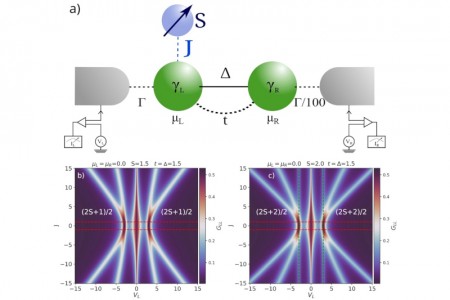
Top: Schematic representation of a minimal Kitaev wire with only two quantum dots and an external magnetic particle with an S-spin. Bottom: The two possible spectral configurations determined by the interaction between the wire and S. The shape of the spectrum allows the statistics of the external particle to be determined for a fermionic particle (left) and a bosonic particle (right) (illustration: Antonio Carlos F. Seridonio et al.)
A theoretical study conducted at São Paulo State University shows that quantum excitations without topological protection, previously considered experimental limitations, can serve as spectroscopic tools for identifying quantum statistics and stabilizing exotic states in superconducting nanostructures.
A theoretical study conducted at São Paulo State University shows that quantum excitations without topological protection, previously considered experimental limitations, can serve as spectroscopic tools for identifying quantum statistics and stabilizing exotic states in superconducting nanostructures.
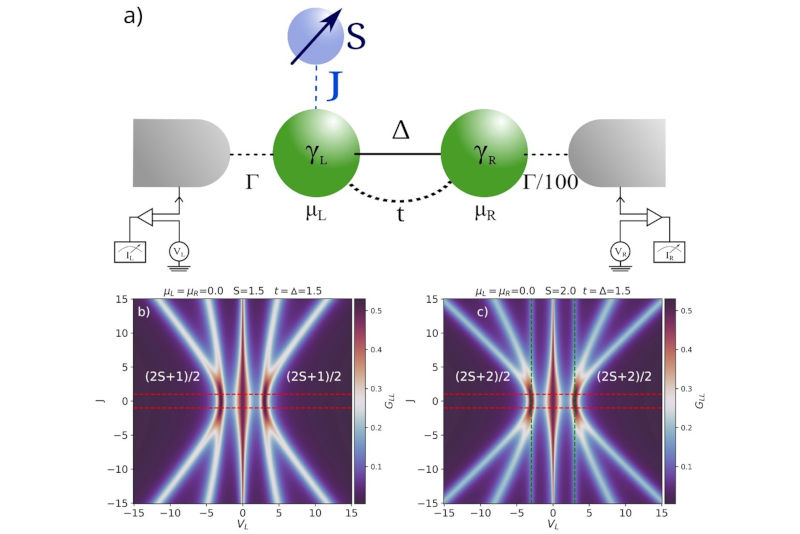
Top: Schematic representation of a minimal Kitaev wire with only two quantum dots and an external magnetic particle with an S-spin. Bottom: The two possible spectral configurations determined by the interaction between the wire and S. The shape of the spectrum allows the statistics of the external particle to be determined for a fermionic particle (left) and a bosonic particle (right) (illustration: Antonio Carlos F. Seridonio et al.)
By José Tadeu Arantes | Agência FAPESP – A “Majorana fermion” is a particle that would be identical to its antiparticle. Such an object has not yet been found. However, certain solid materials exhibit analogous behavior as if Majorana fermions were present through collective excitations of the system called “quasiparticles.”
In addition to generating interest in basic science, as key components for understanding the material world, Majorana fermions have primarily been studied due to their potential technological applications in areas such as fault-tolerant quantum computing.
The main theoretical model used in this study is the “Kitaev wire.” It is a one-dimensional superconducting chain formed by electrons or collective excitations. Under certain conditions, it generates an isolated Majorana fermion at each end without altering the total energy of the system. Short Kitaev wires based on semiconductor nanowires with quantum dots coupled to superconductors already exist in the real world. Conversely, a long Kitaev chain provides the conceptual foundation for producing topological qubits protected against local perturbations.
A new study published in the Journal of Physics: Condensed Matter, as a “Topical Review” – a format that synthesizes recent advances in a field with elements of review and original research – takes a diametrically opposite approach. Instead of seeking the topological shielding provided by long chains, the authors explored the potential of short chains.
The study was conducted in Brazil by researchers from the Department of Physics and Chemistry at the Ilha Solteira campus of São Paulo State University (UNESP), under the direction of Professor Antonio Carlos Ferreira Seridonio.
“Unlike long chains, we consider minimal chains of only two quantum dots coupled by a superconducting segment. In this minimal chain, unlike the long Kitaev wire, the two Majorana modes are located only at the ends in a very specific system configuration. In other configurations, they may overlap or be distributed between the two quantum dots. And they may even disappear with small variations in the electrostatic potential at the two quantum dots. Since they are highly sensitive to local perturbations, topological protection is eliminated,” says Seridonio.
For the researcher, however, this vulnerability is precisely the strength of this arrangement – not for developing robust quantum computing shielded from local perturbations but for producing a kind of sensor. “The sensitivity of the device to local perturbations proves to be a useful tool for detection. And the resulting spectral signature can be recorded directly in electrical conductance measurements [which describe how easily a current flows through a device],” he explains.
Politically incorrect nickname
This configuration, featuring minimal Kitaev chains and topologically unprotected Majorana states, is referred to in the literature by the term “poor man’s Majorana.” Although some researchers condemn the term, the majority has ultimately accepted it and abbreviates it as PMM.
The group’s primary area of study is the phenomenon known as spillover, which occurs when the wave function of a Majorana mode overflows from one quantum dot to another. This effect occurs when the system is locally disturbed. Traditionally, spillover was analyzed as an undesirable effect caused by electrostatic variations. However, the new work shows that it can be induced in a controlled manner by magnetic coupling with a neighboring quantum spin. “The perturbation of a PMM by a magnetic potential originating from an S-spin near the quantum dot induces the spillover of its wave function to the neighboring dot. This interaction is theoretically described as a J exchange coupling between the external spin and the electronic spin of the quantum dot,” says Seridonio.
The most important result of the study is that the spectral structure produced by this spillover depends directly on the quantum nature of the perturbing spin.
In an ideal superconductor, there is a forbidden energy interval, or gap, in which no electronic states should exist. However, impurities, magnetic couplings, and quantum confinement cause allowed levels to arise within this interval. These states within the gap are called “subgap levels.” In this case, the basis system (i.e., the minimal chain with the PMMs) has two zero-energy PMM modes, each of which is located at an extreme quantum dot of the chain. When the external spin interacts with the spin of the quantum dot of the PMM (via the J exchange coupling), several discrete levels emerge within the gap in addition to the zero mode of the PMM. The number of these levels depends on the S-spin value and statistics. Thus, the pattern and number of these levels act as a spectral signature that can reveal the quantum nature of the coupled magnetic object.
In summary, the number of subgap levels indicates whether the S-spin particle is fermionic or bosonic.
“For half-integer spins [fermions], 2S+1 states appear. For integer spins [bosons], 2S+2 states appear. This means that a minimal chain of quantum dots can function as a spectroscopic probe capable of identifying whether a neighboring magnetic object obeys fermionic or bosonic statistics,” Seridonio explains.
Quantum particles
It is worth remembering that fermions and bosons are the two major classes of quantum particles. They are distinguished by their spin value and the statistical rules they obey. Fermions (such as electrons, quarks, and neutrinos) have half-integer spin (S = 1/2) and obey Fermi–Dirac statistics and the Pauli exclusion principle. This principle prevents two identical particles from occupying the same quantum state simultaneously. Bosons (such as photons and gluons), on the other hand, have integer spin (S = 1) and obey Bose–Einstein statistics. This allows them to share the same state. This enables collective phenomena, such as superconductivity and Bose–Einstein condensation. This fundamental statistical difference determines how particles organize, interact, and form states of matter.
The authors of the study emphasize that the theoretical device closely corresponds to architectures that have already been achieved in the laboratory. Recent experiments have demonstrated minimal Kitaev chains using indium antimonide (InSb) semiconductor nanowires with quantum dots defined by electrostatic gates. These platforms allow for continuous control of parameters and have exhibited zero-energy conductance peaks consistent with the formation of “poor man’s Majorana” states.
Another important conclusion emerges when the model explicitly includes coupling quantum dots to multiple metallic reservoirs, a situation that is typical in transport experiments. Rather than merely degrading the Majorana states, the environment can partially stabilize them. The article refers to this phenomenon as “environmentally induced protection.”
Seridonio explains using an analogy: “If the magnetically affected quantum dot has a stronger coupling to its terminal, the PMM wave function is contained, preventing it from spilling over. It’s like a game of tug-of-war: the terminal pulls the state and keeps it confined.” This stabilization is neither topological nor absolute; it only works within a certain range of parameters. However, it suggests a new experimental strategy of controlling dissipation to manipulate quantum states.
Truly topological Majoranas remain promising candidates for robust qubits because quantum information can be encoded in their global fermionic parity. PMMs lack this complete protection but offer practical advantages. They allow for the direct manipulation, initialization, and reading of quantum states as well as entanglement and fusion operations, albeit with limited fidelity.
Braiding and fusion
Braiding and fusion are conceptual procedures used to manipulate and read topologically encoded quantum information in systems with exotic quasiparticles, such as Majorana modes.
Braiding involves moving two quasiparticles around each other and swapping their positions. In topological systems, this swap does more than just change their positions; it also alters the global quantum state of the system in a controlled and robust manner. In proposals for topological quantum computing, these swaps function as quantum logic gates.
Fusion is the process of bringing two of these excitations close enough together that they combine and disappear as separate entities. The result of fusion – the presence or absence of a residual excitation, for example – reveals the quantum information stored in the parity of the system.
In short, braiding processes quantum information, and fusion reads that information.
Thus, the study suggests that non-ideal systems may be useful even before perfect topological platforms are achieved. It also proposes an important conceptual shift: rather than viewing the absence of topological protection as a defect, we should exploit it as an experimental tool. If these ideas are confirmed experimentally, they suggest that Majorana-based quantum computing may depend not only on ideal systems and long topological chains but also on the rich and controllable physics of minimal and imperfect versions.
The study was supported by FAPESP through a Regular Research Grant awarded to Professor Seridonio.
The article “Revisiting the Poor Man’s Majoranas: the spin-exchange induced spillover effect” can be read at iopscience.iop.org/article/10.1088/1361-648X/ae2f13.
The Agency FAPESP licenses news via Creative Commons (CC-BY-NC-ND) so that they can be republished free of charge and in a simple way by other digital or printed vehicles. Agência FAPESP must be credited as the source of the content being republished and the name of the reporter (if any) must be attributed. Using the HMTL button below allows compliance with these rules, detailed in Digital Republishing Policy FAPESP.
