




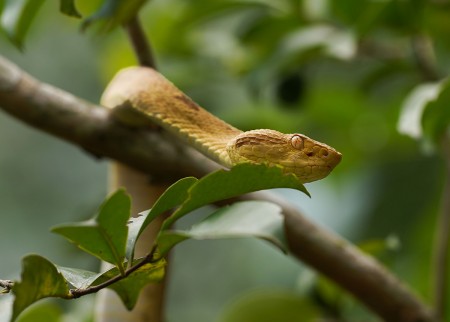
Study paves the way for biotechnological applications such as anticoagulant drugs or drugs that lower blood pressure (image: Daniel Antônio/Agência FAPESP)
One of the most complete sequencing projects ever performed on snakes worldwide serves as a reference for all jararaca vipers, which may contribute to new discoveries about toxins and the conservation of the species on Queimada Grande Island in Brazil, where it is critically endangered.
One of the most complete sequencing projects ever performed on snakes worldwide serves as a reference for all jararaca vipers, which may contribute to new discoveries about toxins and the conservation of the species on Queimada Grande Island in Brazil, where it is critically endangered.
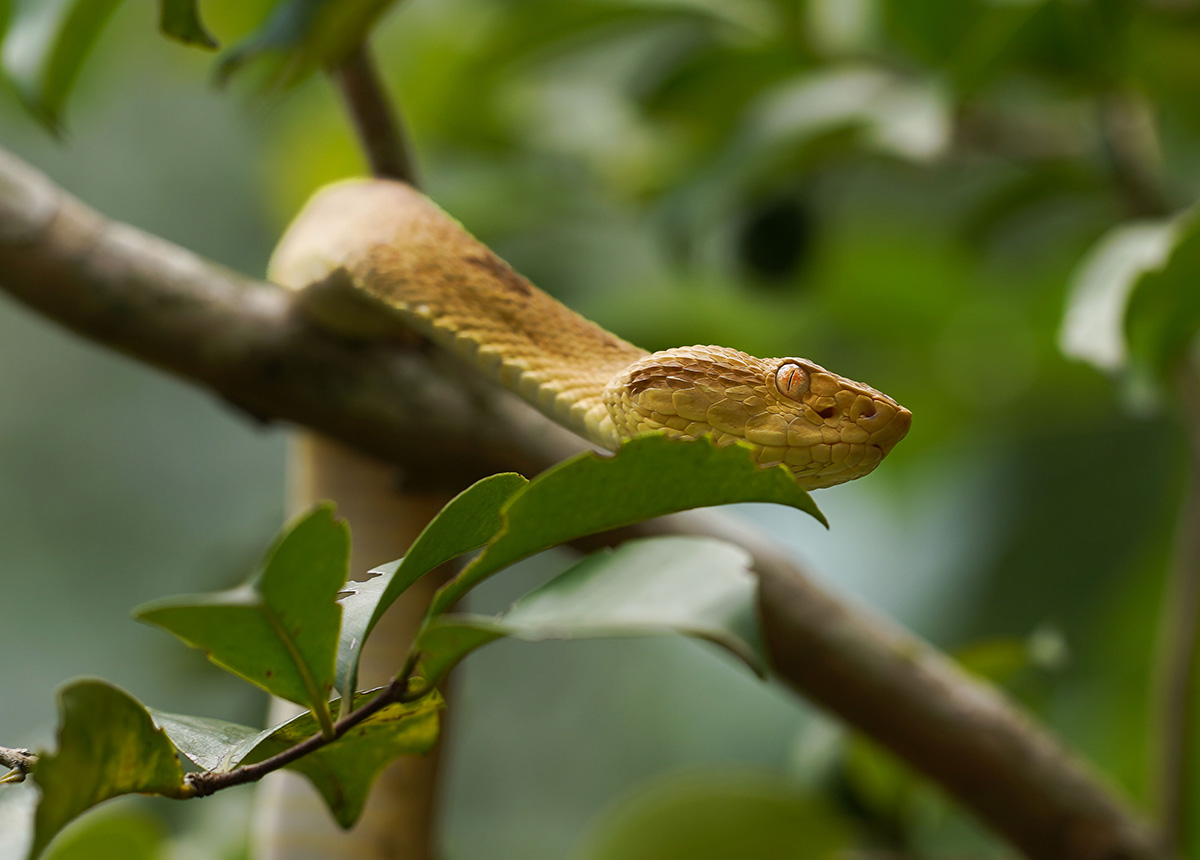
Study paves the way for biotechnological applications such as anticoagulant drugs or drugs that lower blood pressure (image: Daniel Antônio/Agência FAPESP)
By André Julião | Agência FAPESP – A research team led by scientists at the Butantan Institute in São Paulo, Brazil, and funded by FAPESP, has completed the most extensive genetic sequencing of a jararaca viper to date. The focus of the study was the genome of the golden lancehead (Bothrops insularis), particularly its venom genes. Since the species shares most of its genes with the other 48 species in the genus, the data serve as a reference for broader studies on the evolution of jararaca vipers and their toxins.
The study was published in the journal Genome Biology and Evolution.
The golden lancehead was described in 1921 as a different species from the one known on the mainland, simply called jararaca (Bothrops jararaca). Isolated on Queimada Grande Island, off the coast of São Paulo, about 100,000 years ago, the population differed from its mainland counterparts to the point of separating into a new species.
In addition to having yellow skin, the golden lancehead is semi-arboreal and feeds on birds as an adult. Jararacas on the mainland, on the other hand, are dark in color and usually hunt small mammals, such as rats, on the ground. In 2021, B. jararaca became the first Brazilian snake to have its genome sequenced (read more at agencia.fapesp.br/36548).
“Experimental studies have long shown that the venom of the golden lancehead is more potent in birds than in mammals. We didn’t find major differences in the toxin genes, but it’s likely that some protein or smaller piece of one of them may be enough to make the venom more lethal to birds,” says Pedro Nachtigall, the lead author of the study, which was conducted during his postdoctoral research at the Butantan Institute with a fellowship from FAPESP.
The genome revealed that the golden lancehead’s venom is rich in enzymes and proteins that cause bleeding and coagulation disorders. It also has the potential to act on other fronts, such as hypotension and tissue damage, which are common to the venoms of jararacas on the continent.
The researchers also noted that variations in the species’ genome do not occur randomly through a process known as genetic drift. On the contrary, the analyses pointed to a high degree of natural selection.
“Because it’s an isolated population, these changes could be occurring randomly as a result of low genetic variability. That isn’t what we saw. There’s a more specific distribution, a sign that selective pressure exists. This may have been caused by either diet or by the species being restricted to a very small area,” says Inácio Junqueira de Azevedo, a researcher at the Butantan Institute who coordinated the study, which is part of a project supported by FAPESP.
The entire wild population of golden lanceheads is restricted to Queimada Grande Island, which is 43 hectares in size. The island was formed off the coast of São Paulo after the last glaciation 100,000 years ago, when sea levels rose considerably.
In addition to the complete genome of a male from the island, the study included the less detailed genomes of eight other individuals: seven living in the wild and one part of an ex situ conservation program at the Butantan Institute. By comparing the genomes, researchers can better understand the genetic variability within the species.
Among future applications, the study will serve as a basis for comparing the genome of the wild population with that of the captive population, allowing for an assessment of the genetic health of the latter. Additionally, the genetic profile of the wild population informs conservation policies for the critically endangered golden lancehead.
Evolution and dating
Another analysis that provided the basis for the study was the transcriptome of four individuals, which is the set of molecules produced by the venom gland. While a doctoral student in the early 2000s, Junqueira de Azevedo conducted the first transcriptomic study of a snake’s venom gland, specifically that of the golden lancehead. At that time, genetic sequencing was still novel, and he received a scholarship from FAPESP.
The current study expands our knowledge of jararaca venom and could be used in the future for biotechnological applications such as anticoagulant drugs or drugs that lower blood pressure. For example, one such drug, captopril, originated from the venom of the jararaca viper found on the continent.
“Far beyond finding applications, studies like this help us understand the evolution of venom genes and, in this case, revealed the origin of a toxin subtype from an existing type,” Junqueira de Azevedo explains.
The complete genome made it possible to reconstruct the species’ demographic history, beginning with an origin population approximately 100,000 years ago. A mathematical model was used to estimate past periods of population decline and the number of individuals expected today. These estimates are based on the mutation rate and the assumption of a new generation of snakes every two years.
According to the model, approximately 100,000 years ago, a portion of a continental population of around 140,000 individuals likely became isolated on a mountain that now comprises Queimada Grande Island. Analyses show two subsequent severe population declines that coincide with two possible insularization events. One occurred 50,000 years ago, reaching 30,000 snakes, and the other occurred 11,000 years ago when the population fell to 10,000 individuals.
“It’s impossible to know for sure, but there may have been an initial isolation due to rising sea levels, which would have subsequently fallen, allowing that population to come into contact with snakes from the mainland and exchange genes with them. Then, a second rise in sea levels isolated them for good,” says Nachtigall, who completed an internship at Florida State University in the United States during his research.
A more gradual decline occurred between 10,000 and 5,000 years ago, reaching about 5,000 snakes, which is consistent with the current census of the island, which estimated the current population at between 2,000 and 4,000 golden lanceheads.
“We were able to achieve a genome with very high resolution, which generates a robust database for population, evolutionary, conservation, genomic, and venom studies, to understand both the origins and possible applications of toxins,” Junqueira de Azevedo concludes.
The work also received a grant from FAPESP through the FAPESP Research Program on Biodiversity Characterization, Conservation, Restoration, and Sustainable Use (BIOTA-FAPESP).
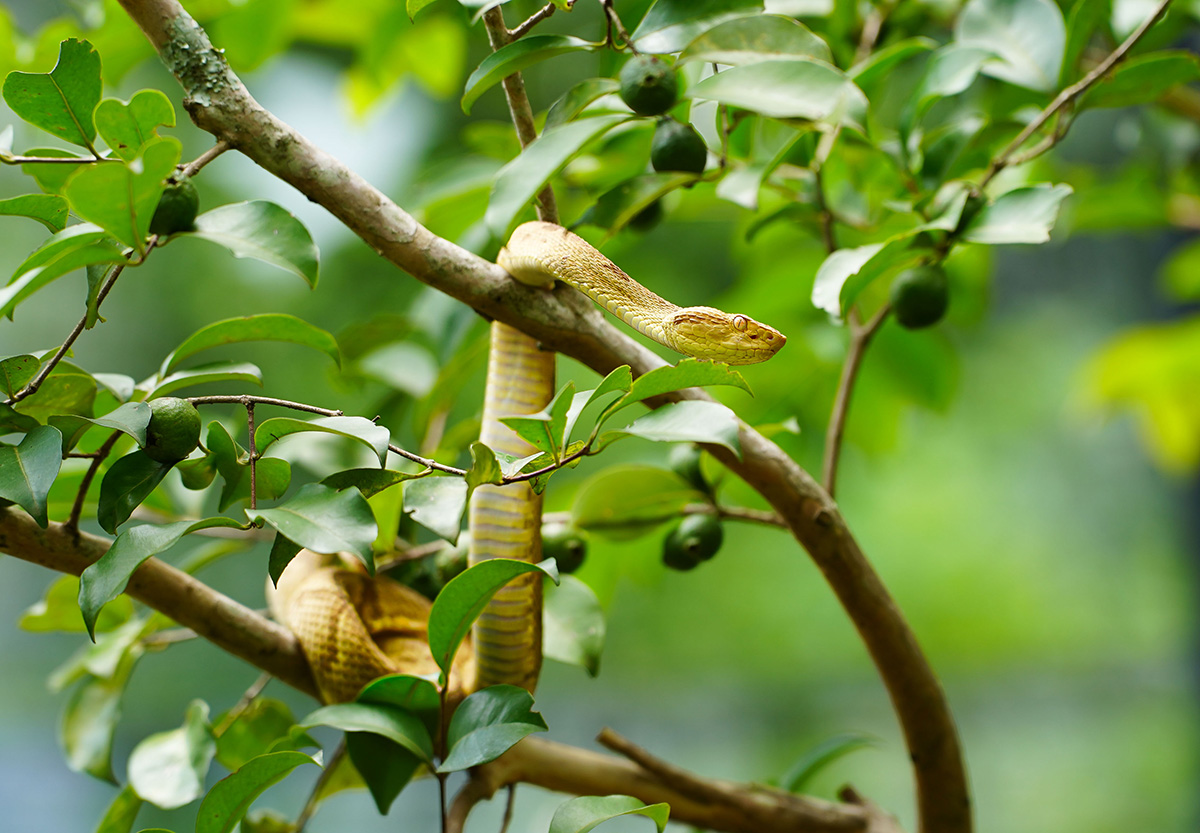
Approximately 100,000 years ago, a portion of a continental population of around 140,000 individuals likely became isolated on a mountain that now comprises Queimada Grande Island (photo: Daniel Antônio/Agência FAPESP)
The article “The golden lancehead genome reveals distinct selective processes acting on venom genes of an island endemic snake” can be read at academic.oup.com/gbe/article/18/1/evaf243/8379231.
The Agency FAPESP licenses news via Creative Commons (CC-BY-NC-ND) so that they can be republished free of charge and in a simple way by other digital or printed vehicles. Agência FAPESP must be credited as the source of the content being republished and the name of the reporter (if any) must be attributed. Using the HMTL button below allows compliance with these rules, detailed in Digital Republishing Policy FAPESP.
