




The Vila Joaninha Community Plan for Risk Reduction and Climate Adaptation consolidated a methodology that can serve as a reference for developing other plans (image: CEFAVELA)
For 11 months, researchers from the FAPESP-funded Center for Favela Studies provided support to the community in the municipality of Diadema.
For 11 months, researchers from the FAPESP-funded Center for Favela Studies provided support to the community in the municipality of Diadema.
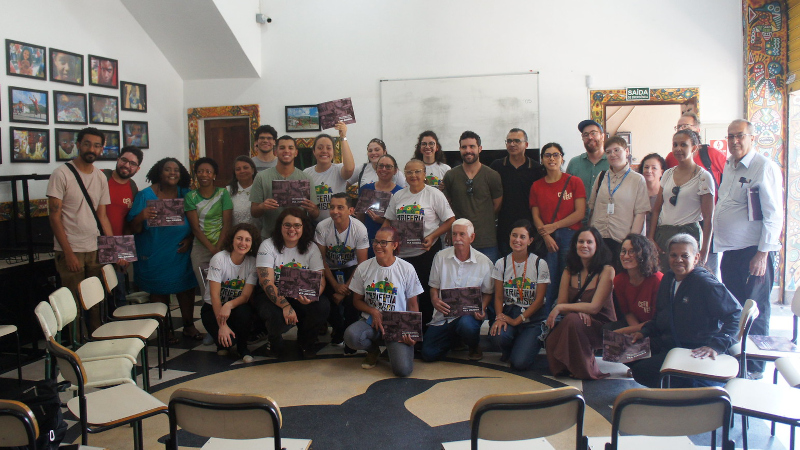
The Vila Joaninha Community Plan for Risk Reduction and Climate Adaptation consolidated a methodology that can serve as a reference for developing other plans (image: CEFAVELA)
Agência FAPESP* – The neighborhood of Vila Joaninha, on the outskirts of Diadema, a municipality in the São Paulo Metropolitan Area, is one of the first places in Brazil to complete its Community Plan for Risk Reduction and Climate Adaptation (PCRA). The strategy was presented to the community at a meeting at the headquarters of the Beija-Flor Cultural Network, Sítio Joaninha Center, on September 20, 2025.
The work began in October 2024. It was carried out over the course of 11 months by researchers from the Center for Favela Studies (CEFAVELA), one of FAPESP’s Research, Innovation, and Dissemination Centers (RIDCs), based at the Federal University of ABC (UFABC). The center develops research and promotes human resource training, technology transfer, and knowledge dissemination in coordination with various institutions, movements, and organizations committed to the territorial agenda of favelas.
Through the PCRA, the organized community identifies risk problems and develops strategies to solve them collectively in the short, medium, and long term. These strategies include self-management actions, collective efforts, mobilization, monitoring, and demands directed at public authorities and other partners. The plan can also provide technical support for community dialogue with the executive (city, state, and federal), legislative, and judicial branches.
“The PCRA was developed based on the daily lives and territory where the residents live, who came to better understand the risks they’re exposed to in order to organize and deal with them. Its development also strengthened this organization, focusing attention on the areas where it’s most needed,” says Luciana Ferrara, a researcher at CEFAVELA who coordinated the development of the plan.
Identified risks
The survey of the areas identified 27 risk sectors, 21 of which were classified as medium risk and six as high risk. No area presented a very high risk. There are no homes that need to be condemned immediately. However, those in high-risk sectors are in precarious conditions that must be addressed in the short term to prevent them from worsening. “On their own, the families in these areas can’t solve the problems, as the cost of carrying out the necessary works and adaptations is high, so support from the public sector is needed,” Ferrara points out.
The most common problems that increase the risk situation in Vila Joaninha are the lack of drainage for rainwater and everyday wastewater, which ends up being discharged directly into the ravine and can cause landslides, a situation identified in 18 sectors; the cutting of ravines without adequate protection, leaving exposed earth that can slide during heavy rains, a situation identified in 12 sectors; and houses built on top of or near ravines, a situation identified in six sectors.
The PCRA goes beyond diagnosis and proposes structural and non-structural measures for the entire neighborhood and for each lot that can be implemented by the residents themselves or require support from the state. It also establishes short-, medium-, and long-term schedules for implementing the actions outlined in the plan. One of these measures is the establishment of a permanent residents’ commission to monitor risk areas. Its members must visit the mapped areas every three or four months to check for changes.
Collective construction
Fifteen people were directly involved in developing the Vila Joaninha PCRA, including architecture and urban planning technicians, social workers from the Diadema Municipal Housing and Urban Development Office (SHDU-Diadema), an interdisciplinary group from CEFAVELA, community mobilizers, and favela residents.
“What we learned from doing the PCRA on climate change was better than going to college,” says Maria Edineuma dos Santos, one of the community leaders who participated in the development of the plan. Eliete Leite, another leader, points out that the plan will improve communication among residents. “It helps us humanize our conversations with the population. The work isn’t over. We’ll fight hard to move forward,” she says.
“We have 12 plans being developed by various communities at the moment, and the PCRA in Vila Joaninha has created a methodology that can serve as an example for the development of other plans,” says Jeroen Klink, director of CEFAVELA. “We’re grateful to the community, the city government, and the team of student researchers who worked on developing the plan. The level of community involvement was impressive, and the PCRA is a tool for the community to engage in dialogue with the city government and other public agencies to improve the territory,” adds Rosana Denaldi, deputy director.
The plan is part of a policy formulated by the Department of Risk Mitigation and Prevention of the National Secretariat for Peripheries (SNP) of the Ministry of Cities through the “Periferia Sem Risco” (Risk-Free Periphery) strategy.
Origin and profile
Vila Joaninha originated from the irregular subdivision of the so-called Sítio (“farm”) Joaninha, without approval from the competent authorities and without urban infrastructure. The Alvarenga landfill was located next door and received all kinds of waste, negatively impacting the population and the environment. According to a 2023 survey by the Corda Institute, 71% of the 1,229 lots in Vila Joaninha were occupied, 21.5% were empty or vacant, and 7% were under construction.
A total of 857 households were interviewed, revealing that 58% of the local population are children, adolescents, and young adults, while 42% are adults and older adults. The majority (51%) earn between one and three minimum wages, and 31% have completed high school. Only 35% of those aged 18 or older are formally employed, and 53% of heads of households are women.
The full PCRA Vila Joaninha report can be found at drive.google.com/file/d/10ef-oj-z9Z7_XubrFraJWfdLBlWKPH-h/view?usp=sharing.
* With information from Janaína Simões from CEFAVELA
The Agency FAPESP licenses news via Creative Commons (CC-BY-NC-ND) so that they can be republished free of charge and in a simple way by other digital or printed vehicles. Agência FAPESP must be credited as the source of the content being republished and the name of the reporter (if any) must be attributed. Using the HMTL button below allows compliance with these rules, detailed in Digital Republishing Policy FAPESP.
