




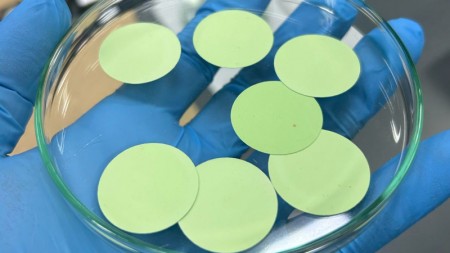
Metal-supported solid oxide fuel cells (MS-SOFCs): A “sandwich” of materials enables durability, conductivity, and porosity (photo: CINE)
Funded by FAPESP, the Center for Innovation on New Energies has already produced 100% Brazilian prototypes, reducing dependence on foreign suppliers.
Funded by FAPESP, the Center for Innovation on New Energies has already produced 100% Brazilian prototypes, reducing dependence on foreign suppliers.
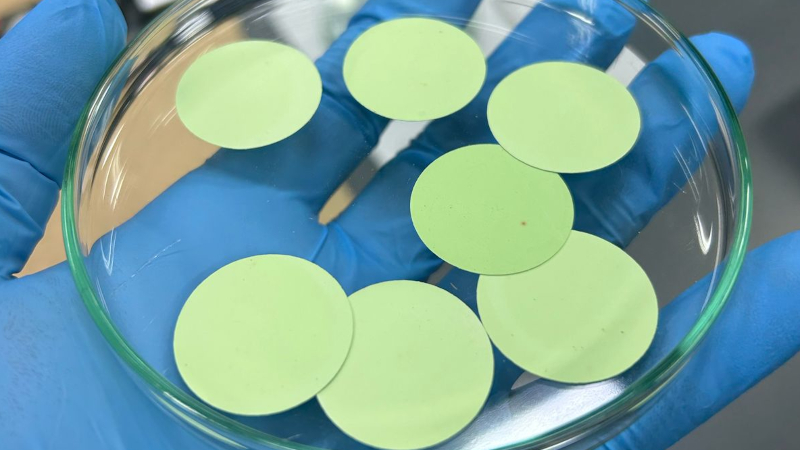
Metal-supported solid oxide fuel cells (MS-SOFCs): A “sandwich” of materials enables durability, conductivity, and porosity (photo: CINE)
Agência FAPESP* – A scientific article published in the journal Ceramics International by researchers from the Center for Innovation on New Energies (CINE) and their collaborators brings together essential information for improving the latest generation of fuel cells, known as SOFCs (solid oxide fuel cells). The CINE is one of the Applied Research Centers (ARCs) supported by FAPESP in the state of São Paulo, Brazil. Founded in 2018 in partnership with Shell, its co-funder, the CINE is based at the State University of Campinas (UNICAMP), the University of São Paulo (USP), and the Federal University of São Carlos (UFSCar), with the participation of eight other Brazilian institutions.
SOFCs are devices capable of generating clean, renewable energy with high efficiency. They need to be supplied with fuel to produce electricity, but, unlike other fuel cells, SOFCs can use various substances, such as bioethanol, methane, or hydrogen. Therefore, they can be useful in a wide range of contexts, from electric vehicles to communities far from the power grid.
However, this technology is still limited in terms of device durability and stability due to its high operating temperatures, which can reach 1,000 °C. To overcome these challenges, metal-supported SOFCs (MS-SOFCs) emerged at the beginning of the century.
“Imagine a fuel cell as a sandwich of materials,” suggests Gustavo Doubek, a chemical engineer from UNICAMP. “In this sandwich, the metal support acts as the firm base that sustains the entire structure. It’s important because it provides strength so that the cell doesn’t break easily, helps to conduct electricity efficiently, and facilitates the entry and exit of gases, since it’s made of porous metal, full of ‘pathways’ for the fuel to circulate,” he explains. “This means that the cells are more durable, function more stably, and can operate for much longer without failure,” he adds.
Doubek is one of the main authors of the article, which specifically addresses advances in the development of metal supports. According to the scientist, supports made of stainless steel-based metal alloys have shown good results in practice, as they combine robustness with corrosion resistance.
At CINE, Doubek conducts research focused on developing MS-SOFCs. Currently, these efforts include producing 100% Brazilian-made prototypes, testing porous metal alloys to determine their ability to withstand operating conditions, and conducting performance studies to increase cell power and durability.
“The results already show that Brazil has the capacity to develop its own technology in this area, reducing dependence on foreign suppliers and opening up space for applications in clean energy and sustainable mobility,” Doubek says.
The article provides valuable guidance for improving metal supports for SOFCs, which will be useful for researchers and engineers. The text discusses advances in manufacturing these components, the materials used, and the surface treatments applied, with a focus on finding scalable and economical techniques.
The study, which involved researchers from UNICAMP and a scientist from King Abdullah University of Science and Technology in Saudi Arabia, received funding from FAPESP (22/02235-4, 17/11958-1, and 14/02163-7) and the Support Foundation of the Federal University of Minas Gerais (FUNDEP), as well as Brazil’s National Council for Scientific and Technological Development (CNPq).
The article “Porous metal substrates for solid oxide fuel cells: Manufacturing techniques and future perspectives” can be read at doi.org/10.1016/j.ceramint.2025.01.059.
* With information from Verónica Savignano from the CINE
The Agency FAPESP licenses news via Creative Commons (CC-BY-NC-ND) so that they can be republished free of charge and in a simple way by other digital or printed vehicles. Agência FAPESP must be credited as the source of the content being republished and the name of the reporter (if any) must be attributed. Using the HMTL button below allows compliance with these rules, detailed in Digital Republishing Policy FAPESP.
