




By José Tadeu Arantes | Agência FAPESP – The Baniwa are an indigenous people living in the border region between Brazil, Colombia, and Venezuela. The Içana River, a tributary of the Rio Negro, is the epicenter of their geographical distribution. In 2025, their population is estimated to be around 20,000 people, spread across several villages and urban centers, including São Gabriel da Cachoeira, Santa Isabel, and Barcelos. In more informed circles in Brazil’s large cities, the Baniwa are mainly known for their exquisite handicrafts and the production of jiquitaia pepper, which is highly prized in gastronomy. They are also known for the cultural activities of some of their members, such as the artist Denilson Baniwa and the anthropologist, philosopher, university professor, and activist Gersem Baniwa, who teaches at the University of Brasília (UnB).
Like other indigenous peoples, the Baniwa experienced extreme colonial violence, economic exploitation, and attempts at cultural erasure at the hands of Catholic (Salesian) and Evangelical missionaries.
However, an educational experiment that began in the late 1980s has become an instrument of cultural preservation and social innovation. A recent study by Antônio Fernandes Góes Neto investigated how the multilingual Baniwa and Koripako, who speak a dialect of the Baniwa language and live in Colombia and Alto Içana, Brazil, and community organizations in the Baniwa territory coordinate curricula, value chain projects, and traditional knowledge, promoting student retention, income generation, and local governance.
The results were presented in a chapter of the book Equalizing the Three Pillars of Sustainability.
Góes Neto holds a Ph.D. from the Faculty of Education at the University of São Paulo (FE-USP) in Brazil and is currently a visiting professor at the Universidad Andina Simón Bolívar in Ecuador. His field research was supported by FAPESP through the project “Indigenous School Education: Learned Knowledge and Innovation”, which was coordinated by Professor Elie Ghanem.
“We call the logic of boarding schools and moral surveillance, which separated young people from their families and prohibited indigenous knowledge, an 'irresponsible paradigm’ of schooling. Our research shows how Baniwa and Koripako indigenous schools today are vectors for the reappropriation of territory, language, and economy by communities,” says Góes Neto.
The turnaround began with the indigenous associative movement of the late 1980s and 1990s amid the mining crisis and mobilization for territorial rights. Entities such as the Indigenous Organization of the Içana Basin (OIBI), the Association of Indigenous Teachers of the Upper Rio Negro (APIARN), and the Association of Indigenous Communities of Putyra Kapuamo (ACIPK) [Putyra Kapuamo means “Island of Flowers” in the Yẽgatu language], converged to form the Federation of Indigenous Organizations of the Rio Negro (FOIRN). Representing 23 peoples of the Upper and Middle Rio Negro, including the Baniwa, Tukano, Desana, Baré, Tariana, among others, FOIRN is based in São Gabriel da Cachoeira and is one of the most important indigenous organizations in Brazil. It works to defend territorial rights, promote education and health, preserve languages and cultures, and strengthen grassroots associations politically.
Following the approval of the land and the establishment of the Rio Negro Ethno-Educational Territory (Decree 6,861/2009), a community-managed school was founded, with teachers and administrators selected by the community. “Associations and schools have become spaces for maneuvering to preserve and strengthen knowledge while creating economic alternatives so studying doesn’t drive young people away from their communities. Community radio, implemented with the assistance of the Socio-Environmental Institute [ISA], was a key element in coordinating between associations and schools,” says the researcher.
The study focuses on the Cabari community in the Aí Waturá micro-region in the municipality of São Gabriel da Cachoeira. The municipal school of the same name is managed by the ACIPK and organizes its curriculum and projects based on the concept of “kupixá” (farm or forest) and topics raised by the community (e.g., useful plants, fishing, ceramics, waste, health, and local history). The model is based on pilot schools on the Içana River, such as the Baniwa and Coripaco Pamáali Indigenous School and, more recently, the Baniwa Eeno Hiepole School.
“The classroom flows with the territory. Students hike, farm, fish, interview elders, record their findings in languages such as Baniwa, Koripako, or Yẽgatu, and present them to the community. This becomes teaching material. It's the school that builds its support resources through research,” reports Góes Neto.
The idea of “educating through research” is based on the work of Pedro Demo, a sociologist, professor emeritus at UnB, and former president of the Anísio Teixeira National Institute for Educational Studies and Research (INEP). Demo is a leading author in the field of education. He considers research to be the ultimate educational principle, mobilizing students and teachers based on criteria such as autonomy and critical thinking. His approach was deeply absorbed by Indigenous Teacher Training programs in the late 1990s and early 2000s.
A striking feature is the sociolinguistic diversity: Yẽgatu predominates in Lower Içana, Baniwa in Middle Içana, and Koripako in Upper Içana. The spelling system was proposed by Henri Ramirez, a French-Brazilian linguist born in Algeria who was called upon by Baniwa associations decades ago to advise them. It has since been adjusted by indigenous teachers. There is also a demand to recognize Baniwa and Koripako as a linguistic heritage within the Sociolinguistic Diagnosis of the Medzeniako Language and Community, a collaboration between FOIRN and the National Institute of Historic and Artistic Heritage (IPHAN), and in the Baniwa and Koripako Linguistic Documentation Project of the Endangered Languages Documentation Program (ELDP).
The recovery of ancestral knowledge is a priority. However, the incorporation of new knowledge that can support innovation for good living is equally valued. In Cabari and many other communities, this takes place on three fronts: producing basketry with traditional motifs, producing jiquitaia pepper (including through partnerships) to manufacture craft beer with pepper, and ethnic tourism integrating trails, landscape and plant identification, cuisine, and storytelling.
“In pepper production, the challenge was to master all stages of the process: complying with health standards, standardizing packaging, and selling with our own identity. In tourism, the community realized that this activity is only sustainable when the school improves, with research and training of teachers, who are the managers of this type of economic activity,” comments Góes Neto.
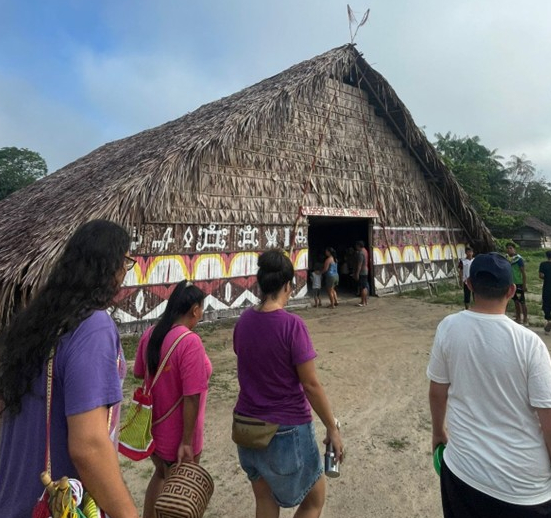
Maloca of the Assunção do Içana Community, where a movement to revive traditional shamanism is underway (photo: Antônio Fernandes Góes Neto/USP)
Ancestral spirituality and shamanic practices were heavily stigmatized and demonized by Catholic and Evangelical missionaries. Today, the vast majority of the Baniwa people identify as Christian in some form. However, even in this delicate area, there is an ongoing resurgence. Ucuqui-Cachoeira is recognized as a Catholic community that maintained shamanic practices despite strong evangelizing efforts in the 20th century. According to anthropologist Robin Wright, Ucuqui-Cachoeira was one of the main centers of resistance and revitalization of Baniwa shamanism. Shamans from this community participated in initiatives such as the School of Shamans, a project led by Wright in the 1990s that aimed to record, strengthen, and transmit shamanic knowledge.
Assunção do Içana is another example. Despite being known for being one of the largest Salesian boarding schools in the region, it has become a new hub for strengthening shamanism. Most residents do not speak Baniwa, but Yẽgatu, an Amazonian lingua franca, especially in the 18th and 19th centuries, reflecting their historical coexistence with non-indigenous peoples and marriage to women from the Baré people. From 2022 to 2023, Escola Viva was established in Assunção do Içana. This community project aims to teach and disseminate traditional knowledge, including shamanism and the desire to return to speaking the Baniwa language, as there are still speakers of it in the community. Baniwa researchers and teachers, such as Francy Baniwa and Francisco Fontes Baniwa (authors of the 2023 book Umbigo do Mundo [Navel of the World]), provide the intellectual leadership for this process. The book articulates Baniwa cosmology and female perspectives of the Baniwa people.
“The traditional maloca is being rebuilt as a ceremonial enclosure and community center. But there’s a growing consensus that school is one thing and maloca is another. Classes can take place in the maloca, or in a brick room, hut, farm, port, or trail. The essential thing is not to dilute school time and not to reduce the maloca to a classroom,” emphasizes Góes Neto.
The chapter, written by the researcher, is the result of a collaboration between FE-USP and FOIRN, as well as workshops held between 2018 and 2020. The chapter argues that indigenous schools overcome the “irresponsible paradigm” of boarding schools, Bible schools, and old agricultural technical schools. They do this by reflecting local life, mobilizing knowledge of the territory, and reducing the exodus from indigenous communities. They accomplish this by articulating curriculum, language, economy, and management. “School is a laboratory of invention: books, games, maps, videos, toys, crafts, and value chain design. Innovation here is not a contraption; it’s the collective agency to solve real problems,” emphasizes Góes Neto. Currently, FE-USP is advising the Baniwa and Koripako schools, in conjunction with UnB, on the Sociolinguistic Diagnosis of the Medzeniako Language and Community.
The text “Reassembling residual knowledge: an ethnographic overview of the Baniwa organizations in the northwest Amazon” can be accessed at springerprofessional.de/en/reassembling-residual-knowledge-an-ethnographic-overview-of-the-/51328560.
Republish
The Agency FAPESP licenses news via Creative Commons (CC-BY-NC-ND) so that they can be republished free of charge and in a simple way by other digital or printed vehicles. Agência FAPESP must be credited as the source of the content being republished and the name of the reporter (if any) must be attributed. Using the HMTL button below allows compliance with these rules, detailed in Digital Republishing Policy FAPESP.
