




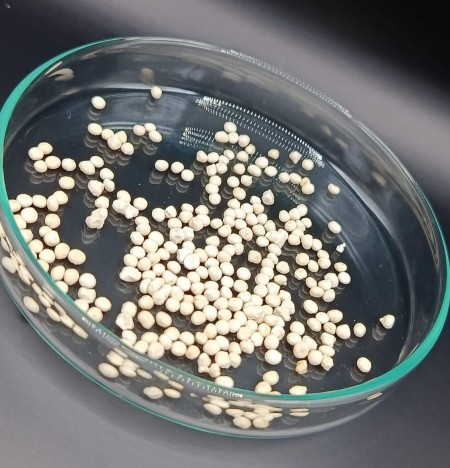
Carboxymethylcellulose and aluminum beads after drying. The formulation promotes the durability of the fungus used as a bioinsecticide (photo: José Antônio Boiaro Caxa/UNIARA)
Encapsulating Beauveria bassiana in a biopolymer made of cellulose and aluminum increased the viability of the fungus from 69% to 85% after five months of storage, providing a more sustainable alternative that releases the bioinsecticide over an extended period and reduces the need for new applications.
Encapsulating Beauveria bassiana in a biopolymer made of cellulose and aluminum increased the viability of the fungus from 69% to 85% after five months of storage, providing a more sustainable alternative that releases the bioinsecticide over an extended period and reduces the need for new applications.
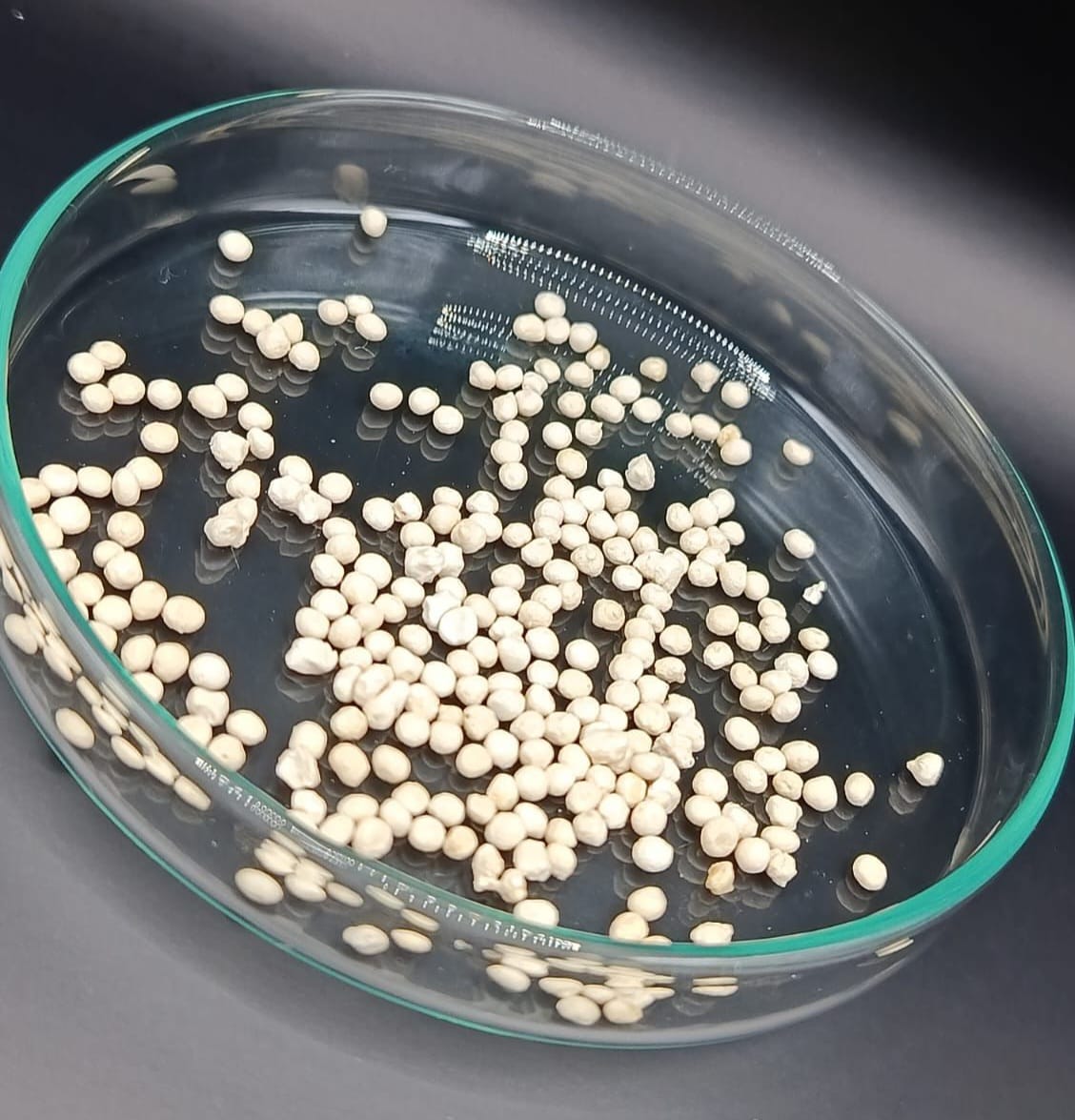
Carboxymethylcellulose and aluminum beads after drying. The formulation promotes the durability of the fungus used as a bioinsecticide (photo: José Antônio Boiaro Caxa/UNIARA)
By André Julião | Agência FAPESP – Researchers at the Center for Sustainable Management of Pests, Diseases, and Weeds (CEMASU), one of the Science Centers for Development (SCDs) funded by FAPESP in the state of São Paulo, Brazil, used a biopolymer to encapsulate and extend the storage life and release rate of a bioinsecticidal fungus. The study was published in the scientific journal ACS Omega.
The goal is to extend the shelf life of Beauveria bassiana, a fungus widely used as a bioinsecticide on various agricultural crops. Encapsulation is also a more sustainable alternative because it requires fewer applications and has less potential to impact non-target species (read more at agencia.fapesp.br/50389).
“We carried out a relatively common process called ionotropic gelation, in which one material is dripped into another to form spheres, or ‘beads,’ with a polymer shell on the outside and the microorganism inside. This preserves the contents to ensure a sustained release,” explains Hernane da Silva Barud, the coordinator of the study, a professor at the University of Araraquara (UNIARA), and one of CEMASU’s principal investigators.
The biopolymer is based on carboxymethylcellulose, a water-soluble polymer derived from cellulose, and uses aluminum as a cross-linking agent, which gives the material its three-dimensional structure. In vitro results showed that the biopolymer increased the viability of the fungus from 69% to 85% after five months of storage compared to pure fungus. Like other fungal bioinsecticides, this one uses B. bassiana blastospores, which are fungal reproductive cells produced by liquid fermentation that germinate rapidly. The blastospores colonize insect pests and kill them without affecting mammals, which can be harmed by chemical insecticides.
The next step is to conduct field trials to test the effectiveness of the product outside the laboratory. In addition to B. bassiana, testing other fungi could expand the range of agricultural crops that could benefit from the product. Another possibility would be to use it in livestock farming to combat ticks, for example.
Barud adds that if the field tests show satisfactory efficacy, the production process is scalable. This would dramatically reduce costs and help make the product commercially viable.
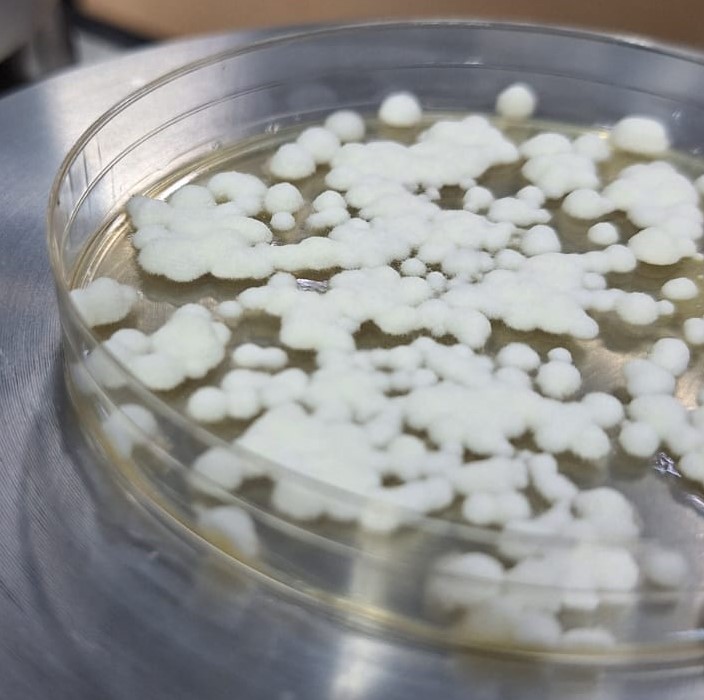
Beauveria bassiana grown in a laboratory. The fungus is pathogenic to insects but harmless to mammals (photo: Lívia Contini Massimino/UNIARA)
Trials
The study compared two encapsulation methods. In addition to the method using carboxymethylcellulose and aluminum, the researchers tested a different formulation that used carboxymethylcellulose and calcium. Both formed the expected spherical structures to the naked eye. However, significant differences were observed after drying.
The aluminum-based ones maintained their shape and exhibited high morphological uniformity. The calcium-based ones, on the other hand, collapsed structurally and clumped together, forming aggregates of varying sizes.
Images obtained by scanning electron microscopy (SEM) revealed that the surface of the beads in the aluminum-containing material was slightly rough with some cracks. Meanwhile, the calcium-based aggregates had a very rough and irregular surface.
“It’s important to emphasize that even the calcium-based spheres manage to keep the fungus viable longer than the fresh product, but the aluminum-based ones had greater uniformity, which allows for better quality control,” says Barud, who coordinates the Biopolymers and Biomaterials Laboratory at UNIARA.
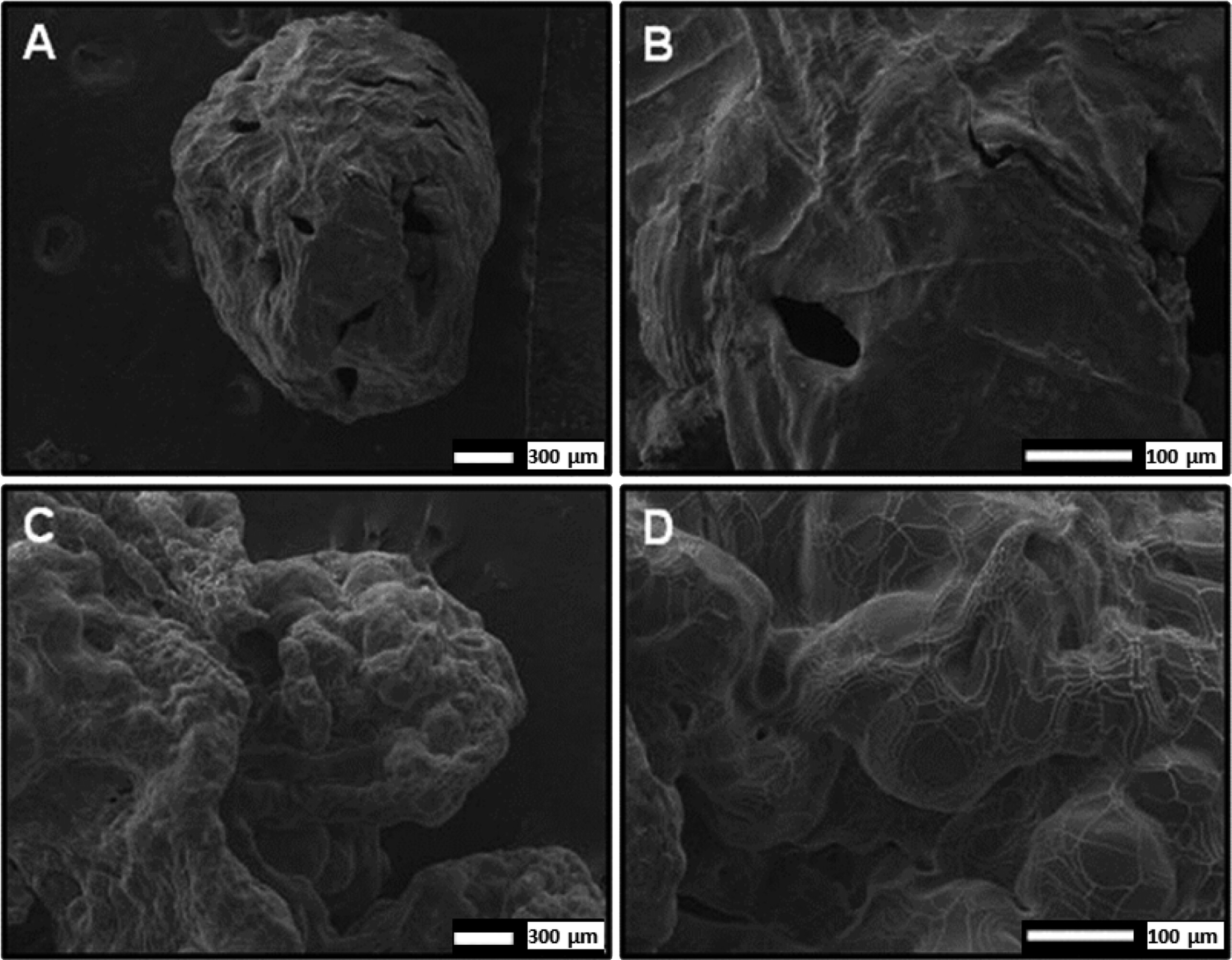
Scanning electron microscope images show the regular structure of beads containing aluminum (A and B) and the irregular structure of those containing calcium (C and D) (images: Zaldivar et al./CCY-BY 4.0)
In addition to their uniform size, the aluminum beads exhibited greater thermal stability and a higher water-retention capacity than the calcium ones, which is important for preserving the fungus inside.
The authors conclude that the encapsulation method is simple, fast, and efficient. Viable conidia remained on the surface of the beads even after five months of storage at -18 °C. The researchers will now test storage in a conventional refrigerator (4 °C) and at room temperature.
The first author of the study was Mayté Zaldivar. It was co-authored by Jean Carlos Machado and Lívia Contini Massimino. All three are all from the Biopolymers and Biomaterials Laboratory at UNIARA.
The study was also co-authored by Marcel Marques and Ricardo Bortoletto-Santos from the University of Ribeirão Preto (UNAERP), and researchers José Eduardo de Almeida and Ana Paula Bartels from the Biological Institute of the São Paulo Agency for Agribusiness Technology (IB/APTA).
The article “Sustainable encapsulation of biocontrol agents: cross-linker influence on carboxymethylcellulose-based microbeads” can be read at pubs.acs.org/doi/10.1021/acsomega.5c06970.
The Agency FAPESP licenses news via Creative Commons (CC-BY-NC-ND) so that they can be republished free of charge and in a simple way by other digital or printed vehicles. Agência FAPESP must be credited as the source of the content being republished and the name of the reporter (if any) must be attributed. Using the HMTL button below allows compliance with these rules, detailed in Digital Republishing Policy FAPESP.
