




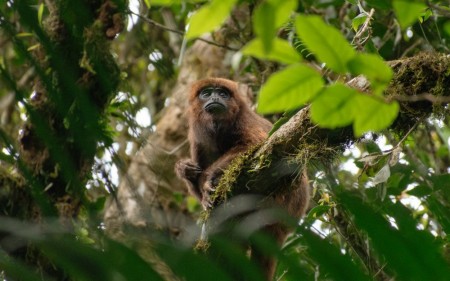
Howler monkey in Carlos Botelho State Park. Groups move more when they encounter other primate species, such as muriquis and capuchin monkeys (photo by Lucas Leoni/LaP-UNESP)
Findings from a study that monitored a group in Carlos Botelho State Park in São Paulo, Brazil, help shed light on the habitat use of this vulnerable species.
Findings from a study that monitored a group in Carlos Botelho State Park in São Paulo, Brazil, help shed light on the habitat use of this vulnerable species.
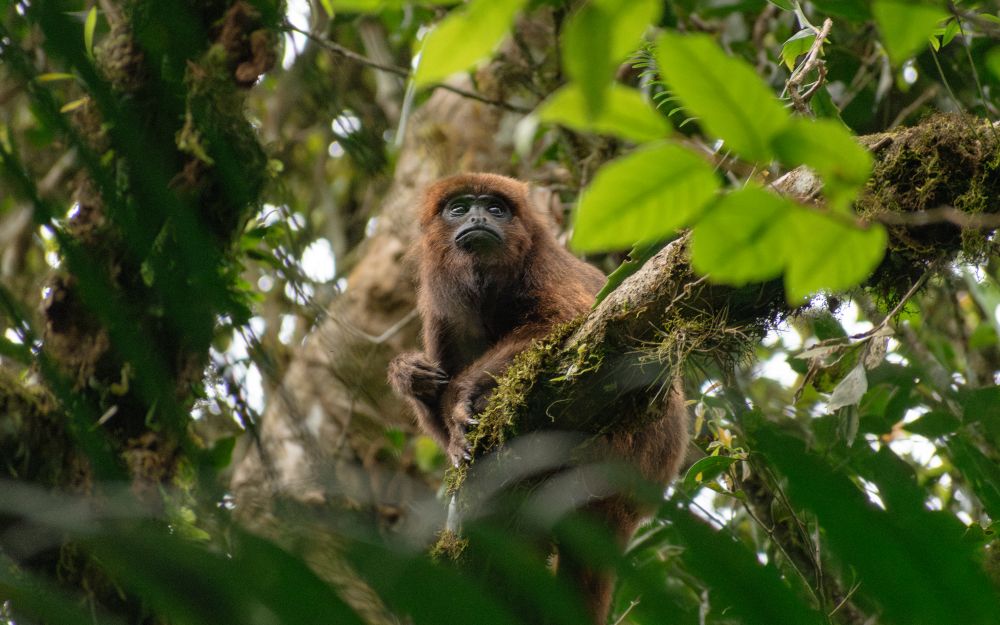
Howler monkey in Carlos Botelho State Park. Groups move more when they encounter other primate species, such as muriquis and capuchin monkeys (photo by Lucas Leoni/LaP-UNESP)
By André Julião | Agência FAPESP – The daily movements of brown howler monkeys (Alouatta guariba) in the forest are determined by an interplay of environmental, behavioral, and social factors. This is one of the conclusions of a study conducted in Brazil and published in April in the International Journal of Primatology by researchers supported by FAPESP. The study may guide conservation efforts for the species.
For example, warmer and longer days require more rest time and result in the species traveling a shorter daily distance. Howler monkeys also rest more when feeding on leaves, which are quite fibrous and take a long time to digest.
Interaction with other primate species, such as southern muriquis (Brachyteles arachnoides) and capuchin monkeys (Sapajus cucullatus), is another factor that directly influences the distance traveled each day. This interaction causes howler monkeys to travel farther in search of new feeding or resting sites and to avoid conflicts. In the study, consuming easily digestible fruits and encountering other howler monkeys did not influence daily movement.
“The muriqui is larger, and its mere presence is enough to scare off howler monkeys, which prefer to leave the area rather than confront them. Capuchin monkeys are smaller but travel in groups of up to 30 individuals and can jump on top of howler monkeys, pull their tails, and do everything they can to drive them away from where they’re resting,” says Erika Alejandra Chaves-Diaz, the first author of the study. She conducted the research during her master’s program at the Federal University of Minas Gerais (UFMG) and the Institute of Biosciences at São Paulo State University (IB-UNESP) in Rio Claro.
Chaves-Diaz tracked a group of brown howler monkeys from August 2023 to January 2024 in São Paulo state, specifically in the São Miguel Arcanjo section of Carlos Botelho State Park. Over the course of 63 days in the field, she monitored the group for 37 days, 22 of which were consecutive. During this time, she observed the monkeys from the moment they woke up until they went to sleep. She recorded their behaviors, feeding habits, and interactions with primates of the same and other species.
“Most studies tracking howler monkey populations have taken place in small fragments of the Atlantic Forest rather than in a continuous forest like this one, which is part of the Paranapiacaba Mountain Range. Therefore, we didn’t have a good reference for how the species lives in a preserved area or what would be ideal for its habitat, which is often significantly altered by human activity,” explains Laurence Culot, a professor at IB-UNESP.
Culot coordinates the project “Primate Resilience in an Anthropized Landscape”, which is supported by FAPESP through the Research Program on Biodiversity Characterization, Conservation, and Sustainable Use (BIOTA-FAPESP).
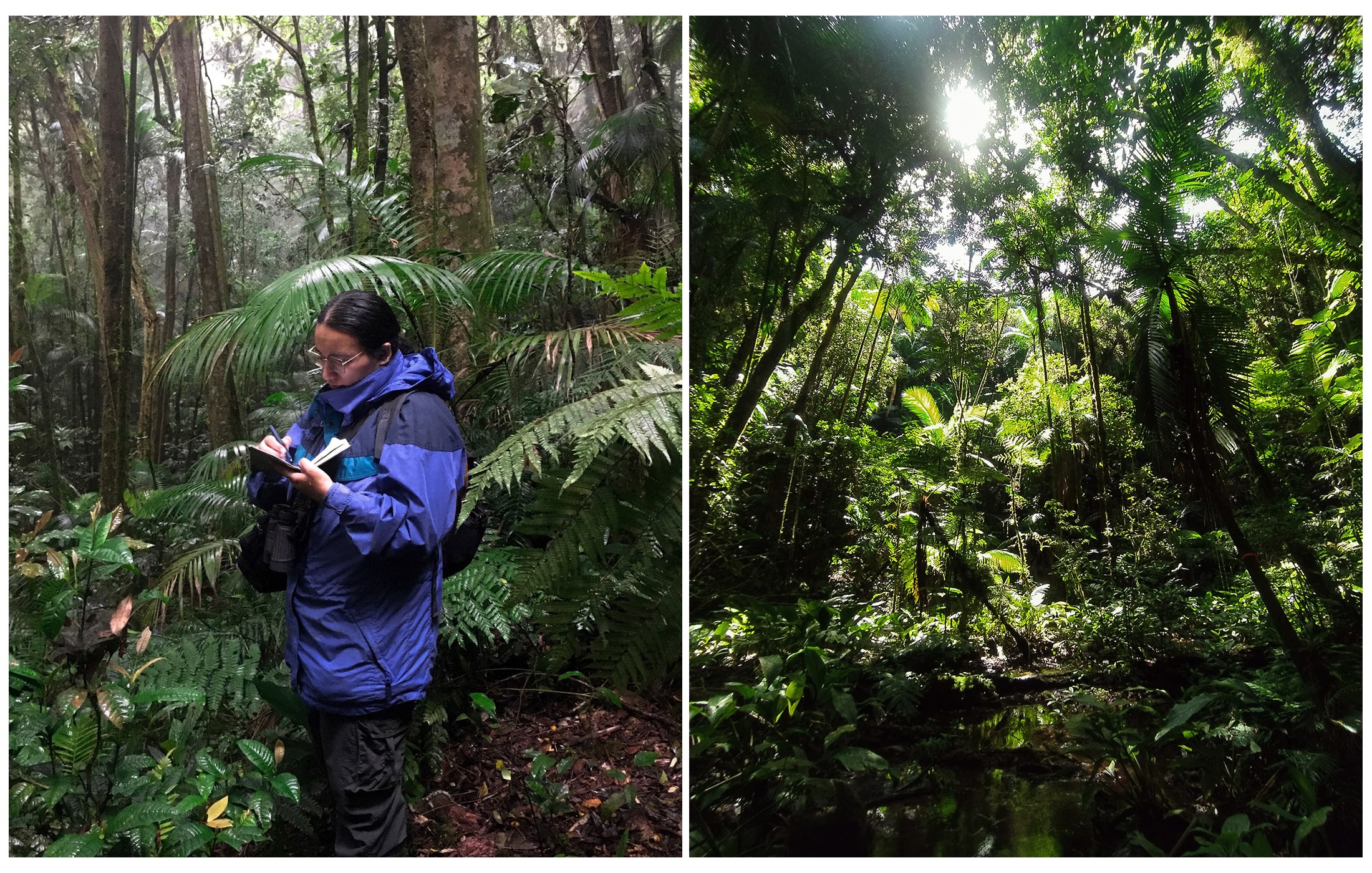
On the left, Erika Chaves during a field day at Carlos Botelho State Park. On the right, dense forest and tall trees make it difficult to spot the primates (photos: Lucas Leoni and Erika Chaves/LaP-UNESP)
Vocalizations
A significant difference between brown howler monkeys in Atlantic Forest fragments and those in Carlos Botelho State Park is the frequency of their vocalizations. Howler monkeys emit a loud sound that primarily serves to alert other groups of their presence.
In small areas, these vocalizations can be heard several times a day. This also helps researchers track the groups as they move through the forest canopy, far from human sight. On 26 of the 63 field days, the group could not be located.
“In the area where we work, they vocalize, on average, only once a day, which makes tracking the groups very difficult. This is likely because it’s a large area with a low density of howler monkeys, where encounters are rare. In smaller areas, encounters are more frequent, and they need to signal their presence more often to avoid conflicts,” Chaves-Diaz explains.
The statistical model used in the study accounted for 70% of the variation in daily travel distance; other studies reached only 37% and 43%. “Although there are other factors accounting for 30% of the variation in daily travel distance, our integrated model gives us confidence in the robustness of our analysis,” says Culot.
The model considered the day’s minimum and maximum temperatures, daylight hours, activity and rest periods, fruit and leaf consumption, and encounters with other howler monkeys and primates. Initially, the monitored group consisted of two males (one adult and one subadult), two adult females, and two infants. By the end of August 2023, the group had dwindled to two males and one female; the other female and the infants had disappeared. By November of that year, only one female and one male remained.
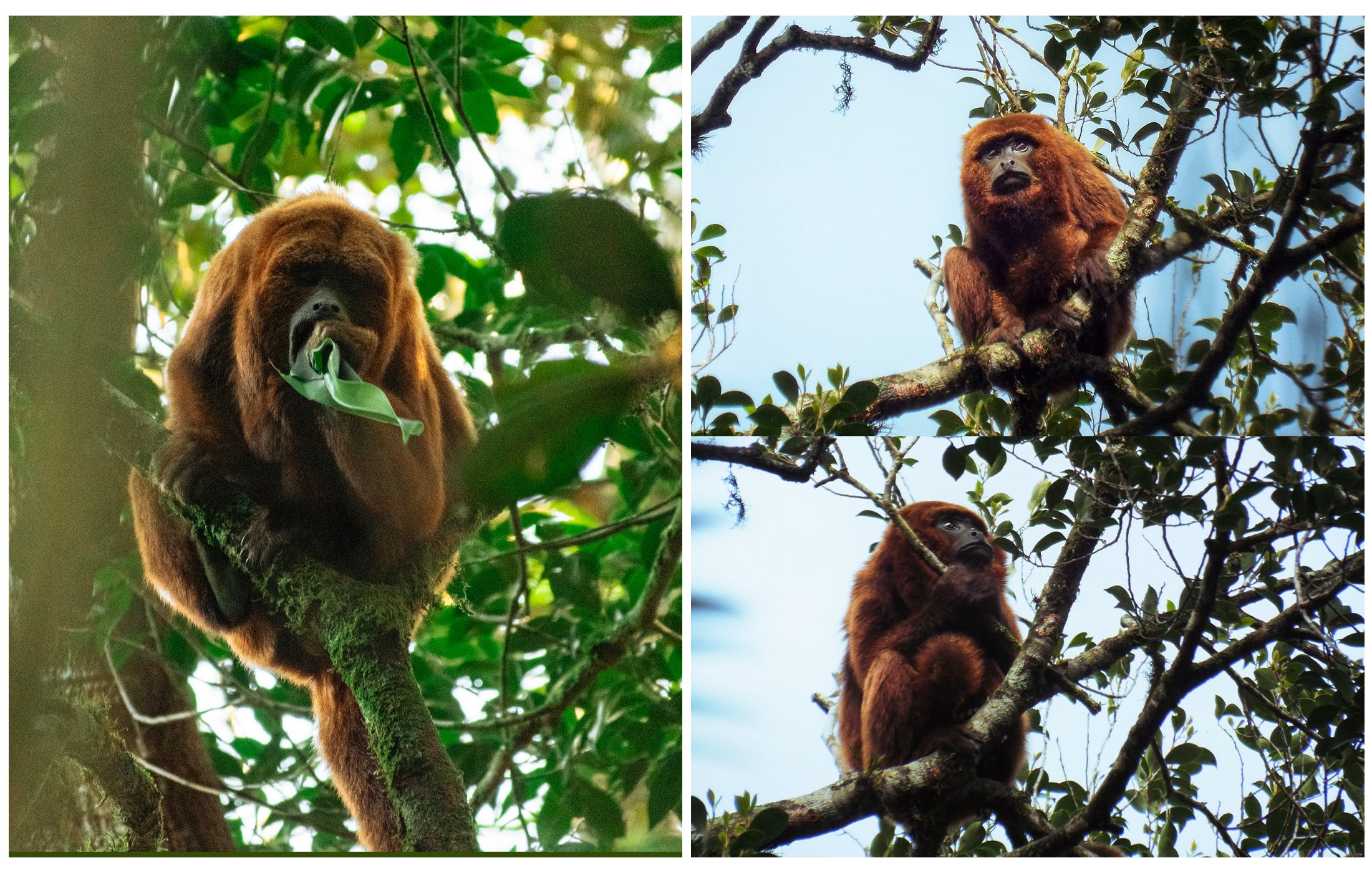
On the left, a diet of leaves reduced the howler monkeys’ travel time, as digestion takes longer. On the right, the monitored group decreased over the course of the study (photos: Lucas Leoni and Erika Chaves/LaP-UNESP)
On average, the group traveled 531 meters. The shortest distance traveled was 202 meters, and the longest was 866 meters. The average activity time was eight hours. There were seven encounters with other brown howler monkeys and 15 with other primates, including six with capuchin monkeys and nine with muriquis. They were chased on six occasions, did not change their behavior on two occasions, and remained vigilant on two occasions.
The group used a 25-hectare area within the 38,000-hectare state park. Geographic coordinates were recorded every five minutes during the tracking.
According to Culot, this study provides insight into the factors that influence habitat use. This information can be used to conserve this vulnerable species and manage protected areas.
“The information can also be used in projects to reintroduce the species into the wild. We now have a good overview of resource use and how interaction with other species can influence the group’s establishment in an area,” concludes Chaves-Diaz.
The article “Determinants of daily path length in Alouatta guariba in a continuous forest” can be read at link.springer.com/article/10.1007/s10764-026-00558-x.
The Agency FAPESP licenses news via Creative Commons (CC-BY-NC-ND) so that they can be republished free of charge and in a simple way by other digital or printed vehicles. Agência FAPESP must be credited as the source of the content being republished and the name of the reporter (if any) must be attributed. Using the HMTL button below allows compliance with these rules, detailed in Digital Republishing Policy FAPESP.
